01Facts
The appellant was convicted under Section 302 IPC by the Sessions Judge, Jabalpur, in S.T. No. 383/2016 on 17.11.2016 and sentenced to life imprisonment with a fine of Rs. 5,000
pp. 1–2The prosecution case is that on 14.04.2016, while the deceased Chhuttu and Shubham were plucking lotus flowers in a pond at Kulon, the appellant told the deceased that he had betrayed him by talking to the appellant's girlfriend. The appellant then threw the deceased into the pond and drowned him
p. 2The eyewitness Shubham Thakur (PW-5) deposed that he saw the appellant throw the deceased into the pond
pp. 3–4 · ¶ 7The appellant did not challenge the findings on occurrence or on his involvement. He contended that the incident was sudden, that he had cut his own hand with a blade during the altercation, that there was no premeditation, that he had no criminal antecedents, and that he had served about 11 years in custody. He sought conversion to Section 304 IPC
¶ 5 · p. 3The State opposed the appeal
¶ 6 · p. 402Issues
i.1. Whether the act of the appellant constitutes murder under Section 302 IPC or culpable homicide not amounting to murder under Section 304 IPC
¶ 7 · p. 4ii.2. If culpable homicide under Section 304 IPC, whether the case falls under Part I or Part II thereof
¶ 7 · p. 4 · ¶ 14–15 · pp. 10–11iii.3. Whether the sentence of life imprisonment should be reduced in view of the absence of premeditation and the period of incarceration already undergone
¶ 16 · pp. 11–1203Law Applied
The Court relied on Section 302 IPC and Section 304 IPC, which distinguishes culpable homicide not amounting to murder into Part I (intention to cause death or such bodily injury as is likely to cause death) and Part II (knowledge only)
¶ 14 · p. 10It applied Exception 4 to Section 300 IPC, which requires that the act be committed without premeditation, in a sudden fight, in the heat of passion upon a sudden quarrel, and without undue advantage or cruel conduct, as laid down in Surinder Kumar v. UT of Chandigarh and Arumugam v. State
¶ 9 · pp. 5–7It followed Anbazhagan v. State (2023 INSC 632) for the rule that under Part I the offence of murder is first established and then an Exception is applied, whereas under Part II murder is never established, and that the weapon, the body part targeted, the nature and number of injuries, and the pre- and post-incident conduct are relevant to intention
¶ 14 · pp. 10–11On sentencing, it relied on Gurpal Singh v. State of Punjab (AIR 2017 SC 471), Arjun v. State of Chhattisgarh (AIR 2017 SC 1150), Prabhakar Vithal Gholve v. State of Maharashtra (AIR 2016 SC 2292), Sikandar Ali v. State of Maharashtra (AIR 2017 SC 2614), Madhavan v. State of Tamil Nadu (AIR 2017 SC 3847), Ankush Shivaji Gaikwad v. State of Maharashtra ((2013) 6 SCC 770), and the Division Bench decision in Chand Khan v. State of M.P. (2006 (3) MPLJ 549)
¶ 8–13 · pp. 5–10Under these decisions, a sudden, unpremeditated fight without cruelty attracts Exception 4, and the sentence may be reduced to the period already undergone where the accused has no antecedents
¶ 8–13 · pp. 5–10Provisions in the judgment · 6 · Linked ones open on LawLens
Code of Criminal Procedure, 1973 Section 374
Indian Penal Code, 1860 Section 34Section 300Section 302Section 304Section 307
04Reasoning
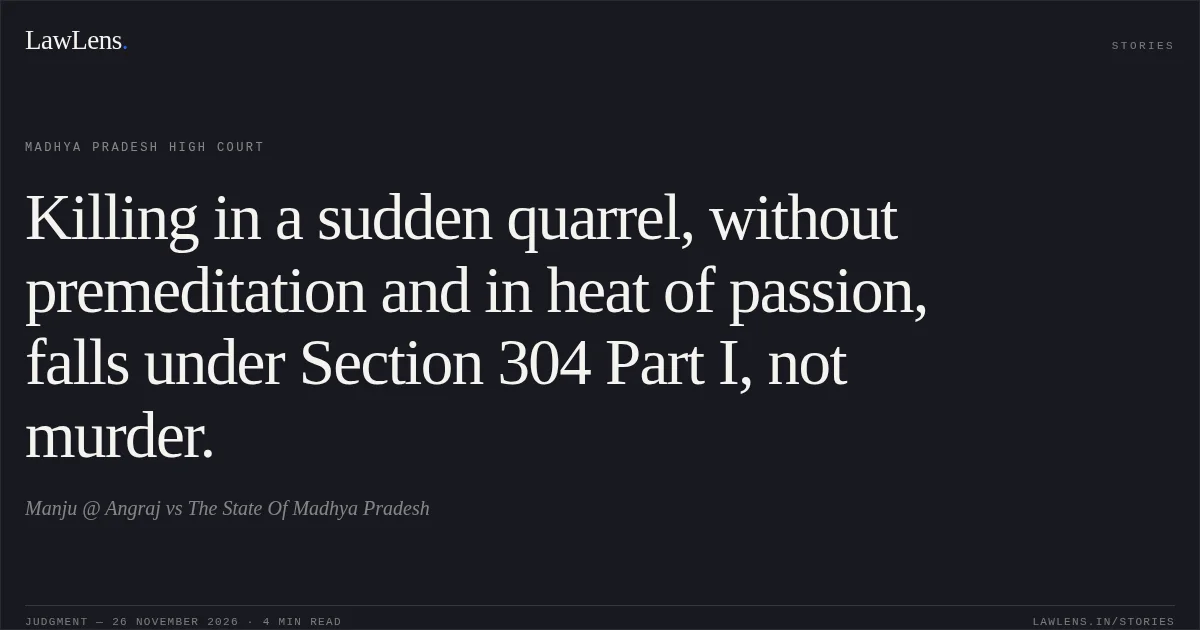
The Court accepted the trial court's findings on occurrence and culpability, as the appellant did not dispute them. It found no evidence of premeditation or prior planning. The offence arose from a sudden exchange about the appellant's girlfriend, during which the appellant cut his own hand and then drowned the deceased in the heat of the moment
¶ 7 · p. 4On this basis, the Court concluded that the appellant had the intention to cause bodily injury likely to cause death, but that the act did not fall within the ambit of murder under Section 302 IPC. Because the intention element was present, the case falls under Section 304 Part I, not Part II
¶ 15 · p. 11The Court also relied on the absence of premeditation, the sudden nature of the incident, the appellant's more than ten years of actual incarceration, and his lack of criminal antecedents to reduce the sentence to the period already undergone
¶ 16 · pp. 11–1205Holding
The Court held that the conviction under Section 302 IPC is not sustainable because the act was committed without premeditation in the heat of the moment, and that the case falls under Section 304 Part I IPC
¶ 15–16 · pp. 11–12The appeal is partly allowed. The findings on occurrence and the appellant's culpability are maintained. The conviction is altered to Section 304 Part I IPC, and the life sentence is reduced to the period already undergone. The appellant is to be released after depositing the fine, if not required in any other case. The trial court record is to be returned along with a copy of the judgment
¶ 16–17 · pp. 11–12Original Court PDF
Manju @ AngrajvsThe State Of Madhya Pradesh
Click to open original judgment
Original judgment, available to read, download and summarize on LawLens.in