01Facts
The appellant, Sukhram, a labourer, lived in a hut in the field of his employer, Prafull Mahajan, with his wife Parvati Bai and two children.
¶ 3On the night of 14/15.08.2015, Parvati Bai was found with an injury on the left side of her head, and she died after Nasir and Prafull came to the hut.
¶ 3The appellant lodged a Merg intimation at Police Station Nepanagar, and a crime was registered.
¶ 3A sickle containing human blood was seized from the appellant's possession.
¶ 7The Sessions Court, Burhanpur, convicted the appellant under Section 302 IPC in Sessions Trial No. 77/2015 on 14.02.2017 and sentenced him to life imprisonment with a fine of Rs. 10,000.
¶ 2The appellant did not challenge the findings on occurrence or his involvement. He challenged only the conviction under Section 302 IPC, contending that there was a single head injury, no premeditation, and no intention to kill, and that he had already undergone over ten years of actual incarceration and had no criminal antecedents.
¶ 5The State opposed the appeal, relying on the nature and location of the sickle blow to the head.
¶ 6The appeal was heard finally with the consent of counsel.
¶ 102Issues
i.1. Whether the appellant's conviction under Section 302 IPC is sustainable, or whether the act falls within Exception 4 to Section 300 IPC and is punishable under Section 304 Part I or Part II IPC.
¶ 7 · ¶ 14–15ii.2. Whether the sentence of life imprisonment should be reduced to the period already undergone, given the lack of premeditation and the appellant's absence of criminal antecedents.
¶ 5 · ¶ 1603Law Applied
The court applied Section 302 IPC (murder) and Section 300 IPC, including its Exception 4 (culpable homicide without premeditation in a sudden fight, in the heat of passion, without undue advantage or cruel conduct).
¶ 9 · ¶ 15(ii)The court relied on Section 304 IPC, Part I for cases of intention to cause death or bodily injury likely to cause death, and Part II for cases of knowledge without intention, as explained in Anbazhagan v. State (2023 INSC 632).
¶ 14Under this framework, the court first asks whether the act would be murder but for an Exception, and the weapon, body part targeted, depth and number of injuries, and conduct before and after the incident are relevant to intention.
¶ 14The court relied on Arjun v. State of Chhattisgarh (AIR 2017 SC 1150) and Arumugam v. State (2008) 15 SCC 590 for the four requirements of Exception 4.
¶ 9The court relied on Ankush Shivaji Gaikwad v. State of Maharashtra (2013) 6 SCC 770, Prabhakar Vithal Gholve v. State of Maharashtra (AIR 2016 SC 2292), Sikandar Ali v. State of Maharashtra (AIR 2017 SC 2614), Gurpal Singh v. State of Punjab (AIR 2017 SC 471), Madhavan v. State of Tamil Nadu (AIR 2017 SC 3847), and Chand Khan v. State of M.P. (2006 (3) MPLJ 549) for sentence reduction where a sudden fight, absence of premeditation, and absence of antecedents are present.
¶ 8–13The State relied on Pulicherla Nagaraju v. State of Andhra Pradesh (2006) 11 SCC 444, which lays down the factors for distinguishing Section 302 from Section 304 IPC. The court's reasoning does not expressly apply that case.
¶ 6Provisions in the judgment · 6 · Linked ones open on LawLens
Code of Criminal Procedure, 1973 Section 374
Indian Penal Code, 1860 Section 300Section 302Section 304Section 307Section 34
04Reasoning
The court held that the appellant's intention was established. A sickle blow of such depth to the head, a vital part, showed intention to cause bodily injury sufficient in the ordinary course to cause death, bringing the act within clause "thirdly" of Section 300 IPC, and therefore outside Section 304 Part II.
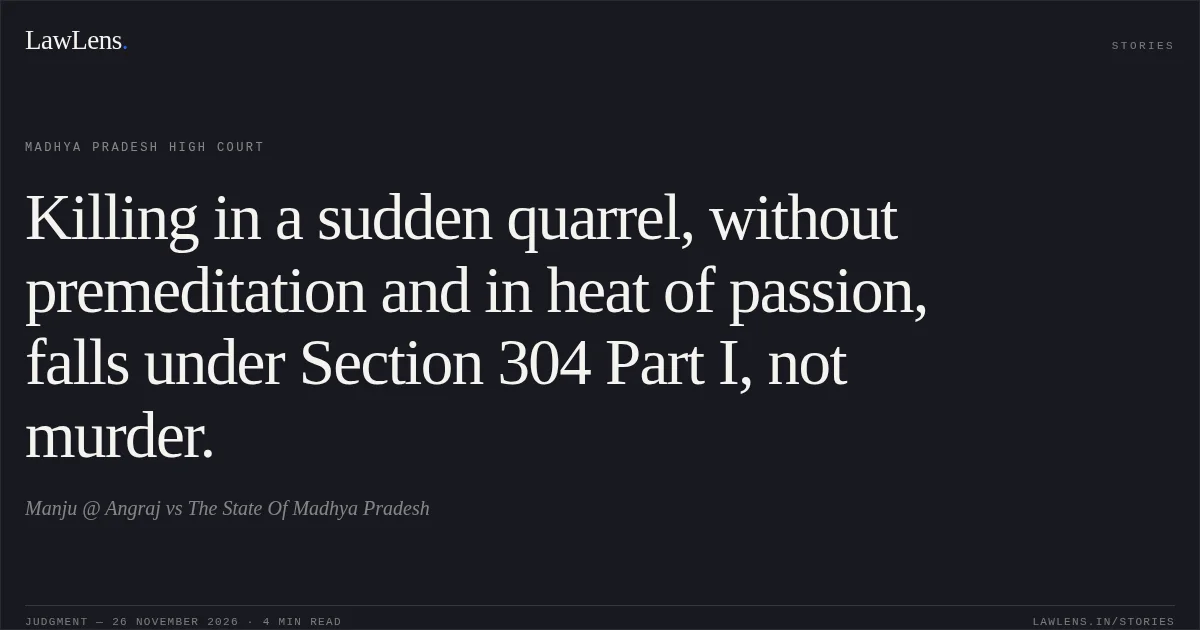
¶ 15(i)The court then found that the blow was delivered in a sudden fight, in the heat of passion, without premeditation, and without cruel or unusual conduct or undue advantage, so Exception 4 applied.
¶ 15(ii)The court noted that the appellant's flight from the spot does not by itself remove the case from Exception 4.
¶ 15(ii)Because the act would have been murder but for the Exception, the culpable homicide fell under Section 304 Part I, and the Part II argument was rejected.
¶ 15(iii)On sentence, the court considered the more than ten years of actual incarceration and the absence of criminal antecedents, following the Supreme Court and High Court decisions cited above.
¶ 5 · ¶ 8–12 · ¶ 1605Holding
The court held that the conviction under Section 302 IPC cannot be sustained. The findings on occurrence and the appellant's culpability were maintained, but the conviction was altered to Section 304 Part I IPC.
¶ 15(iii) · ¶ 16The sentence of life imprisonment was reduced to the period already undergone, given more than ten years of actual incarceration and no criminal antecedents. The appellant is to be released after depositing the fine, unless he is required in any other case. The record is to be returned to the trial court.
¶ 16 · ¶ 17Original Court PDF
Sukhram Urf SukramvsThe State Of Madhya Pradesh
Click to open original judgment
Original judgment, available to read, download and summarize on LawLens.in