Facts
The petitioners, owners of a Mercedes Benz S350 and a Land Rover Defender, sought interim custody of their vehicles which were seized by the respondent police in connection with Cr.No.82 of 2025.
Source reference: para 1, 2The vehicles were originally owned by Futuristic Global Resource Private Limited (the accused company) and were transferred to the petitioners on February 20, 2025, and May 2, 2025, respectively—prior to the registration of the FIR on May 5, 2025.
Source reference: para 4, 9The lower court dismissed the applications for interim custody, citing a lack of proof regarding the payment of sale consideration and the allegation that the vehicles were purchased using "proceeds of crime".
Source reference: para 3The petitioners challenged this dismissal via Criminal Revision under Sections 438 r/w 442 of the BNSS.
Source reference: p. 1-2Issues
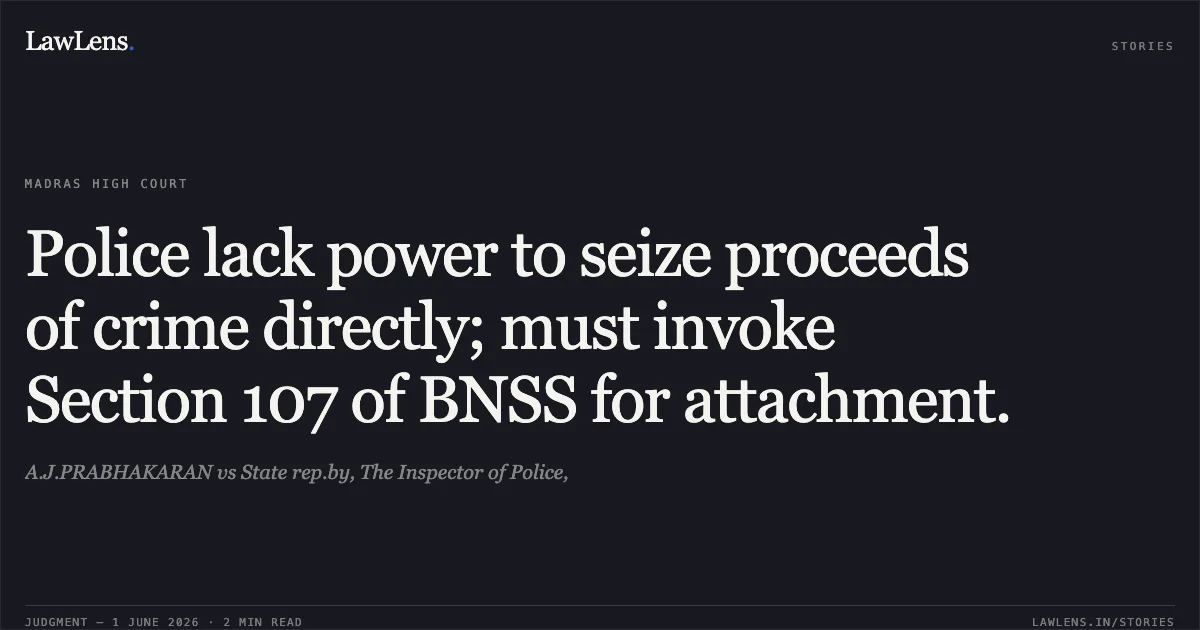
1. Whether the police have the power to directly seize vehicles alleged to be "proceeds of crime" without following the attachment procedures mandated under Section 107 of the Bharatiya Nagarik Suraksha Sanhita (BNSS)?
Source reference: para 11-122. Whether the petitioners are entitled to interim custody of the vehicles despite the ongoing investigation into the source of funds for the original purchase?
Source reference: para 16-17Law Applied
Section 107 of the BNSS, which provides the specific legal framework for the attachment and forfeiture of property derived from proceeds of crime, replacing the necessity of the Criminal Law (Amendment) Ordinance, 1944.
Source reference: para 12-13Supreme Court precedent Sunderbhai Ambalal Desai v. State of Gujarat (2002) 10 SCC 283, which established that seized vehicles should not be left to deteriorate in police stations and should be released on proper bond and security.
Source reference: para 5, 17At the stage of interim custody, the court is not required to adjudicate final title.
Source reference: para 10Reasoning
The court reasoned that even if the prosecution's claim—that the vehicles were "proceeds of crime"—was true, the BNSS provides a specific statutory mechanism under Section 107 for attachment.
Source reference: para 11, 14Direct seizure in lieu of following this procedure is considered illegal.
Source reference: para 12Regarding the lower court's finding on the lack of proof of consideration, the High Court observed that the Registration Certificates (RC) were already transferred to the petitioners' names prior to the FIR registration.
Source reference: para 15The court emphasized that keeping high-value vehicles idle in a police station leads to unnecessary deterioration and concluded that interests of justice would be served by releasing the vehicles subject to stringent conditions to ensure their production during trial, without making a final determination on the validity of the transfer or ownership.
Source reference: para 15-18Holding
The High Court set aside the impugned orders and allowed the Criminal Revision Cases, holding that the first respondent must hand over interim custody of the vehicles to the petitioners.
The release was made subject to the execution of personal bonds (Rs. 13,00,000 and Rs. 40,00,000 respectively), production of original RC books for verification, an undertaking not to alienate or alter the vehicles, and a proviso that the return is subject to any future attachment/confiscation proceedings initiated under Section 107 of the BNSS.
Source reference: para 18Acts & Sections Cited
3 provisions across 1 statute referred to in this judgment. Each provision opens on LawLens.
Bharatiya Nagarik Suraksha Sanhita, 20233
Original Court PDF
A.J.PRABHAKARANvsState rep.by, The Inspector of Police,
Click to open original judgment
Original judgment, available to read, download and summarize on LawLens.in