Facts
The petitioners, stated to be majors, solemnized their marriage on 17 July 2026 and produced a marriage certificate issued by Shri Shiv Sahrda Mandir, Jabalpur, along with Aadhaar Cards evidencing their ages. Petitioner No. 1, the wife, was approximately 23 years old, and Petitioner No. 2, the husband, was approximately 26 years old.
Source reference: para. 2They alleged that the wife’s family and members of their community were threatening to initiate false criminal proceedings, and that the husband and his family had been threatened on account of the marriage.
Source reference: paras. 2, 5The petitioners therefore invoked the writ jurisdiction of the High Court under Article 226 of the Constitution of India, seeking police protection for themselves and the husband’s family, protection against harassment, and non-interference with their matrimonial life.
Source reference: para. 1The State opposed the petition but did not dispute the petitioners’ majority or the fact that the marriage had been solemnized of their own free will.
Source reference: para. 3Issues
Whether major individuals who have voluntarily solemnized their marriage are entitled to protection of their life and personal liberty against threats, harassment, or unlawful interference by family members or community members.
Source reference: paras. 2, 5–7Whether the police authorities should be directed to provide appropriate protection to the petitioners and take preventive action against persons threatening or harassing them.
Source reference: paras. 1, 5–7Law Applied
The Court exercised its constitutional jurisdiction under Article 226 to protect the petitioners’ life and personal liberty.
Source reference: no citationIt applied the principle that a major person is free to marry a person of his or her choice and that family members or other persons cannot threaten, harass, or commit violence against such a couple.
Source reference: no citationRelying principally on Lata Singh v. State of U.P., (2006) 5 SCC 475, the Court reiterated that consensual marriages between majors are legally protected and that police authorities must ensure that the couple and their relatives are not subjected to threats, harassment, or violence; persons responsible must be proceeded against in accordance with law.
Source reference: para. 6The Court also referred to the decision of a Coordinate Bench in Arti Pal & Others v. State of M.P., W.P. No. 19618 of 2026.
Source reference: para. 2Reasoning
The Court found that both petitioners were majors and had voluntarily married on 17 July 2026, facts which were supported by the documents on record and were not disputed by the State.
Source reference: paras. 2–5In light of the alleged threats of false implication and possible violence, the Court held that the petitioners’ right to choose their matrimonial partner and live together could not be obstructed by family or community members.
Source reference: paras. 6–7Applying Lata Singh, the Court treated threats or harassment directed at the petitioners or the husband’s family as unlawful and concluded that the police were duty-bound to take appropriate protective and preventive measures.
Source reference: paras. 6–7Holding
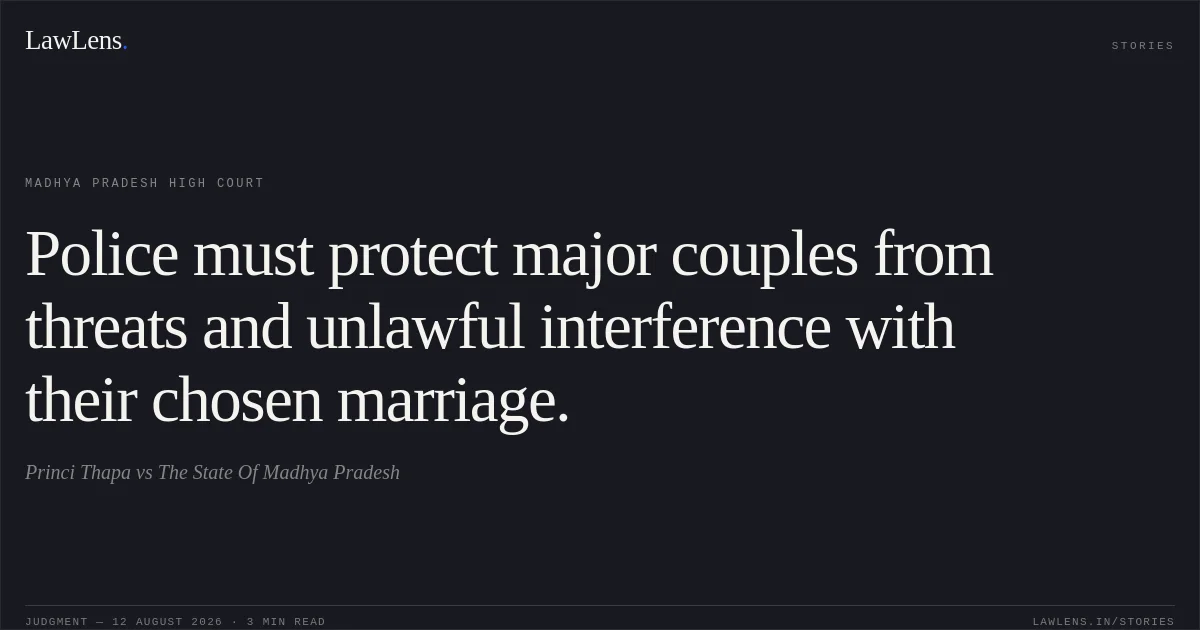
The High Court allowed and disposed of the petition by directing the Superintendent of Police, District Balaghat/respondent No. 3, to examine the matter and take appropriate steps to provide protection to the petitioners for safeguarding their life and personal liberty.
The direction was issued consistently with the principle that no person may unlawfully interfere with the peaceful matrimonial life of consenting major adults or subject them to threats, harassment, or violence.
Source reference: para. 6Original Court PDF
Princi ThapavsThe State Of Madhya Pradesh
Click to open original judgment
Original judgment, available to read, download and summarize on LawLens.in