Facts
The petitioner sought police protection for himself and his family to conduct pooja during the annual Puratasi Pongal festival at Arulmigu Sri Kaliamman Temple from 6 to 10 October 2026, relying on a representation dated 27 August 2026.
Source reference: p.2The third respondent, the petitioner’s nephew, disputed the petitioner’s claim to conduct pooja and stated that his late father had previously conducted it.
Source reference: p.3–5The Court considered an earlier order in Crl.O.P.(MD) No.10388 of 2007, which had directed the police to consider protection for the peaceful conduct of the festival without declaring anyone’s right to conduct it.
Source reference: p.3–4The petitioner also relied on the assertion that village elders had agreed he could conduct the pooja; the Court held that this did not establish a right and indicated that the parties should pursue civil remedies.
Source reference: p.5Issues
1. Whether the petitioner was entitled to a direction for police protection to conduct the pooja during the festival
Source reference: p.2, p.52. Whether the Court should determine either party’s claimed right to conduct pooja, or leave that dispute to the civil court
Source reference: p.4–5Law Applied
The Court relied on the principle stated in its order dated 27 September 2007 in Crl.O.P.(MD) No.10388 of 2007: a direction concerning police protection for the peaceful conduct of a festival does not declare any person’s right to act as poosari or conduct the festival; the police must consider a protection request on its merits.
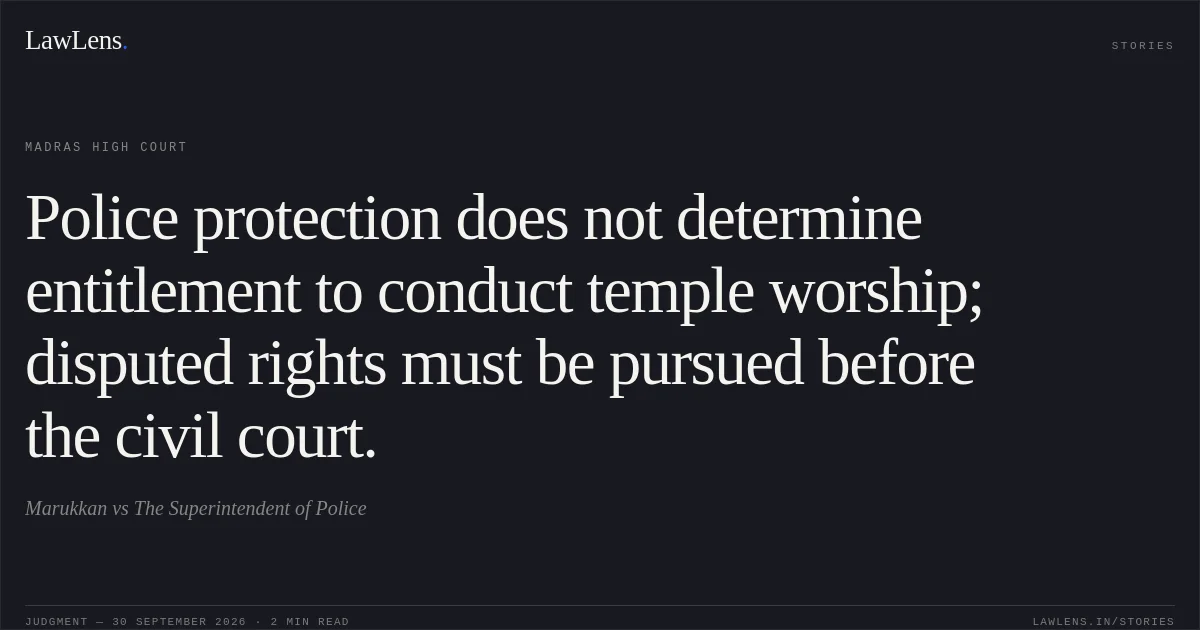
Source reference: p.3–4The Court also applied the principle that disputed rights to perform pooja should be worked out before the civil court, rather than determined in these proceedings.
Source reference: p.5Reasoning
The Court did not adjudicate the competing claims to conduct pooja.
Source reference: p.4–5It treated the 2007 order as governing the police’s consideration of the petitioner’s request, while making clear that the request for protection could not establish a religious or customary right in either party.
Source reference: p.4–5The village elders’ alleged decision likewise did not, in the Court’s view, establish a vested right; the parties were left to seek a civil determination.
Source reference: p.5The Court therefore directed the police to enquire into the matter and decide the representation consistently with the earlier order.
Source reference: p.5–6Holding
The Court disposed of the writ petition without declaring either party entitled to conduct pooja.
It directed the second respondent to decide the petitioner’s representation dated 27 August 2026 within three days, in accordance with the 2007 order, and directed both parties to appear before the police on 1 October 2026 at 11:00 a.m. for enquiry and production of relevant documents.
Source reference: p.5–6The parties were directed to pursue their civil remedies regarding the disputed right to perform pooja.
Source reference: p.5Original Court PDF
MarukkanvsThe Superintendent of Police
Click to open original judgment
Original judgment, available to read, download and summarize on LawLens.in