01Facts
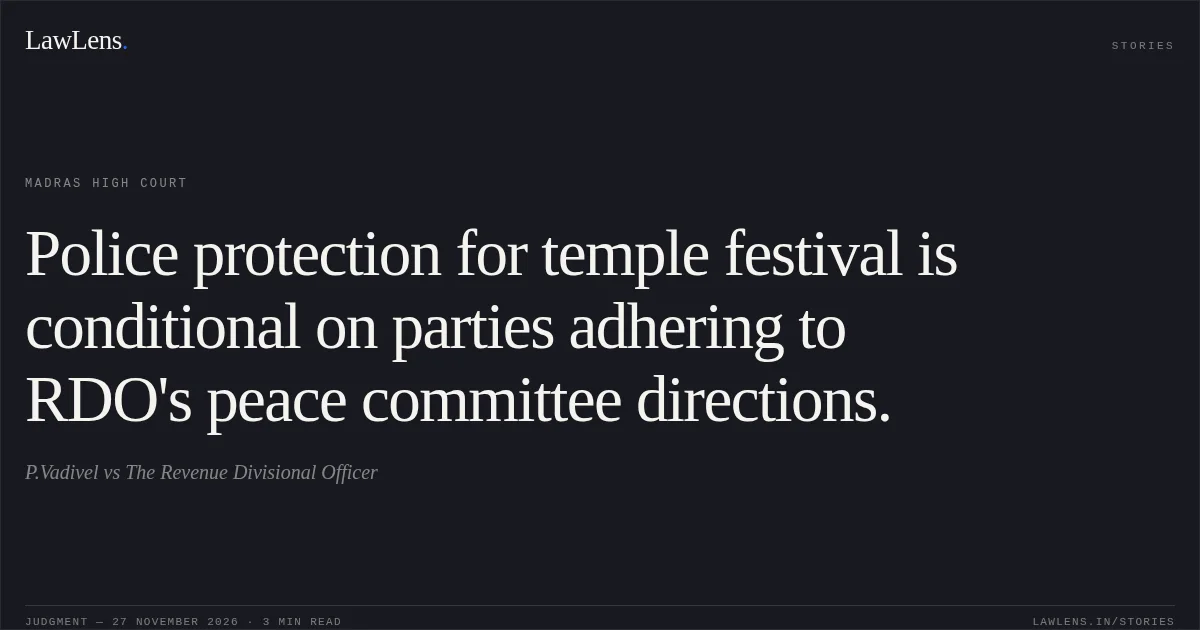
The petitioner, P. Vadivel, filed a writ petition seeking a writ of mandamus directing the 3rd respondent (Assistant Commissioner of Police, Pothanur Range) and other authorities to provide adequate police protection for the peaceful conduct of the Kuruchi Aravan–Pongi Amman Temple Festival at Kuruchi Village, Madukkarai Taluk, from 17.11.2026 to 27.11.2026.
p. 1The request was based on a representation dated 10.09.2026, sent on 22.09.2026 and received by the respondents on 23.09.2026.
p. 1The court suo motu impleaded the 6th respondent, K.A. Padmakumar, and issued notice.
¶ 2 · p. 2After hearing counsel for the petitioner, the 6th respondent, and the Additional Government Pleader, the court directed the Revenue Divisional Officer (RDO), Coimbatore South, to convene a Peace Committee and resolve the disputes, and adjourned the matter to receive the report.
¶ 3 · p. 2The RDO conducted an enquiry and reached certain conclusions. The substance of those conclusions is not legible in the reference text provided.
¶ 4 · pp. 3–602Issues
i.1. Whether the petitioner is entitled to a writ of mandamus directing police protection for the conduct of the temple festival during 17.11.2026–27.11.2026. (Framed by the petition; the order does not expressly frame issues.)
¶ 1 · p. 1ii.2. Whether the festival-related dispute between the parties can be resolved through a Peace Committee convened by the RDO, with police protection made contingent on compliance with the RDO's directions. (Inferred from the court's directions; not expressly framed.)
¶ 3 · p. 2 · ¶ 5 · p. 603Law Applied
The order does not identify any specific statute, constitutional provision, or precedent in the legible text.
The court's disposal rests on the principle that law and order and public-peace disputes over religious processions or festivals may be first addressed through an administrative peace-committee process conducted by the RDO, with police protection to follow compliance with the resulting directions.
¶ 3 · p. 2 · ¶ 5 · p. 6The underlying statutory source for the RDO's and police's powers is not discernible from the text.
04Reasoning
Rather than adjudicating the merits of the mandamus prayer, the court first impleaded the 6th respondent to ensure all affected parties were before it.
¶ 2 · p. 2It then referred the dispute to the RDO to convene a Peace Committee and attempt resolution on the ground.
¶ 3 · p. 2The RDO's enquiry and conclusions formed the factual basis for the final order.
¶ 4 · pp. 3–6The court linked police protection to the parties' adherence to the RDO's directions, so that the police protection sought would operate as a conditional safeguard tied to a negotiated, administratively supervised arrangement.
¶ 5 · p. 6The reasoning for choosing this course over a direct mandamus is not expressly stated in the legible text, and the RDO's specific findings cannot be verified from the reference copy.
05Holding
The court did not decide the writ on its merits. The court did not give a direct answer on whether a writ of mandamus should issue.
¶ 5 · p. 6The court disposed of WP Crl. No. 2765 of 2026 with a direction that, if the parties adhere to the directions issued by the RDO, Coimbatore South, the police shall give appropriate protection for the festival.
¶ 5 · p. 6The order was copied to the RDO, the Tahsildar (Madukkarai), the Assistant Commissioner of Police (Pothanur Range), the Inspectors of Police (Pothanur and Sundarapuram), and the Public Prosecutor, High Court of Madras. The RDO's specific directions are not reproduced in the legible text of the reference judgment.
p. 7 · pp. 4–6 no legible contentOriginal Court PDF
P.VadivelvsThe Revenue Divisional Officer
Click to open original judgment
Original judgment, available to read, download and summarize on LawLens.in