Facts
The petitioners filed an application under Section 482 of the Cr.P.C. to quash an FIR and subsequent criminal proceedings arising from allegations of illegal kerosene diversion.
Source reference: no citationBased on secret information received in January 2008, authorities conducted a raid and found the petitioners transferring subsidized kerosene intended for fair price shops into private vehicles without maintaining Proper records
Source reference: p. 2Following the raid, the District Collector ordered the confiscation of the seized goods and vehicles
Source reference: p. 3, 5Subsequently, an FIR was lodged in June 2008 for offenses under the Essential Commodities Act, 1955, leading to a charge-sheet and a pending criminal case
Source reference: p. 1-2The petitioners challenged the FIR on grounds of double jeopardy and lack of proper authorization for the complaint
Source reference: p. 3-4Issues
1. Whether the criminal prosecution following a departmental confiscation order constitutes double jeopardy in violation of Article 20(2) of the Constitution or Section 300 of the Cr.P.C.
Source reference: p. 32. Whether the Special Court is barred from taking cognizance of the offense because the FIR was not lodged by a person directly authorized by the State Government under Section 12AA(e) of the Essential Commodities (Special Provisions) Act, 1981
Source reference: p. 4, 6Law Applied
The court primarily interpreted Section 12AA(e) of the Essential Commodities (Special Provisions) Act, 1981, which distinguishes between the court taking cognizance via a "police report" versus a "private complaint"
Source reference: p. 6-7Article 20(2) of the Constitution of India regarding the protection against double jeopardy and Section 300 of the Code of Criminal Procedure, 1973, which bars trial for the same offense after a prior conviction or acquittal by a competent court
Source reference: p. 3Reasoning
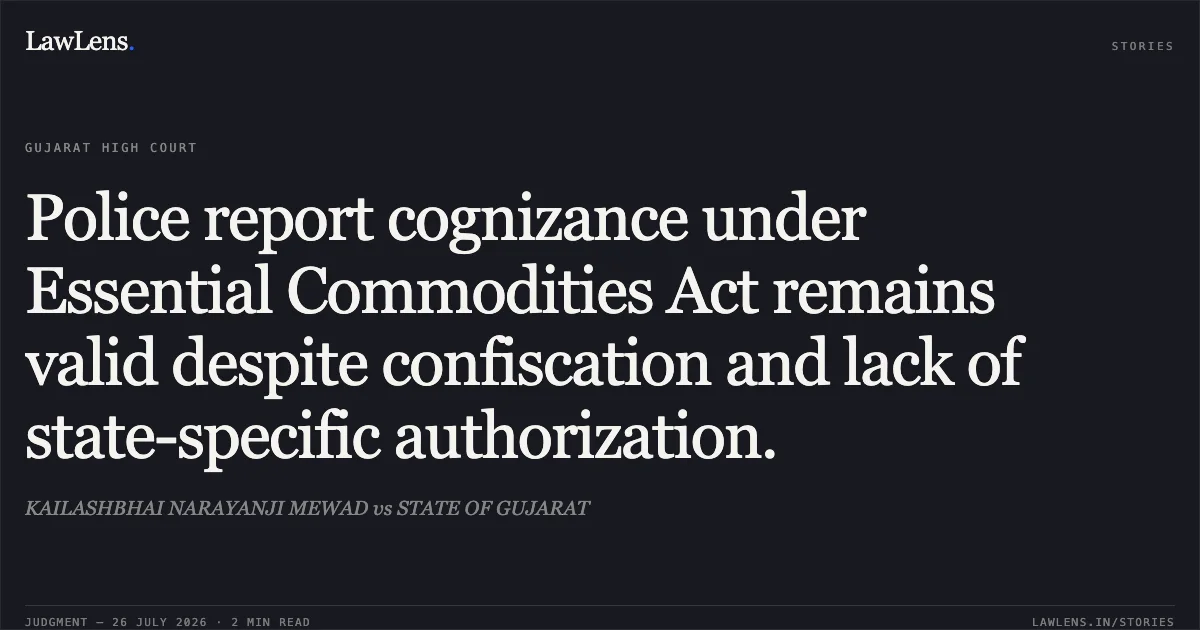
The court rejected the petitioners' contention regarding improper authorization, noting that Section 12AA(e) explicitly allows a Special Court to take cognizance upon a "police report" (charge-sheet) of facts constituting an offense
Source reference: p. 7The requirement for a specific authorized government officer applies only when the proceedings are initiated via a private complaint under Section 2(d) of the Cr.P.C., which was not the case here as a charge-sheet had already been submitted
Source reference: p. 7the court found the petitioners' reliance on precedents (Rhombic Laboratory and Rajeshbhai Shivlal Vasani) misplaced, as those cases involved distinct factual circumstances and mala fide police actions not present in this instance
Source reference: p. 5-6The court emphasized that the statutory bar cited by the defense did not apply to investigations culminating in a police report
Source reference: p. 7Holding
The court held that the petition was devoid of merit and rejected the application to quash the FIR
It clarified that cognizance taken on a police report under the Essential Commodities Act is valid regardless of the specific authorization arguments raised by the petitioners
Source reference: p. 7The interim relief was vacated, and the rule was discharged
Source reference: p. 8Acts & Sections Cited
6 provisions across 2 statutes referred to in this judgment. Each provision opens on LawLens.
Code of Criminal Procedure, 19733
Essential Commodities Act, 19553
Original Court PDF
KAILASHBHAI NARAYANJI MEWADvsSTATE OF GUJARAT
Click to open original judgment
Original judgment, available to read, download and summarize on LawLens.in


