Facts
The Petitioners are various street vendors who applied for vending licenses from the Delhi Cantonment Board. Their applications were rejected by the Town Vending Committee (TVC) during a scrutiny process initiated to finalize the list of authorized vendors
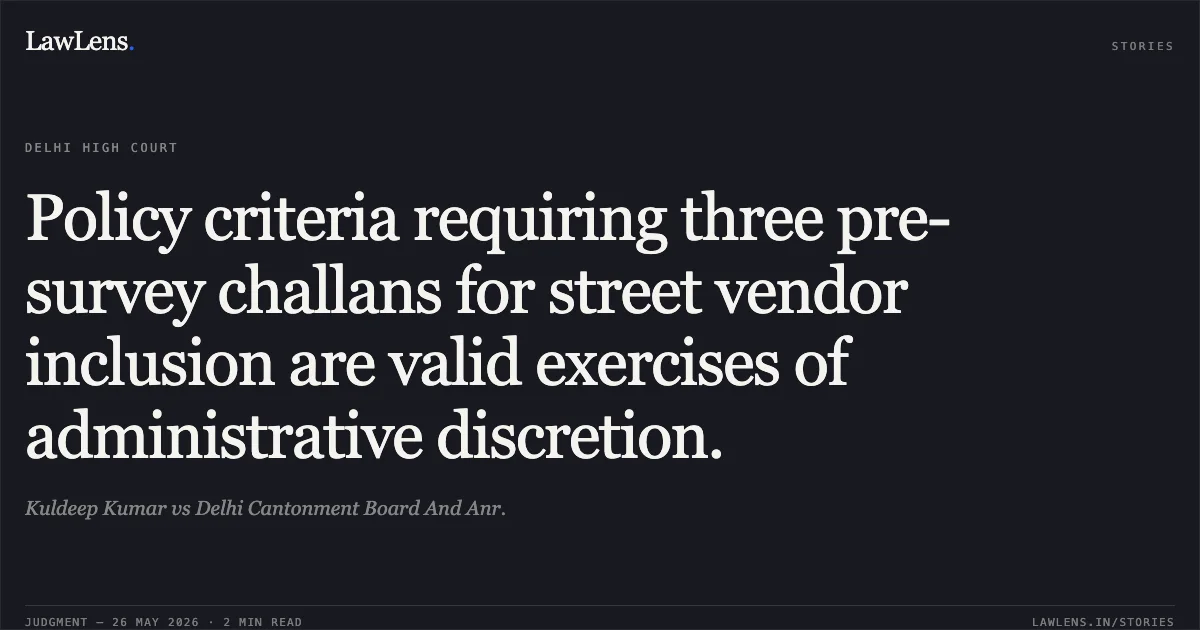
Source reference: p. 3The TVC, via Resolution No. 3 dated January 27, 2026, established a eligibility criterion requiring vendors to produce at least three challans issued by the Board prior to the survey commencement date of October 27, 2023
Source reference: p. 4, para. 3The Petitioners challenged the rejection of their candidatures, arguing that some possessed only one or two challans but continued to vend regularly
Source reference: p. 8, para. 8Issues
1. Whether the eligibility criterion requiring at least three challans issued prior to October 27, 2023, for inclusion in the street vendor list is legally valid
Source reference: p. 8, para. 10; p. 9, para. 132. Whether vendors who failed to meet the three-challan threshold but possessed some evidence of vending (1–2 challans) could be mandated for inclusion in the current authorized list
Source reference: p. 9, para. 15Law Applied
the determination of criteria for drawing up a final list of vendors is a policy decision within the domain of the local authority, provided it considers factors like holding capacity, pedestrian movement, and vehicular traffic
Source reference: p. 8, para. 10Street Vendors (Protection of Livelihood and Regulation of Street Vending) Act framework as interpreted in Gyan Chand v. Delhi Cantonment Board & Ors. and Danveer Yadav v. Delhi Cantonment Board, which upheld the TVC’s authority to verify credentials through specific documentation like challans to regulate vending zones
Source reference: p. 4-7Reasoning
The Court observed that the TVC had conducted a detailed scrutiny of documents based on a deliberate policy decision dated January 15, 2026
Source reference: p. 8, para. 7The Court refused to interfere with the "three-challan" rule, characterizing it as a balanced policy choice aimed at managing limited urban space and ensuring that only long-term, verifiable vendors are accommodated
Source reference: p. 8, para. 10The Court found the scrutiny process to be fair, noting that those who met the documentary requirements were included, while those who did not were rightfully excluded
Source reference: p. 8-9, para. 12-13judicial intervention in such policy-driven administrative criteria is unwarranted unless the process is found to be arbitrary, which was not the case here
Source reference: p. 9, para. 13Holding
The Court answered the issues by upholding the TVC's rejection orders, holding that Petitioners who could not produce the requisite three challans prior to October 27, 2023, have no right to be listed as authorized vendors at this stage
The petitions were disposed of with the direction that if the TVC finds excess holding capacity after finalizing the current vending plan, Petitioners with fewer challans may be considered in the next survey cycle
Source reference: p. 9, para. 15The Board remains free to take action against unauthorized vendors in accordance with law
Source reference: p. 9, para. 16Acts & Sections Cited
3 provisions across 1 statute referred to in this judgment. Each provision opens on LawLens.
Street Vendors (Protection of Livelihood and Regulation of Street Vending) Act, 20143
Original Court PDF
Kuldeep KumarvsDelhi Cantonment Board And Anr.
Click to open original judgment
Original judgment, available to read, download and summarize on LawLens.in