Facts
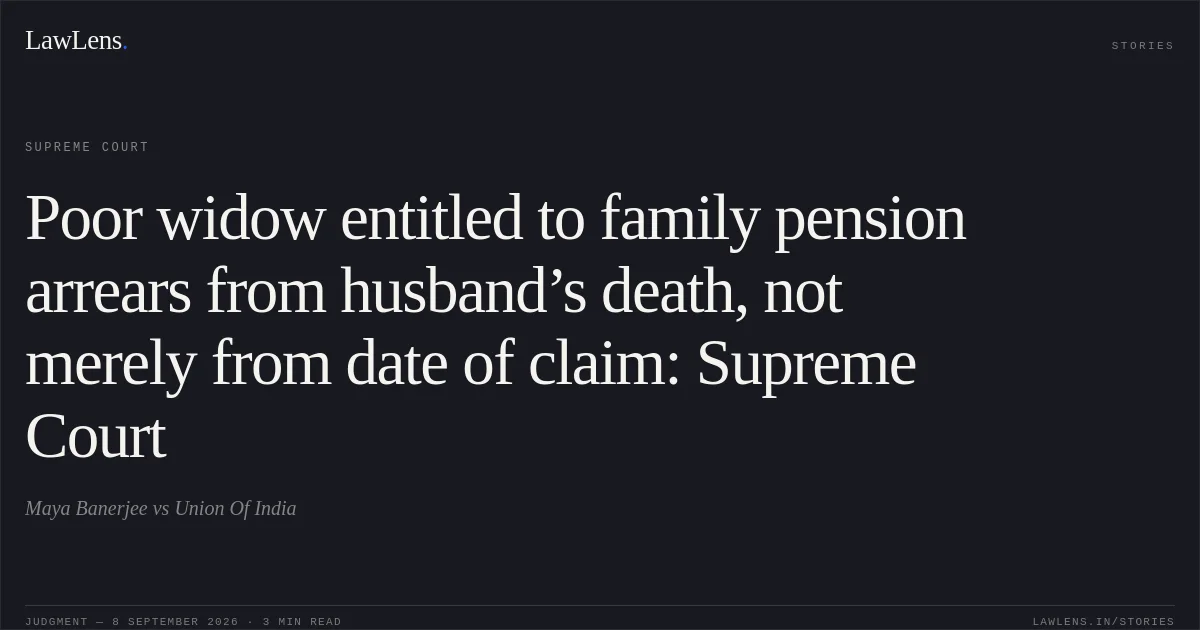
The appellant, widow of Late K.M. Banerjee, a Railway employee who died in service on 12 November 2000, claimed family pension from the date of his death.
Source reference: paras. 3–4; pp. 1–2She stated that she was illiterate, lived separately from her husband, was unaware of his service particulars, and earned her livelihood as a domestic worker.
Source reference: paras. 3–4; pp. 1–2Despite the Railway Board’s circular requiring disciplinary proceedings against a charged employee to be closed upon his death, the appellant’s husband was dismissed posthumously on 10 October 2001.
Source reference: para. 5; p. 2Her appeal against the dismissal was rejected in 2012, and her subsequent claim for service and pensionary benefits was not accepted.
Source reference: para. 5; p. 2The Central Administrative Tribunal dismissed her application on limitation grounds.
Source reference: para. 5; p. 2In separate civil proceedings, the appellant obtained a final declaration that her husband had died on 12 November 2000.
Source reference: para. 6; p. 2The High Court thereafter granted family pension but restricted arrears to the year 2014, when she first approached the Tribunal.
Source reference: para. 7; p. 2Issues
1. Whether the appellant was entitled to family pension from the date of her husband’s death, namely 12 November 2000, rather than only from 2014.
Source reference: paras. 3, 8, 20–22; pp. 1, 3, 11–122. Whether the principle in Union of India v. Tarsem Singh, restricting arrears of pension to a period ordinarily extending three years before the filing of a writ petition, governed the claim, or whether the specific rule in S.K. Mastan Bee v. General Manager, South Central Railway applied.
Source reference: paras. 9, 12–14, 20–21; pp. 3–6, 11–123. Whether, in the event of conflict between decisions of Benches of equal strength, the Court was required to follow the earlier decision not considered by the later coordinate Bench.
Source reference: paras. 14–19; pp. 5–10Law Applied
Pension and family pension are valuable statutory and constitutional rights and are not governmental bounties; culpable delay in their settlement may justify consequential relief and interest, as recognised in State of Kerala v. M. Padmanabhan Nair.
Source reference: para. 11; p. 3In S.K. Mastan Bee v. General Manager, South Central Railway, the Court held that, particularly where an illiterate and economically vulnerable widow is unaware of her entitlement, the employer has an obligation to compute and offer family pension from the date it becomes due, and arrears need not be restricted merely because the claim was made belatedly.
Source reference: para. 12; pp. 3–5Although Union of India v. Tarsem Singh ordinarily permits restriction of arrears to three years preceding the writ petition in cases involving recurring pensionary claims, a coordinate Bench cannot take a contrary view from an earlier coordinate-Bench decision without referring the matter to a larger Bench.
Source reference: paras. 13–18; pp. 5–9A later decision rendered without considering a binding earlier decision may be treated as per incuriam, but that doctrine applies to the ratio decidendi and must be used sparingly.
Source reference: paras. 18–19; pp. 8–10The Railway Board’s Letter dated 19 June 2000 also required disciplinary proceedings to be closed upon the death of the charged Railway servant.
Source reference: para. 5; p. 2Reasoning
The Court treated S.K. Mastan Bee as directly applicable because the present case, like that case, concerned a Railway employee’s widow who was illiterate, economically vulnerable, and unaware of her right to family pension.
Source reference: paras. 12, 21; pp. 3–5, 11–12Family pension became payable upon the employee’s death, and the Railways had an obligation to determine and offer it without compelling the widow to initiate litigation.
Source reference: no citationThe appellant’s delay was not attributable to culpable inaction: she lacked knowledge of her husband’s employment, was confronted with an incorrect posthumous dismissal, and had to obtain a civil court declaration resolving the disputed date of death.
Source reference: paras. 5–6, 21; pp. 2, 11–12Although Tarsem Singh stated the general rule limiting arrears for recurring pensionary claims, it did not consider S.K. Mastan Bee, an earlier decision of equal strength dealing specifically with family pension payable to a widow.
Source reference: paras. 14–21; pp. 5–12Applying the rules of precedent and coordinate-Bench discipline, the Court followed S.K. Mastan Bee rather than restrict relief under Tarsem Singh.
Source reference: paras. 14–21; pp. 5–12Holding
The appeals were allowed.
The Supreme Court modified the High Court’s order and held that the appellant was entitled to family pension from the date of her husband’s death, 12 November 2000, rather than from 2014.
Source reference: para. 22; p. 12The respondents were directed to pay the entire arrears with interest at 6% per annum within three months from the date of the order.
Source reference: para. 22; p. 12Acts & Sections Cited
2 provisions across 1 statute referred to in this judgment. Linked provisions open on LawLens.
the Act (alias, unresolved)2
Original Court PDF
Maya BanerjeevsUnion Of India
Click to open original judgment
Original judgment, available to read, download and summarize on LawLens.in