01Facts
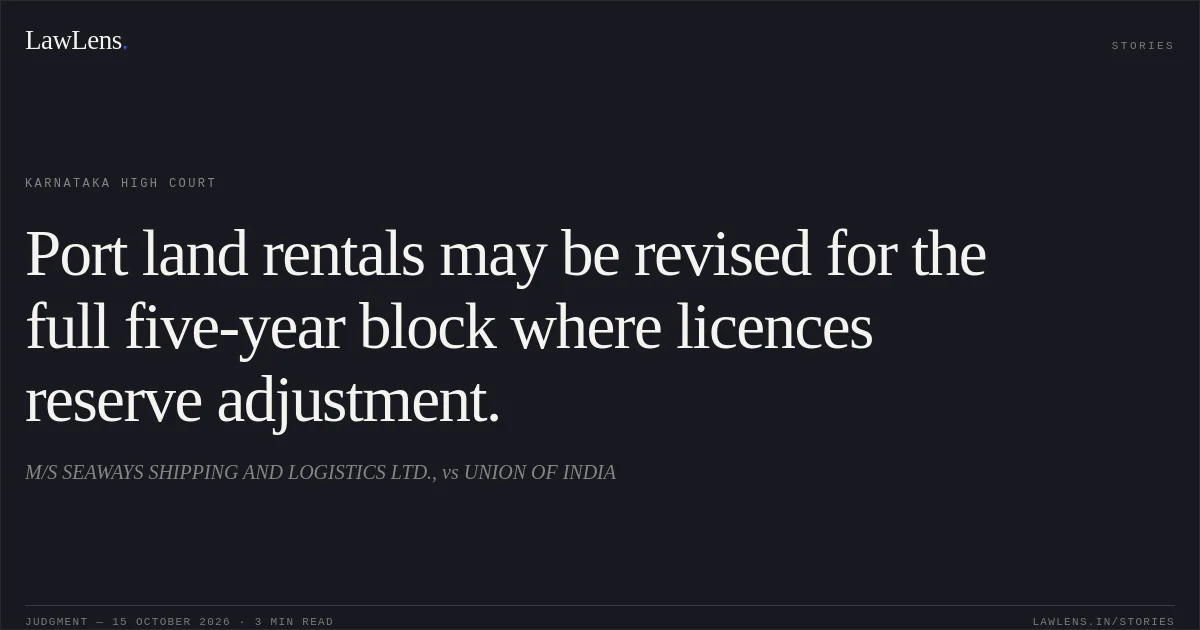
The petitioners, port service providers using port land under short-term licences, challenged a TAMP notification dated 1 July 2014 revising land rentals for the five-year block beginning 20 February 2012.
¶ 1They objected that the revised rates were imposed after the relevant licence periods had expired and that the Port Trust had submitted its proposal late.
¶ 1By amendment, some petitioners also challenged clause 3.2.8 of the Tariff Guidelines, 2004, which permits retrospective effect in exceptional cases for recorded reasons.
¶ 1–3, 11–13The allotment letters stated that the licence fee was provisional and that the difference would be payable following TAMP approval; one letter specifically recorded that revision was due from 20 February 2012.
¶ 15–17The petitioners had also participated in the tariff-review process and joint hearing.
¶ 1802Issues
i.Whether the notification dated 1 July 2014 revising lease rentals with effect from 20 February 2012 was contrary to the Major Port Trusts Act, 1963 and the applicable Land Policy Guidelines.
¶ 10(i)ii.Whether the Tariff Guidelines, 2004, particularly the provision permitting retrospective effect, were issued without statutory authority and were liable to be quashed.
¶ 10(ii), 11, 30–3303Law Applied
Section 49 of the Major Port Trusts Act, 1963 empowered TAMP to fix rates for the use of port property; section 111 empowered the Central Government to issue policy directions binding on TAMP and the Port Boards.
¶ 33–37Clauses 6.3(1)(c) and (d) of the Land Policy Guidelines, 2010 provided for annual escalation pending revision and revision of the Schedule of Rates every five years.
¶ 19–22Clause 3.2.8 of the Tariff Guidelines, 2004 provided that revised charges would ordinarily operate prospectively, but retrospective effect could be given in exceptional cases for recorded reasons.
¶ 30The Court also relied on the principle that parties are bound by accepted contractual terms and cannot approbate and reprobate, as applied in Government of Tamil Nadu v. P.R. Jaganathan.
¶ 38–39The Court followed the earlier Karnataka High Court ruling concerning revision of port rentals for a five-year block period.
¶ 23–25Provisions in the judgment · 4 · Linked ones open on LawLens
Major Port Authorities Act, 2021 Section 1Section 27Section 75
Indian Contract Act, 1872 Section 3
04Reasoning
The Court found that the revision related to the block period commencing on 20 February 2012, rather than imposing an unanticipated charge for a completed period: the allotment terms expressly notified the licensees that rates were provisional and subject to revision from that date.
¶ 15–18, 24, 26–28The petitioners knew of and participated in the revision process, and the Court considered the time required for preparing the proposal, consultation and hearing in assessing the delay.
¶ 15–18, 24, 26–28It held that the 2010 Policy applied because the Port Trust had submitted its proposal in 2012 and the process had substantially been completed under that policy before the 2014 Guidelines took effect; in any event, the five-year revision cycle was retained in the amended 2014 Guidelines.
¶ 19–22The Court further held that clause 3.2.8 was within the policy framework traceable to section 111 and applied to port-property charges under the Guidelines.
¶ 28–37Given the express contractual terms and the prior decision on the same revision mechanism, the petitioners could not avoid the differential rentals.
¶ 17, 23, 38–4005Holding
The Court answered the issues against the petitioners, holding that the retrospective operation of the revised rentals for the applicable five-year block was not unlawful and that the challenge to clause 3.2.8 was untenable.
¶ 39–45Both writ petitions were dismissed.
¶ 46Original Court PDF
M/S SEAWAYS SHIPPING AND LOGISTICS LTD.,vsUNION OF INDIA
Click to open original judgment
Original judgment, available to read, download and summarize on LawLens.in