Facts
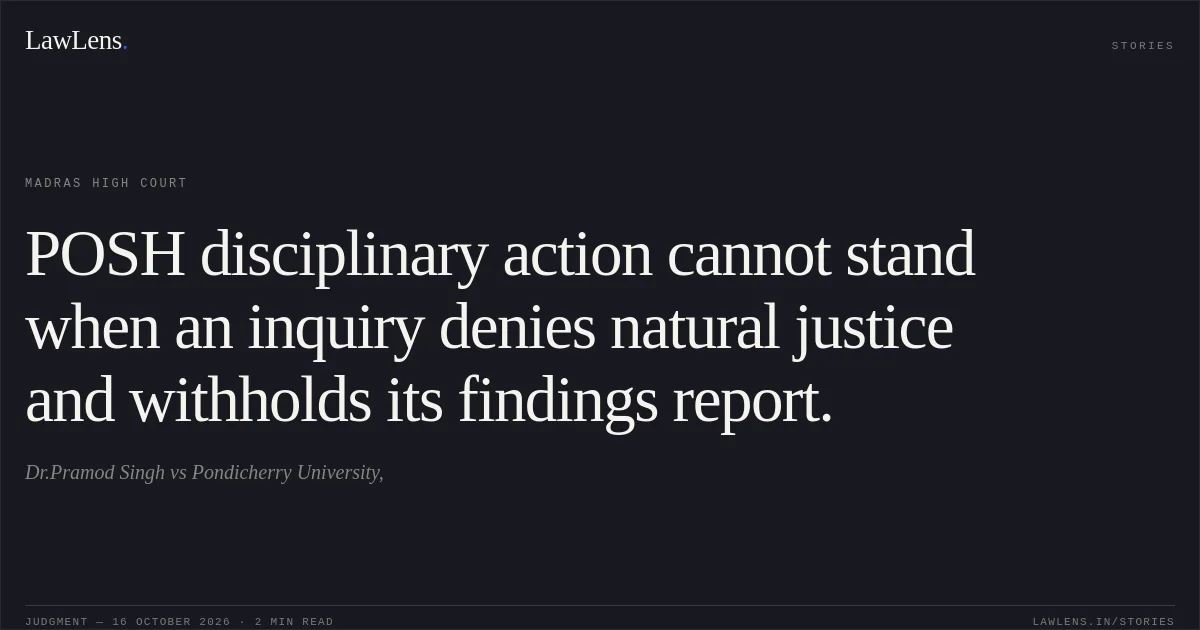
The petitioner, a Professor at Pondicherry University, challenged the University’s order dated 10 May 2023 imposing penalties following a sexual-harassment complaint by his research scholar.
Source reference: paras. 2–3, pp. 2–4He contended that the enquiry was procedurally unfair: he was not given the enquiry report or witness statements, was not allowed to cross-examine witnesses, and was confronted with two earlier allegations that had not been notified to him.
Source reference: paras. 2–3, pp. 2–4The petitioner sought quashing of the order and reinstatement with consequential benefits.
Source reference: para. 1, p. 2Issues
1. Whether the enquiry and resulting punishment were vitiated by non-compliance with the POSH Act and the principles of natural justice
Source reference: paras. 5–6, pp. 4–52. Whether the University could impose multiple substantive penalties for the same misconduct
Source reference: para. 9, pp. 7–9Law Applied
Section 11(1) of the Sexual Harassment of Women at Workplace (Prevention, Prohibition and Redressal) Act, 2013 requires an enquiry to be conducted in accordance with applicable service rules, while the statutory scheme requires the Committee’s findings to be made available to the parties for their representations.
Source reference: para. 5, pp. 4–5The proviso to Rule 14(2) of the CCS (CCA) Rules permits the prescribed enquiry procedure to be followed “as far as practicable,” but does not dispense with natural justice or a reasonable opportunity to defend.
Source reference: para. 6, p. 5; para. 8, p. 7Aureliano Fernandes v. State of Goa confirms that procedural flexibility does not justify an unfair or hurried enquiry.
Source reference: paras. 7–8, pp. 5–7Under Surekha Domaji Bele v. Executive Engineer, applying Union of India v. S.C. Parashar, an amalgam of distinct penalties for the same misconduct is impermissible unless the governing rules authorise it; the Division Bench applied that principle in Thangavelu v. Central Government Industrial Tribunal-cum-Labour Court.
Source reference: paras. 9–10, pp. 7–9Reasoning
The Court found that the petitioner had not received the enquiry report or witness statements and had not been afforded an opportunity to cross-examine witnesses.
Source reference: paras. 5–8, pp. 4–7The Committee also relied on two earlier alleged incidents without first notifying the petitioner or giving him an opportunity to answer them. These defects denied him a fair opportunity to defend, contrary to the POSH framework and natural justice.
Source reference: paras. 5–8, pp. 4–7The Court further considered the order’s imposition of suspension and demotion together, applying the rule against combining separate substantive penalties unless authorised by the service rules.
Source reference: paras. 9–10, pp. 7–9Holding
The Court quashed the order dated 10 May 2023 and remitted the matter to the Complaints Committee for a de novo enquiry, with adequate opportunity for the petitioner to defend himself.
The first hearing was to be fixed within four weeks of receipt of the order, and the proceedings completed within three months of that first hearing; the petitioner was directed to cooperate and avoid unnecessary adjournments.
Source reference: paras. 11–12, pp. 9–10The writ petition was allowed to that extent, with no order as to costs.
Source reference: para. 13, p. 10Acts & Sections Cited
1 provisions across 1 statute referred to in this judgment. Each provision opens on LawLens.
Sexual Harassment of Women at Workplace (Prevention, Prohibition and Redressal) Act, 20131
Original Court PDF
Dr.Pramod SinghvsPondicherry University,
Click to open original judgment
Original judgment, available to read, download and summarize on LawLens.in