Facts
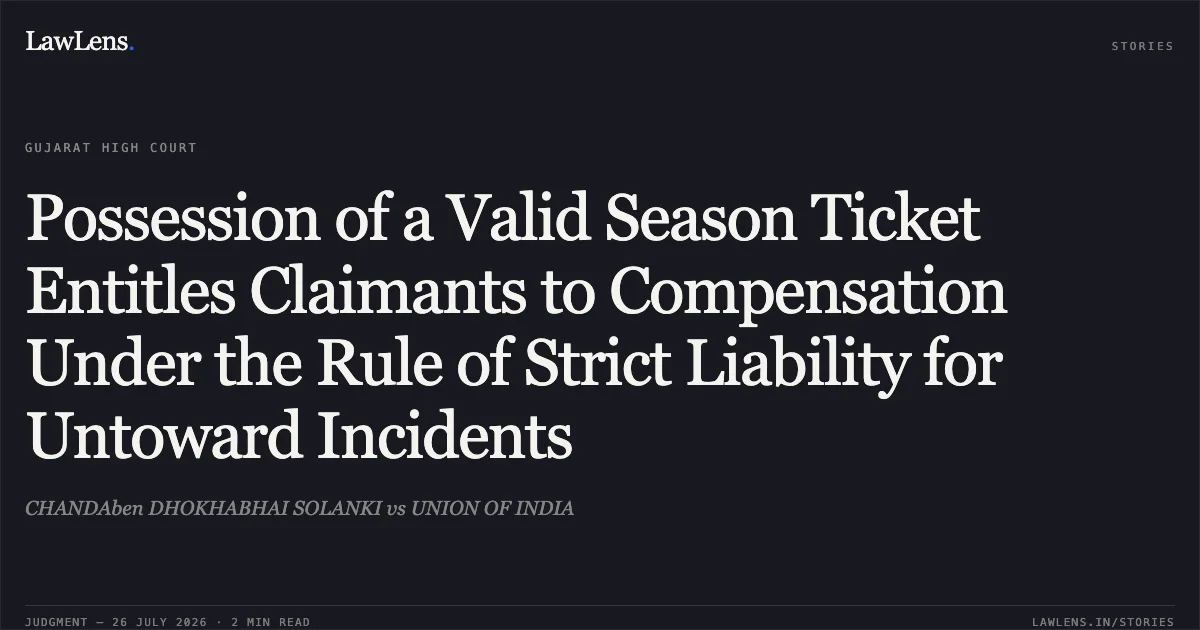
The appellants, dependents of the deceased, challenged a 2019 Railway Claims Tribunal order that dismissed their claim for compensation.
Source reference: para. 1The deceased was traveling from Surat to Navsari with a valid Monthly Season Ticket (MST) when he allegedly fell from the train due to a sudden jerk and heavy rush, resulting in his death on the spot.
Source reference: para. 2The Railway Administration contended that the incident was not an "untoward incident" because the deceased was hit while crossing the tracks by a train that did not have a scheduled halt at Navsari.
Source reference: para. 4, 5Issues
1. Whether the deceased was a bona fide passenger traveling with a valid ticket at the time of the incident?
Source reference: para. 2.2 / Issue 12. Whether the death of the deceased resulted from an "untoward incident" (accidental fall) as defined under Section 123(c)(2) of the Railways Act, 1989?
Source reference: para. 2.2 / Issue 23. Whether the Tribunal erred in dismissing the claim based on the nature of the injuries and the train's lack of a scheduled stop?
Source reference: para. 4, 8Law Applied
The court applied Section 123(c)(2) of the Railways Act, 1989, which defines an "untoward incident" as an accidental fall from a train.
Source reference: para. 4The court relied on the doctrine of "strict liability" as interpreted by the Supreme Court in Union of India v. Rina Devi, holding that negligence by a passenger does not exempt the Railways from liability unless it falls under specific exceptions like suicide.
Source reference: para. 7, 8The court also referenced Rakesh Saini v. Union of India regarding the duty of the railway administration to provide safe passage and Shobha v. Union of India regarding the application of the preponderance of probability in accident cases.
Source reference: para. 6, 7Reasoning
The High Court found that the Tribunal’s dismissal lacked a sound legal basis, noting that the deceased’s possession of a valid MST was undisputed.
Source reference: para. 5The court reasoned that it is difficult to recreate the exact dynamics of an accident and that the position of a body or the lack of a scheduled halt should not be used to automatically disqualify a claim under the "untoward incident" definition.
Source reference: para. 6It emphasized that under the principle of strict liability, the burden was on the Railway Administration to prove the death fell under an exception (e.g., self-inflicted injury), which they failed to do.
Source reference: para. 8Applying a "humanistic visualization" and the rule of preponderance of probability, the court accepted the appellants' version that the deceased fell due to a jerk and the rush of passengers.
Source reference: para. 6, 8Holding
The Court held that the incident constituted an untoward incident and the deceased was a bona fide passenger.
The Court allowed the appeal and set aside the Tribunal’s order. The respondent was directed to pay compensation of Rs. 8,00,000/- with 9% interest per annum from the date of the claim petition until realization.
Source reference: para. 8, 9Acts & Sections Cited
2 provisions across 2 statutes referred to in this judgment. Each provision opens on LawLens.
Railway Claims Tribunal Act, 19871
Railways Act, 19891
Original Court PDF
CHANDAben DHOKHABHAI SOLANKIvsUNION OF INDIA
Click to open original judgment
Original judgment, available to read, download and summarize on LawLens.in