01Facts
The petitioner challenged two orders: one dated 07.01.2025 by the Collector, Sheopur, transferring 7.420 hectares of land to the Public Health Engineering Department for a Water Purification Plant, and another dated 27.05.2026 by the Commissioner, Chambal Division, rejecting his representation against said transfer.
pp. 1-2The petitioner claims he was lawfully allotted a portion of this land (0.940 hectares) in 1996.
p. 2He alleges that his patta (land title) was cancelled suo motu in 2001 without notice or a hearing.
p. 2Currently, an appeal against the 2001 cancellation is pending before the Commissioner, and a civil suit for declaration and injunction is pending in the Court of Civil Judge, Vijaypur.
p. 2Despite these pending adjudications and a report confirming his actual physical possession, the Tehsildar issued an order on 19.05.2026 directing his dispossession.
p. 302Issues
i.1. Whether the High Court should adjudicate upon disputed questions of fact regarding the legality of land allotment and title cancellation under Article 226 of the Constitution of India.
p. 4ii.2. Whether the respondents can dispossess an occupant of land without following the due process of law while title disputes are sub judice.
p. 503Law Applied
The court applied the fundamental principle of the Rule of Law and Article 226 of the Constitution of India regarding the limits of extraordinary writ jurisdiction over disputed facts.
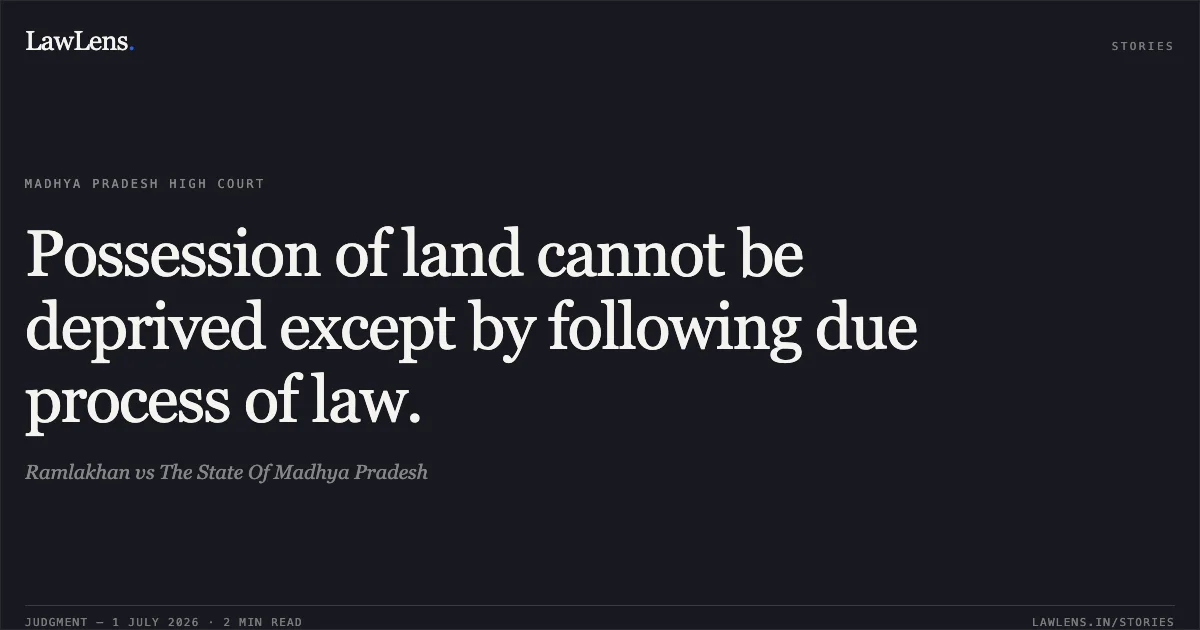
pp. 4-5It emphasized the settled legal principle that no person can be deprived of possession of property except in accordance with the "procedure established by law" and the "due process" prescribed under relevant statutory provisions.
p. 504Reasoning
The Court declined to adjudicate the merits of the title dispute, noting that the legality of the 2001 cancellation and the rival claims are already being litigated in competent revenue and civil forums.
p. 4It held that the High Court’s writ jurisdiction is not the appropriate venue for resolving such intricate disputed questions of fact.
p. 4The Court reasoned that since the petitioner's possession was supported by a spot inspection report dated 21.02.2025, any eviction must strictly adhere to statutory requirements, including providing a reasonable opportunity of hearing to the petitioner.
p. 505Holding
The Court disposed of the writ petition without expressing an opinion on the merits of the case and held that the petitioner shall not be evicted from the disputed land except by following the "due process of law".
p. 5The competent authorities were directed to proceed strictly in accordance with applicable statutes and afford the petitioner a proper hearing before taking any coercive action; All other issues remain open for decision by the pending civil and revenue proceedings.
p. 5Original Court PDF
RamlakhanvsThe State Of Madhya Pradesh
Click to open original judgment
Original judgment, available to read, download and summarize on LawLens.in