Facts
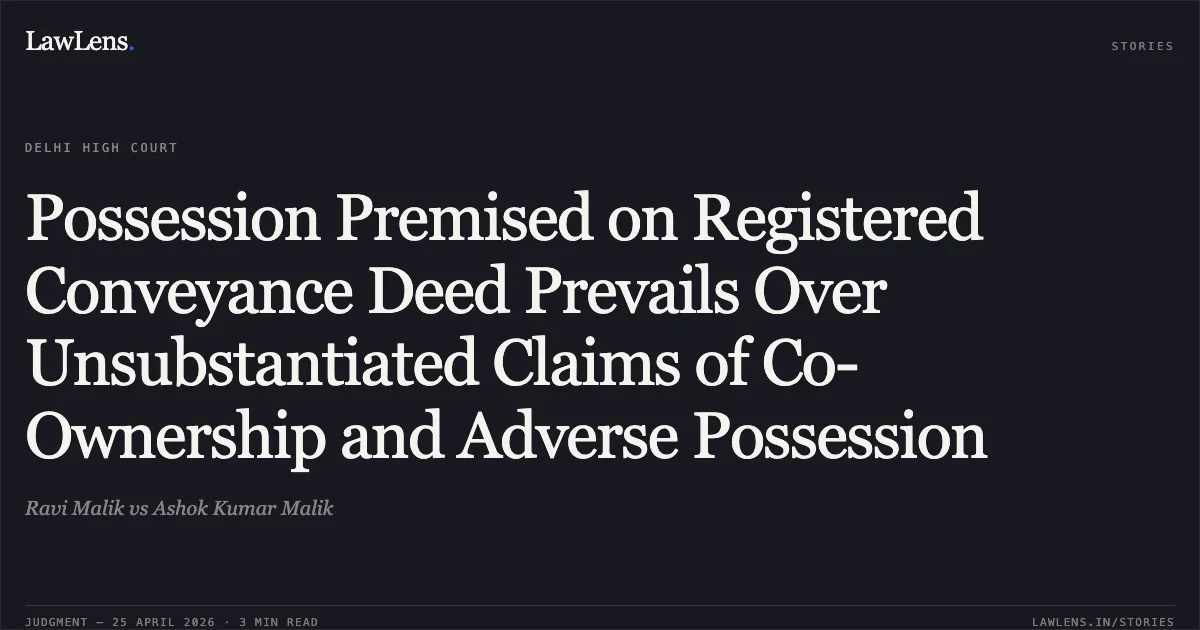
The Respondent (Plaintiff) filed a suit for possession and mesne profits regarding the second floor of property No. 1241, Dr. Mukherjee Nagar, Delhi
Source reference: p. 1-2The Respondent claimed absolute ownership via a registered Conveyance Deed dated 11.08.2000
Source reference: p. 2He alleged that the Appellant (Defendant), his younger brother, was inducted as a permissive licensee in 2010 but refused to vacate following a legal notice dated 09.09.2013
Source reference: p. 2-3The Appellant contested the suit, claiming co-ownership on the grounds that the property was purchased using joint family funds, including his own earnings and proceeds from the sale of their mother's property in 1986
Source reference: p. 3-4The Appellant further pleaded adverse possession and argued the Respondent held the property in a fiduciary capacity
Source reference: p. 4The Trial Court decreed the suit in favor of the Respondent on 07.10.2024
Source reference: p. 1, 7Issues
1. Whether the Plaintiff is the absolute owner and entitled to a decree of possession
Source reference: p. 5/para. 18(i)2. Whether the Defendant is a co-owner of the suit property or has acquired title through adverse possession
Source reference: p. 6/para. 18(iv-v)3. Whether the Plaintiff is entitled to mesne profits and at what rate
Source reference: p. 5/para. 18(ii)Law Applied
The Court applied Section 96 and Order XLI Rule 1 of the CPC regarding the maintainability of the first appeal
Source reference: p. 1It relied on the principle that a registered Conveyance Deed carries a presumption of valid title under the Evidence Act
Source reference: p. 9Regarding adverse possession, the Court applied the doctrine established in M. Radhey Shyam Lal v. V. Sandhya & Anr., which requires the claimant to prove "nec vi, nec clam, nec precario"—possession that is adequate in continuity, publicity, and hostility to the true owner for over 12 years
Source reference: p. 13The Court invoked Section 114(g) of the Evidence Act regarding the non-production of best evidence and the impact of a witness's death before cross-examination on the admissibility of their evidence-in-chief
Source reference: p. 8-9Reasoning
The Court found that the Respondent proved his title through the registered Conveyance Deed (Ex. PW1/1)
Source reference: p. 9It rejected the Appellant’s claim of joint family funding because the suit property was purchased in 1985, whereas the "source" property (Khyala) was sold only in 1986, making the timeline logically inconsistent
Source reference: p. 10The Appellant failed to produce bank records or account books to corroborate financial contributions, leading the Court to conclude his claims were "bald assertions"
Source reference: p. 10, 14On the issue of the Grandmother’s GPA, the Court reasoned that executing a GPA in a relative's name to facilitate a sale to oneself is a common practice and does not confer ownership on the GPA holder
Source reference: p. 14Regarding adverse possession, the Court held that the Appellant’s possession was permissive (as a licensee/family member) and lacked the requisite "hostile intent" or "open defiance" of the Respondent’s title
Source reference: p. 13-14Finally, the Court upheld the mesne profits, noting that even in the absence of exact market rent evidence, the court can take judicial notice of the premises' nature to assess a reasonable sum
Source reference: p. 14-15Holding
the Respondent is the sole legal owner of the property by virtue of the registered Conveyance Deed
the Appellant failed to prove co-ownership or the essential ingredients of adverse possession
Source reference: p. 13-14the award of mesne profits at ₹7,000 per month was reasonable based on judicial notice of the property's location and size
Source reference: p. 14-15The High Court dismissed the appeal and upheld the Trial Court's judgment. All pending applications were disposed of accordingly.
Source reference: p. 15Acts & Sections Cited
2 provisions across 2 statutes referred to in this judgment. Each provision opens on LawLens.
Code of Civil Procedure, 19081
Prohibition of Benami Property Transactions Act, 19881
Original Court PDF
Ravi MalikvsAshok Kumar Malik
Click to open original judgment
Original judgment, available to read, download and summarize on LawLens.in