Facts
The plaintiff/appellant entered into a registered agreement to sell with the defendants on 02.05.2014 for land measuring 34,600 Sq.M., asserting that the entire consideration of ₹15,21,37,274/- was paid and possession was delivered
Source reference: para. 4Subsequent sale deeds were executed for portions of the land in 2015, adjusting earnest money from the original agreement
Source reference: para. 5The defendants contended the agreement expired on 10.03.2015 and relied on an unregistered compromise dated 18.07.2022 to argue that the plaintiff was not in possession
Source reference: para. 14, 16, 23The Trial Court rejected the plaintiff’s application for temporary injunction (6C-2) on 05.09.2025, leading to this appeal
Source reference: para. 2Issues
1. Whether a prospective purchaser under a registered agreement to sell, having performed their part of the contract and being in possession, is entitled to protect that possession under Section 53A of the Transfer of Property Act, 1882
Source reference: para. 3, 432. Whether the Trial Court erred in refusing temporary injunction based on an unregistered compromise and the expiration of the agreement's initial validity period
Source reference: para. 39, 44Law Applied
The court applied Section 53A of the Transfer of Property Act, 1882, which protects the possessory title of a transferee who has performed his part of a written contract even if the transfer is incomplete
Source reference: para. 3, 12It relied on Ghanshyam v. Yogendra Rathi (2023), establishing that such possessory rights cannot be invaded by the transferor
Source reference: para. 13Gunwantbhai Mulchand Shah v. Anton Elis Farel (2006), which distinguishes between the limitation for specific performance and the right to protect possession via injunction
Source reference: para. 9The court also noted Article 54 of the Limitation Act, 1963, regarding the commencement of limitation from the date performance is refused
Source reference: para. 5, 24Reasoning
The Court observed that the defendants admitted to executing a registered agreement to sell "with possession" and receiving consideration
Source reference: para. 38, 41Crucially, the defendants failed to produce any registered document showing how possession was legally re-transferred from the plaintiff back to them
Source reference: para. 41, 43The Court dismissed the defendants' reliance on the unregistered compromise dated 18.07.2022, noting it could not override the possessory rights established by the registered 2014 agreement
Source reference: para. 39, 43Regarding limitation, the Court held that the continuation of sale deed executions after the "expiry date" of 10.03.2015 suggested an implicit extension of the agreement’s terms
Source reference: para. 40, 41Therefore, at the prima facie stage, the plaintiff’s physical possession remained undisturbed and legally protected under the doctrine of part-performance
Source reference: para. 44Holding
The Court allowed the appeal and set aside the order dated 05.09.2025. It held that the plaintiff established a prima facie case, the balance of convenience, and the threat of irreparable injury
The defendants/respondents are restrained from interfering with the plaintiff’s peaceful possession and from changing the nature of the property during the suit's pendency; The impleadment application of the third party was disposed of with liberty to approach the Trial Court
Source reference: para. 45, Order on Impleadment para. 2Acts & Sections Cited
11 provisions across 4 statutes referred to in this judgment. Each provision opens on LawLens.
Transfer of Property Act, 18821
Limitation Act, 19637
Registration Act, 19082
Code of Civil Procedure, 19081
Original Court PDF
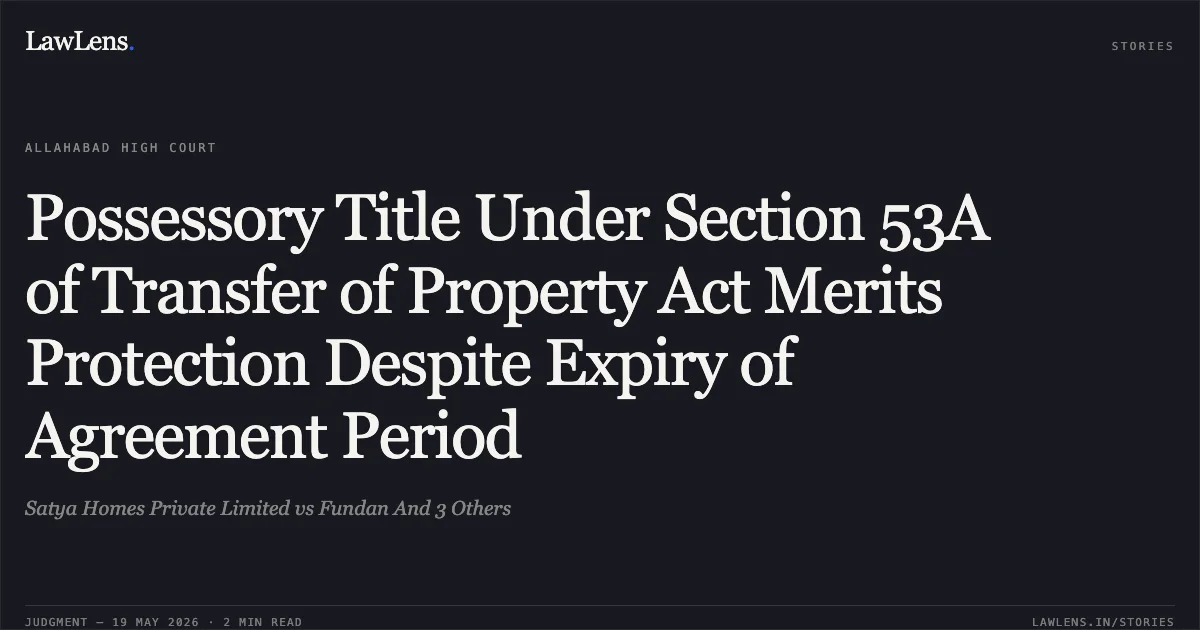
Satya Homes Private LimitedvsFundan And 3 Others
Click to open original judgment
Original judgment, available to read, download and summarize on LawLens.in