Facts
The petitioner and the informant’s daughter were to be married. The informant alleged that ₹12 lakhs had been paid towards marriage expenses, but the marriage was not solemnised and the amount was not returned.
Source reference: p.2Pursuant to Paras Bigha P.S. Case No. 43 of 2017, the Sub-Divisional Judicial Magistrate, Jehanabad, convicted the petitioner and his father under Section 4 of the Dowry Prohibition Act and sentenced them to six months’ rigorous imprisonment with a fine of ₹5,000, with one month’s further imprisonment in default.
Source reference: p.1The petitioner’s criminal appeal, Cr. Appeal No. 07 of 2023, was pending before the Additional District and Sessions Judge-I, Jehanabad.
Source reference: p.2During the proceedings, the parties entered into an amicable settlement under which the petitioner agreed to pay ₹15 lakhs to Opposite Party No. 2 as a full and final settlement. The demand draft was handed over to and accepted by her in Court.
Source reference: p.2The informant had also filed Cr. Appeal No. 11 of 2023 seeking enhancement of sentence, but agreed not to pursue it.
Source reference: p.5Issues
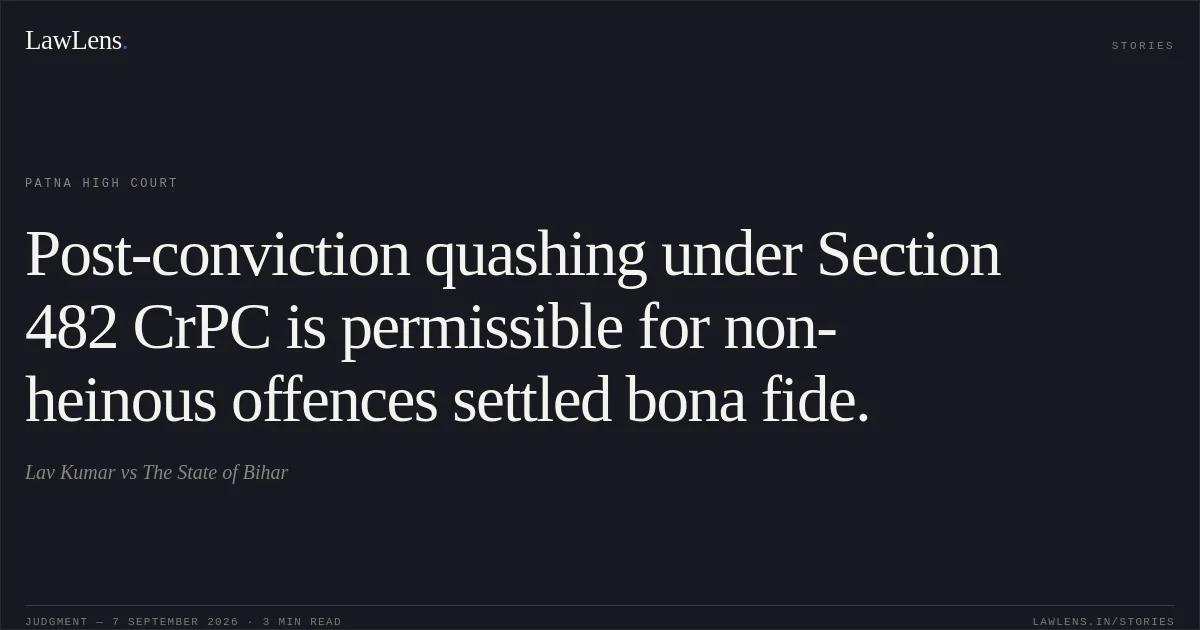
Whether the High Court could exercise its inherent jurisdiction under Section 482 Cr.P.C. to quash the criminal proceedings and the consequential conviction after conviction had been recorded, where the offence arose from a predominantly private dispute and the parties had entered into a bona fide compromise?
Source reference: pp.3–5, para. 6Whether the pending appeals against conviction and for enhancement of sentence justified post-conviction quashing of the proceedings and consequential disposal of the appeals as infructuous?
Source reference: pp.2, 5–6, paras. 3, 7–8Law Applied
The Court applied Section 482 Cr.P.C., which preserves the High Court’s inherent power to prevent abuse of process and secure the ends of justice.
Source reference: no citationIt relied on Ramawatar v. State of Madhya Pradesh, (2022) 13 SCC 635, and Ramgopal v. State of Madhya Pradesh, (2022) 14 SCC 531, for the principle that proceedings involving non-heinous offences or predominantly private disputes may be quashed on the basis of a genuine compromise even after conviction, subject to the pendency of an appeal and careful consideration of the circumstances, nature of the offence, and conduct of the accused.
Source reference: pp.3–5, para. 6The Court also relied on State of Punjab v. Avtar Singh, 2026 INSC 934, which reiterated the principle in Ramgopal, and on Narinder Singh v. State of Punjab, (2014) 6 SCC 466, and State of Madhya Pradesh v. Laxmi Narayan, (2019) 5 SCC 688, which caution against extending compromise-based relief in cases involving heinous offences or serious offences affecting public interest.
Source reference: p.4, para. 6Reasoning
The Court treated the dispute as essentially private and non-heinous, arising from the failure of a proposed marriage and non-return of money, rather than from conduct involving overriding public-policy concerns.
Source reference: pp.2–3, 5The compromise was found to be bona fide because the parties and their counsel were present, Opposite Party No. 2 expressly accepted the ₹15-lakh demand draft, and the Court found no indication of threat or coercion.
Source reference: pp.2, 6, para. 9Since the petitioner’s appeal against conviction was pending, the procedural condition identified in Ramgopal and related authorities was satisfied.
Source reference: pp.2–5, paras. 3, 6Balancing the private nature of the dispute, the completed settlement, and the objective of securing the ends of justice, the Court concluded that continued prosecution would serve no useful purpose.
Source reference: p.5, para. 8Holding
The High Court allowed the application and exercised its inherent jurisdiction under Section 482 Cr.P.C. to quash the entire criminal prosecution arising out of Paras Bigha P.S. Case No. 43 of 2017, including the consequential judgment of conviction in Trial No. 711 of 2022.
Consequently, Cr. Appeal No. 07 of 2023 and the informant’s Cr. Appeal No. 11 of 2023 were rendered infructuous.
Source reference: p.6, para. 8The Court recorded that the compromise was entered into voluntarily and without coercion.
Source reference: p.6, para. 9Acts & Sections Cited
2 provisions across 2 statutes referred to in this judgment. Each provision opens on LawLens.
Dowry Prohibition Act, 19611
Code of Criminal Procedure, 19731
Original Court PDF
Lav KumarvsThe State of Bihar
Click to open original judgment
Original judgment, available to read, download and summarize on LawLens.in