Facts
The Petitioners were awarded catering licenses for railway station stalls and entered into Master License Agreements (MLAs) with the Respondents (Railways) in March 2021 or later.
Source reference: p. 5-6These agreements, issued under the Catering Policy 2017, stipulated a fixed five-year term with an express clause stating "there will be no extension/renewal".
Source reference: p. 3, 6The Petitioners sought a writ of mandamus for a license extension, arguing that the COVID-19 pandemic caused a sharp decline in footfall, preventing them from operating at full potential.
Source reference: p. 3They sought parity with other licensees (e.g., *Ved Prakash Mishra v. UOI*) who had been granted extensions by the Court.
Source reference: p. 3-4, 8Issues
1. Whether licensees who entered into contracts *after* the onset of the COVID-19 pandemic are entitled to an extension of their license term on the grounds of reduced footfall during the pandemic.
Source reference: p. 8-92. Whether the principle of parity applies to grant extensions to the Petitioners based on previous court orders involving differently situated licensees.
Source reference: p. 9-10Law Applied
The Court applied the principle of sanctity of contract, specifically Article 3.2 of the Master License Agreement which prohibits extensions or renewals.
Source reference: p. 6Regarding the principle of parity, the Court relied on the Supreme Court’s ruling in *Tarun Kumar v. Assistant Director Directorate of Enforcement*, which establishes that Article 14 of the Constitution guarantees "positive equality" and cannot be invoked to perpetuate an illegality or a wrong order passed in favor of others.
Source reference: p. 10Furthermore, the Court distinguished the precedent in *Ved Prakash Mishra v. Union of India*, where transition time was granted only to pre-pandemic allottees.
Source reference: p. 8Reasoning
The Court reasoned that the Petitioners "consciously entered into a contract" in 2021, well after the pandemic began, with full knowledge of the prevailing situation and footfall impacts.
Source reference: p. 9Unlike the licensees in *Ved Prakash Mishra* (who were 2018-2020 allottees), these Petitioners could not claim they were caught off-guard by the pandemic.
Source reference: p. 8-9Additionally, the Respondents had already granted the Petitioners concessions in the form of reduced license fees, which the Petitioners accepted; they cannot now seek further benefits beyond the contract.
Source reference: p. 5, 9The Court further clarified that previous orders granting seven-month extensions to other parties were either uncontested or did not constitute binding precedents to be applied where the facts (timing of the contract) were materially different.
Source reference: p. 9-10Holding
The Court dismissed all the writ petitions, holding that the Petitioners were not entitled to any extension of the license period.
The Court directly answered the issues by stating that the principle of parity does not apply because the Petitioners were not "similarly placed" to those granted relief in earlier cases, as their licenses commenced post-pandemic.
Source reference: p. 10All pending applications were disposed of accordingly.
Source reference: p. 11Original Court PDF
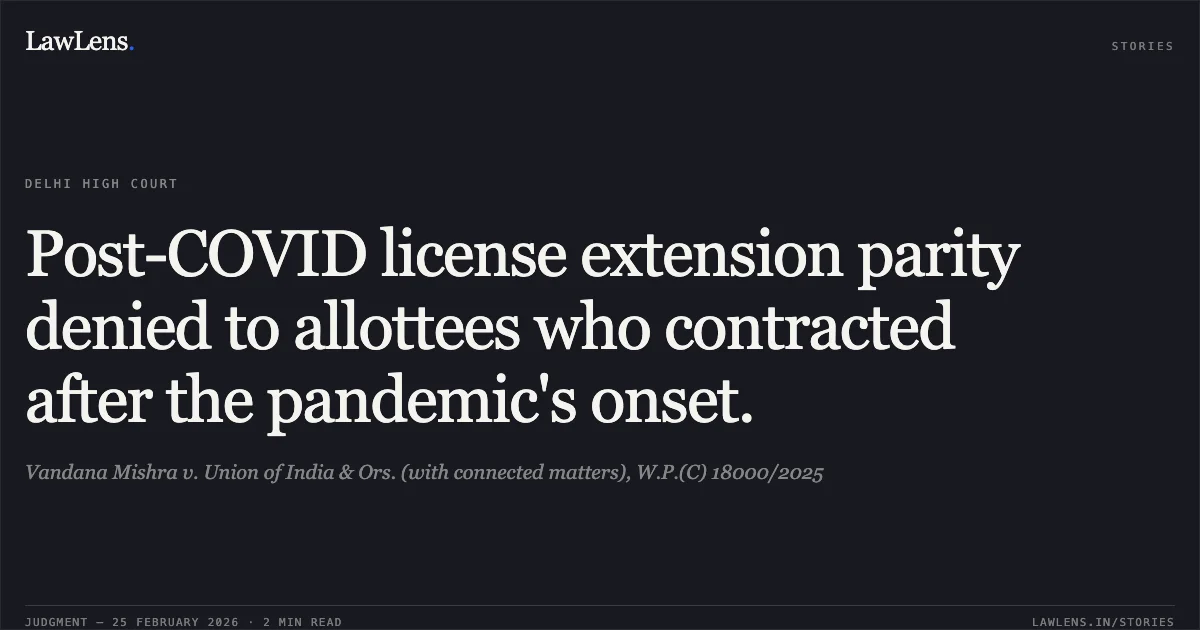
Vandana Mishra v. Union of India & Ors. (with connected matters), W.P.(C) 18000/2025
Click to open original judgment
Original judgment, available to read, download and summarize on LawLens.in