Facts
M/s Mega Corporation Ltd. imported an aircraft under Bill of Entry No. 221491 dated 30 July 2007 and claimed full exemption under Notification No. 21/2002-Cus., Serial No. 347B, subject to Condition No. 104.
Source reference: para. 3The condition required the aircraft to be imported by an operator approved for non-scheduled passenger or charter services and used only for those specified services, with an undertaking to pay duty if the condition was violated.
Source reference: para. 3The importer possessed an NOC to import the aircraft and an NOC to operate non-scheduled charter services.
Source reference: para. 4The operational permission was extended only up to 23 September 2007, with a stipulation that no further extension would be granted.
Source reference: paras. 4, 18Despite the absence of a valid NSOP authorisation, the importer commenced commercial charter operations on 29 December 2007 and operated the aircraft for more than 100 hours.
Source reference: paras. 7–8, 19Its officers admitted that invoices were raised and payments received for those operations.
Source reference: paras. 7–8, 19During investigation, the importer deposited customs duty amounting to Rs. 2,36,82,303 under protest.
Source reference: paras. 9, 20The Commissioner subsequently confiscated the aircraft under Section 111(o) of the Customs Act, 1962, allowed redemption on payment of Rs. 2.5 crore, confirmed customs duty of Rs. 2,86,96,309 under Section 125(2), and imposed penalties of Rs. 30 lakh on the importer and Rs. 10 lakh each on its Managing Director, Shri Kunal Lalani, and CEO, Shri Anil Kumar Soni.
Source reference: para. 13Issues
Whether Customs had jurisdiction to determine non-compliance with Condition No. 104 and recover duty despite the operational permissions having been issued by the Ministry of Civil Aviation/DGCA?
Source reference: paras. 23–24, 43Whether commercial charter operations undertaken without a valid NSOP authorisation constituted violation of Condition No. 104 of Notification No. 21/2002-Cus.?
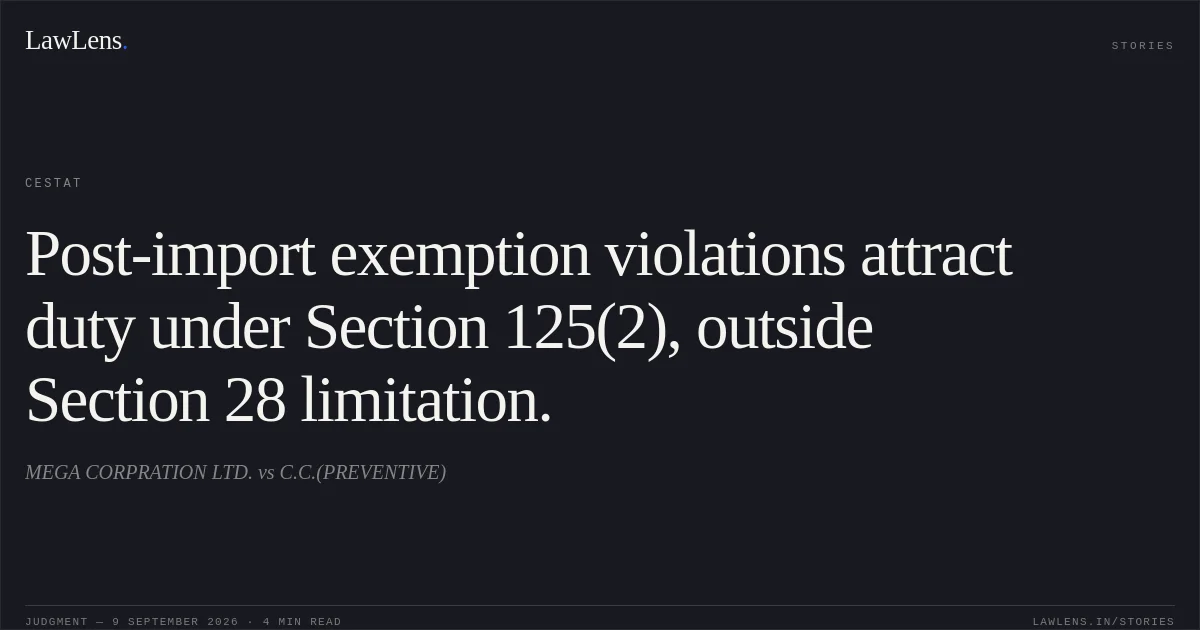
Source reference: paras. 21–24Whether the aircraft was liable to confiscation under Section 111(o) and whether duty could be recovered under Section 125(2) without applying the limitation prescribed under Section 28?
Source reference: paras. 25–27, 31–46Whether the freight and transit-insurance components of the assessable value could be calculated on a notional basis when actual costs were available?
Source reference: paras. 28–30Whether the penalties imposed under Section 112 on the importer and its responsible officers were legally sustainable?
Source reference: paras. 49–53Law Applied
The Tribunal applied Condition No. 104 of Notification No. 21/2002-Cus., under which the aircraft had to be used only for non-scheduled passenger or charter services, with charter services being those provided by an operator registered with and approved by the DGCA and conforming to the applicable Civil Aviation Requirements.
Source reference: paras. 3, 24Under Section 111(o) of the Customs Act, goods imported subject to an exemption condition are liable to confiscation if the condition is not observed, unless the non-observance is sanctioned by the proper officer.
Source reference: paras. 31–35Section 125(2) requires payment of the duty and charges payable when confiscated goods are redeemed, and, following Commissioner of Customs v. Jagdish Cancer & Research Centre and Commissioner of Customs v. C.T. Scan Research Centre (P) Ltd., such recovery is consequential to confiscation and is not governed by the limitation periods under Section 28.
Source reference: paras. 25–27, 46The proper officer may sanction minor or technical non-observance of exemption conditions, but deliberate and substantive violations cannot ordinarily be sanctioned.
Source reference: paras. 33–42Section 112 authorises penalties for acts or omissions rendering goods liable to confiscation, including penalties on persons knowingly concerned in dealing with such goods.
Source reference: paras. 49–53Reasoning
The Tribunal held that Customs was competent to determine eligibility for the exemption and recover duty because the exemption and confiscation consequences arose under the Customs Act; the DGCA or Ministry of Civil Aviation would be relevant only if the scope or validity of an existing permit had to be interpreted.
Source reference: paras. 23, 43Here, no valid permit existed for the period in which the aircraft was commercially operated.
Source reference: paras. 18–24Since the importer knowingly conducted more than 100 hours of charter operations after its authorisation had expired, the flights could not qualify as authorised non-scheduled charter services under Condition No. 104.
Source reference: paras. 18–24The violation rendered the aircraft confiscable under Section 111(o), and the duty was recoverable under Section 125(2), independently of Section 28 limitation.
Source reference: paras. 25–27, 44–46The Tribunal further found that the deliberate commercial use without authorisation was not a minor technical infraction capable of being sanctioned by the proper officer.
Source reference: paras. 40–42The penalties were proportionate because the importer and its senior officers were responsible for the unauthorised operations.
Source reference: paras. 49–53However, the Tribunal accepted that actual freight and transit-insurance costs, rather than notional amounts under Rule 9(2) of the Customs Valuation Rules, had to be used where such actual figures were available.
Source reference: paras. 28–30Holding
The Tribunal upheld the finding that Condition No. 104 was violated, that the aircraft was properly confiscated under Section 111(o), and that duty was recoverable under Section 125(2) without reference to Section 28 limitation.
The redemption fine of Rs. 2.5 crore and penalties of Rs. 10 lakh each on Shri Lalani and Shri Soni were sustained.
Source reference: paras. 52–53Customs Appeal No. 541 of 2010 and Customs Appeal No. 542 of 2010 were dismissed.
Source reference: paras. 54–57Customs Appeal No. 540 of 2010 was partly allowed only to the extent that the duty had to be recomputed using the actual cost of transporting and insuring the aircraft instead of the notional values; the remaining findings against Mega Corporation Ltd. were upheld, and the matter was remanded to the Commissioner for that limited purpose.
Source reference: paras. 54–57Acts & Sections Cited
20 provisions across 2 statutes referred to in this judgment. Each provision opens on LawLens.
Customs Act,1962
Original Court PDF
MEGA CORPRATION LTD.vsC.C.(PREVENTIVE)
Click to open original judgment
Original judgment, available to read, download and summarize on LawLens.in