Facts
The respondents, Public Works Department engineers deputed to the Panchayat Raj Engineering Department, were involved in road works executed under the NABARD-15 Plan in 2009–2010.
Source reference: paras. 2–7; pp. 4–8Following a complaint alleging misappropriation, a Lokayukta investigation reported excess payments and disciplinary proceedings were initiated.
Source reference: paras. 2–7; pp. 4–8One respondent had retired on 30 November 2014; a charge memo was issued to him on 7 October 2015.
Source reference: paras. 2–7; pp. 4–8The Karnataka State Administrative Tribunal (KSAT) quashed the punishment orders and directed refund of amounts recovered.
Source reference: paras. 2–7, 16; pp. 4–8, 12Issues
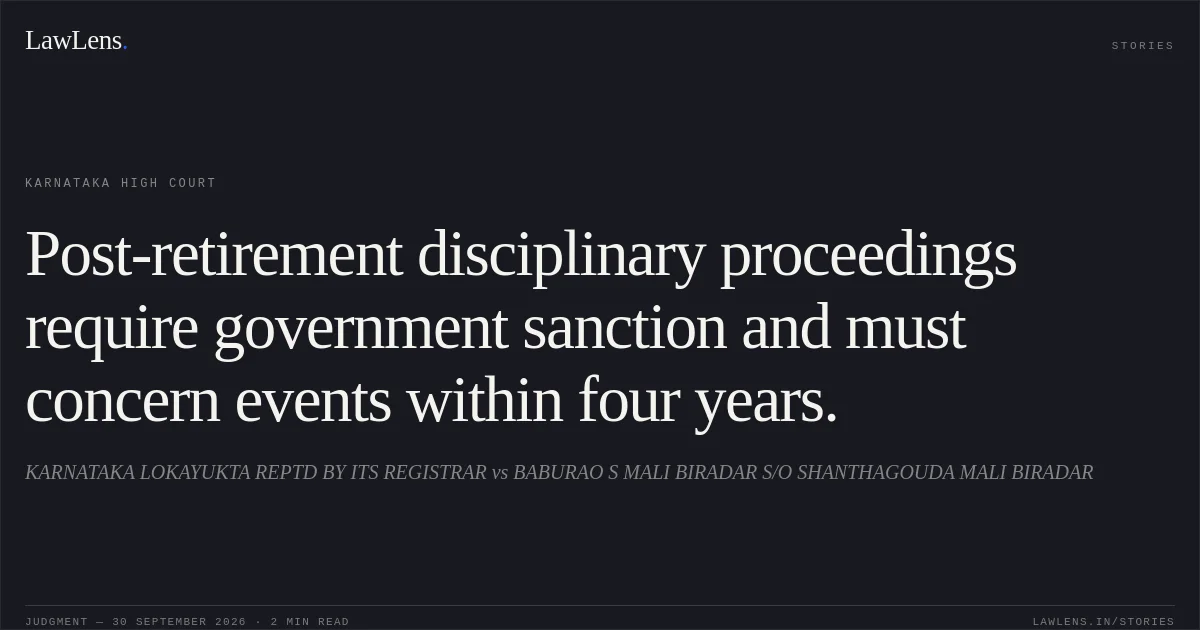
Whether departmental proceedings initiated against the retired respondent, after his retirement and without demonstrated prior Government sanction, complied with Rule 214 of the Karnataka Civil Services Rules (KCSR).
Source reference: paras. 16–19; pp. 12–14Whether the proceedings were barred by the applicable time limits, having regard to the dates of the work and the complaint.
Source reference: paras. 20–22; pp. 15–18Law Applied
Rule 214(2)(a) of the KCSR provides that departmental proceedings instituted while a Government servant is in service may continue after retirement.
Source reference: para. 17; pp. 13–14Under Rule 214(2)(b), proceedings not instituted during service require Government sanction and cannot concern an event occurring more than four years before their institution; they must also follow the prescribed procedure.
Source reference: para. 17; pp. 13–14The Court also referred to Section 8(2)(c) of the Karnataka Lokayukta Act, 1984, as considered in Karnataka Lokayukta v. G.N. Prakash (W.P. No. 200031/2022, decided 22 July 2024), concerning complaints made more than six months after the relevant action became known to the complainant.
Source reference: para. 20; pp. 15–16Reasoning
The Court noted that the relevant works were completed in 2009–2010 and that the retired respondent’s charge memo was issued after his retirement.
Source reference: paras. 16, 19; pp. 12, 14–15The Lokayukta had not produced material showing that the Government’s sanction was obtained before proceedings were initiated against either respondent; the Court therefore held that the proceedings were contrary to Rule 214.
Source reference: paras. 16, 19; pp. 12, 14–15It also relied on the Tribunal’s finding that the relevant events fell beyond the four-year period and considered the complaint’s delay in light of G.N. Prakash.
Source reference: paras. 20–22; pp. 15–18Finding no error in the Tribunal’s decision, the Court declined to interfere.
Source reference: para. 23; p. 18Holding
The Court dismissed both writ petitions.
The Court dismissed both writ petitions and left undisturbed the Tribunal’s order quashing the punishment orders and directing refunds of amounts recovered.
Source reference: para. 23; p. 18Acts & Sections Cited
2 provisions across 1 statute referred to in this judgment. Each provision opens on LawLens.
KARNATAKA LOKAYUKTA ACT, 19842
Original Court PDF
KARNATAKA LOKAYUKTA REPTD BY ITS REGISTRARvsBABURAO S MALI BIRADAR S/O SHANTHAGOUDA MALI BIRADAR
Click to open original judgment
Original judgment, available to read, download and summarize on LawLens.in