Facts
The Plaintiffs filed a suit in 2017 for the partition of ancestral properties in Village Wazirabad belonging to Sh. Fateh Lal, alleging the property remained joint despite urbanization
Source reference: p. 1-2, para 1-4Issues were framed and trial commenced on 01.05.2019
Source reference: p. 4, para 5In August 2023, Plaintiff No. 1 filed an application for amendment of the plaint under Order VI Rule 17 CPC to include land in Khasra No. 5/6, claiming it was newly discovered ancestral property
Source reference: p. 4-5, para 6The Defendant opposed the application, arguing it was a mala fide attempt to delay trial, that the Plaintiffs had prior knowledge of these properties due to multiple litigations (including a separate suit, CS DJ No. 1145/2024, filed and later settled by Plaintiff No. 1 regarding the same property), and that it lacked due diligence
Source reference: p. 6-7, para 7Issues
1. Whether the Plaintiffs satisfied the requirement of "due diligence" under the proviso to Order VI Rule 17 CPC for amendments sought after the commencement of trial
Source reference: p. 7, para 9; p. 15, para 132. Whether the proposed amendment to include new property and factual developments would materially alter the nature of the suit or cause prejudice to the Defendant
Source reference: p. 16, para 16-18Law Applied
The Court primarily applied Order VI Rule 17 of the CPC, which allows amendments necessary for determining the real controversy, provided that after the trial has commenced, the applicant must establish "due diligence"
Source reference: p. 7, para 9The Court relied on Ganesh Prasad v. Rajeshwar Prasad & Ors [2023 SCC OnLine SC 256], which mandates that amendments should not work injustice to the other side or introduce a "new set of ideas" to the prejudice of rights acquired by lapse of time
Source reference: p. 8-11, para 11It further applied Life Insurance Corporation of India v. Sanjeev Builders Private Limited [(2022) 16 SCC 1], which summarizes that amendments should be disallowed if they are mala fide, change the nature of the suit, or introduce a time-barred claim
Source reference: p. 12-14, para 12Reasoning
The Court found that since the trial had already commenced in 2019, the burden was on the Plaintiffs to prove due diligence
Source reference: p. 15, para 13The Court rejected the Plaintiffs’ "discovery" plea because the property was ancestral and had been the subject of multiple litigations and criminal proceedings since 2009, which the Plaintiffs ought to have known
Source reference: p. 15-16, para 14Furthermore, Plaintiff No. 1 had independently pursued a separate suit (CS DJ No. 1145/2024) regarding the same Khasra No. 5/6 and settled it, demonstrating that he treated it as a distinct controversy and lacked bona fides in seeking to incorporate it into the current suit now
Source reference: p. 16-17, para 17-18The Court observed that Plaintiff No. 1 had taken inconsistent stands (claiming oral partition in one suit while claiming the property was joint ancestral in the current application), which is impermissible under amendment law
Source reference: p. 17-18, para 19Holding
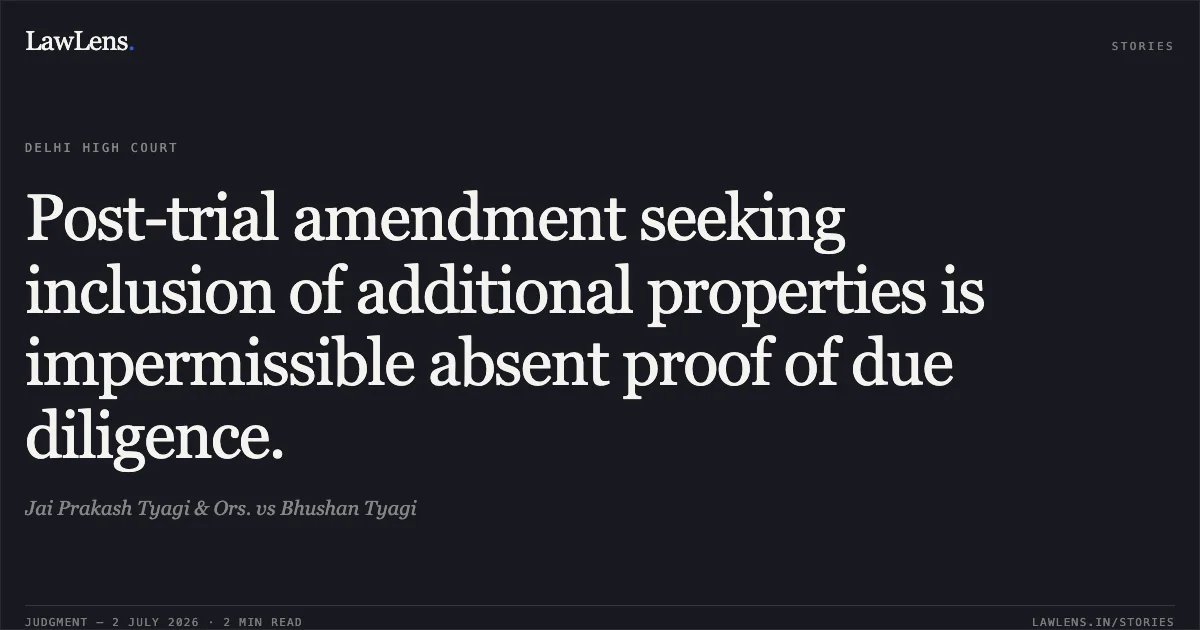
The Court held that the Plaintiffs failed to establish due diligence as required by the proviso to Order VI Rule 17 CPC
The Court dismissed the application. It concluded that the amendment was not necessary to determine the real controversy in the original suit, would materially change the suit's scope after the trial had commenced, and appeared to be an attempt to split claims or reopen settled issues
Source reference: p. 21, para 25; p. 20-21, para 22-24Acts & Sections Cited
6 provisions across 3 statutes referred to in this judgment. Each provision opens on LawLens.
Code of Civil Procedure, 19084
Delhi Municipal Corporation Act, 19571
Code of Criminal Procedure, 19731
Original Court PDF
Jai Prakash Tyagi & Ors.vsBhushan Tyagi
Click to open original judgment
Original judgment, available to read, download and summarize on LawLens.in


