Facts
The appellant challenged an order dated 09.06.2025 passed in WPS No. 6056 of 2021, wherein a learned Single Judge partly allowed the appellant's writ petition by ordering reinstatement but denying back wages
Source reference: para. 2, 4Pursuant to that order, the appellant joined duty on 31.07.2025
Source reference: para. 3The appellant subsequently filed Review Petition No. 414/2025 seeking back wages, which was dismissed on 15.12.2025
Source reference: para. 2The present writ appeal was filed with a delay of 213 days from the original order
Source reference: para. 1The appellant moved I.A. No. 01/2026 under Section 5 of the Limitation Act, citing financial hardship, poverty, and non-payment of salary post-reinstatement as reasons for the delay
Source reference: para. 1, 3Issues
1. Whether the appellant established "sufficient cause" for the condonation of a 213-day delay in filing the writ appeal under Section 5 of the Limitation Act
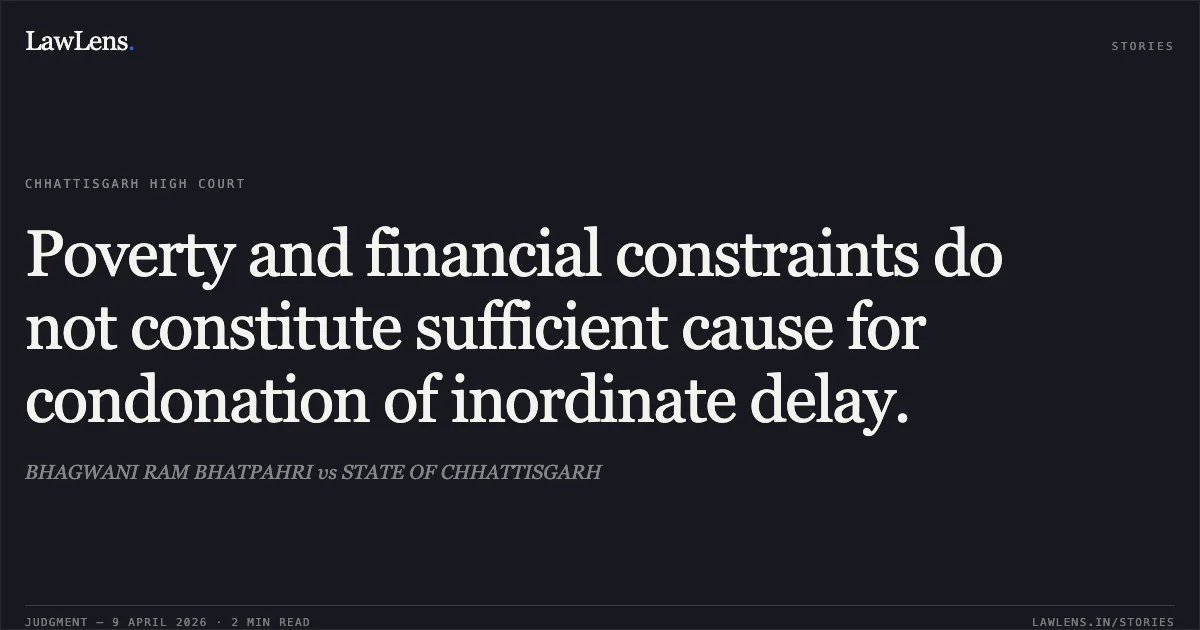
Source reference: para. 1, 82. Whether financial constraints, poverty, or ignorance of law constitute adequate grounds to exercise judicial discretion in condoning inordinate delay
Source reference: para. 8, 10Law Applied
The Court primarily applied Section 5 of the Limitation Act, 1963, which requires the applicant to demonstrate "sufficient cause" for failing to approach the court within the prescribed limitation period
Source reference: para. 1It relied on the Supreme Court’s decision in State of Madhya Pradesh v. Ramkumar Choudhary (2024 INSC 932), which held that "sufficient cause" must be an adequate reason that prevented the party from approaching the court and cannot be liberally interpreted in cases of negligence or inaction
Source reference: para. 7The Court further cited Ajit Singh Thakur Singh v. State of Gujarat, affirming that sufficient cause must be traced to circumstances arising within the limitation period, and events occurring after the expiry of limitation cannot constitute such cause
Source reference: para. 7Reasoning
The Court found the 213-day delay to be "grossly inordinate"
Source reference: para. 10It observed that while the appellant was reinstated on 31.07.2025, he failed to pursue legal remedies immediately
Source reference: para. 9The Court noted that the review petition appeared to have been filed at a belated stage merely to extend the limitation for the writ appeal
Source reference: para. 9Applying the principles from Ramkumar Choudhary, the Court reasoned that the discretion to condone delay must be exercised with caution and that poverty, financial constraints, or ignorance of law do not, in the eyes of the law, fulfill the requirement of "sufficient cause"
Source reference: para. 8, 10The Court emphasized that the law of limitation creates valuable rights for the opposite party which cannot be lightly set aside due to a litigant's own inaction or lack of diligence
Source reference: para. 10Holding
The Court held that no case for condonation of delay was made out as the appellant failed to provide a satisfactory or legally sufficient explanation
Consequently, the application for condonation of delay (I.A. No. 01/2026) was rejected, and the writ appeal was dismissed
Source reference: para. 11Acts & Sections Cited
1 provisions across 1 statute referred to in this judgment. Each provision opens on LawLens.
Limitation Act, 19631
Original Court PDF
BHAGWANI RAM BHATPAHRIvsSTATE OF CHHATTISGARH
Click to open original judgment
Original judgment, available to read, download and summarize on LawLens.in