Facts
The Petitioner, a Public Relations Inspector (Postal), was subjected to departmental proceedings under Rule 14 of the CCS (CCA) Rules, 1965, for allegedly assaulting a Postmaster with a slipper on 28.02.2000
Source reference: para. 2.1Following an inquiry where charges were proved, the Petitioner was dismissed from service on 05.12.2000
Source reference: para. 2.2On revision, the penalty was reduced to compulsory retirement on 04.03.2002
Source reference: para. 2.4The Petitioner challenged these orders before the Central Administrative Tribunal (CAT), primarily contending that the inquiry was vitiated because the Inquiry Officer (IO) failed to compel the attendance of a defense witness, Sh. D.K. Vashishtha, who had refused to testify
Source reference: para. 2.6, 3The CAT dismissed the original and review applications in 2005
Source reference: para. 1Issues
1. Whether Section 5 of the Departmental Inquiries (Enforcement of Attendance of Witnesses and Production of Documents) Act, 1972, imposes a mandatory duty on an Inquiry Officer to compel the attendance of a witness
Source reference: para. 4, 82. Whether the non-examination of a defense witness who refused to participate vitiates the departmental inquiry proceedings
Source reference: para. 8, 11Law Applied
Section 5 of the Departmental Inquiries (Enforcement of Attendance of Witnesses and Production of Documents) Act, 1972, which grants an inquiring authority the same powers as a Civil Court under the Code of Civil Procedure (CPC), 1908, for summoning and enforcing witness attendance
Source reference: para. 9, 10Section 32 of the CPC, which stipulates that a Court "may" compel attendance, signifying discretionary rather than mandatory power
Source reference: para. 10Under Article 226 of the Constitution, the High Court does not sit as an appellate authority over disciplinary findings unless they are perverse or patently illegal
Source reference: para. 6The "preponderance of probabilities" standard of proof applicable to departmental proceedings
Source reference: para. 12Reasoning
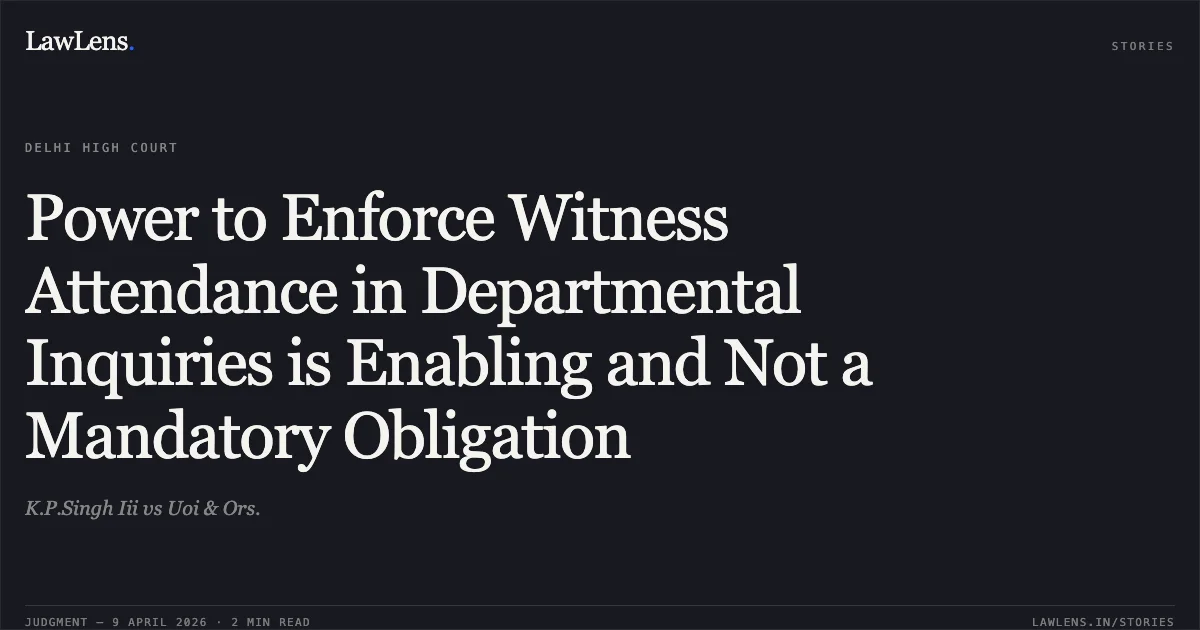
The Court rejected the Petitioner's argument that Section 5 of the 1972 Act creates a "rigid obligation" on the IO to enforce witness attendance
Source reference: para. 11The Court reasoned that the Act is an enabling provision, equipping the IO with procedural tools rather than casting a binding duty to compel witnesses in every instance
Source reference: para. 10, 11The Court noted that the IO must exercise this power "judiciously and not mechanically"
Source reference: para. 11The Court found that the Petitioner failed to demonstrate any prejudice caused by the absence of the witness
Source reference: para. 12The inquiry report relied on the consistent testimony of five eyewitnesses who confirmed the assault, satisfying the threshold of preponderance of probabilities
Source reference: para. 12The Court emphasized that it cannot reapreciate evidence or interfere with findings of fact unless a patent illegality is shown, which was absent in this case
Source reference: para. 6, 13Holding
The High Court dismissed the petition, holding that the inquiry proceedings were not vitiated by the IO's decision not to compel the attendance of the unwilling witness
The Court affirmed the CAT’s findings, concluding there was no infirmity in the impugned orders as the charges were established through ample evidence provided by other eyewitnesses
Source reference: para. 12, 13Acts & Sections Cited
5 provisions across 3 statutes referred to in this judgment. Each provision opens on LawLens.
Departmental Inquiries (Enforcement of Attendance of Witnesses and Production of Documents) Act, 19722
Code of Civil Procedure, 19082
Banking Companies (Acquisition and Transfer of Undertakings) Act, 19701
Original Court PDF
K.P.Singh IiivsUoi & Ors.
Click to open original judgment
Original judgment, available to read, download and summarize on LawLens.in