Facts
The Appellants (landlords) filed an eviction suit (S.C.C. Suit No. 52 of 2021) against the Respondent (tenant) for arrears of rent and damages.
Source reference: para. 5The Appellants moved an application under Order XV Rule 5 CPC to strike off the tenant's defence for failing to deposit the admitted rent and arrears on or before the first date of hearing.
Source reference: para. 6The Trial Court allowed the application and struck off the defence on 05.08.2023.
Source reference: para. 8On revision, the Allahabad High Court set aside the order on 10.12.2024, granting the tenant time to deposit rent.
Source reference: para. 9Despite a "final opportunity" warning, the tenant defaulted again, and the High Court subsequently extended the time further via an order dated 07.02.2025.
Source reference: para. 10Issues
1. Whether the High Court erred in interfering with the Trial Court’s order to strike off the defence despite repeated defaults by the tenant under Order XV Rule 5 CPC.
Source reference: para. 12, 142. Whether the "first date of hearing" was properly determined for the purpose of initiating the penal consequences of Order XV Rule 5 CPC.
Source reference: para. 18-203. Whether the power to strike off a defence is mandatory or discretionary in nature.
Source reference: para. 15-17Law Applied
Order XV Rule 5 of the Code of Civil Procedure (CPC), which allows the striking off of a defendant's defence for non-deposit of admitted rent, noting it is a "drastic" penal provision intended for "grossly recalcitrant" situations rather than a mechanical application.
Source reference: para. 15-17Bimal Chand Jain v. Sri Gopal Agarwal (1981), which held that the word "may" in the rule vests discretion in the court.
Source reference: para. 16Siraj Ahmad Siddiqui v. Prem Nath Kapoor (1993), as the date the court applies its mind to frame issues.
Source reference: para. 19Salem Advocate Bar Association v. Union of India (2005) that procedural law is the "handmaid of justice" and should advance the cause of justice.
Source reference: para. 22Reasoning
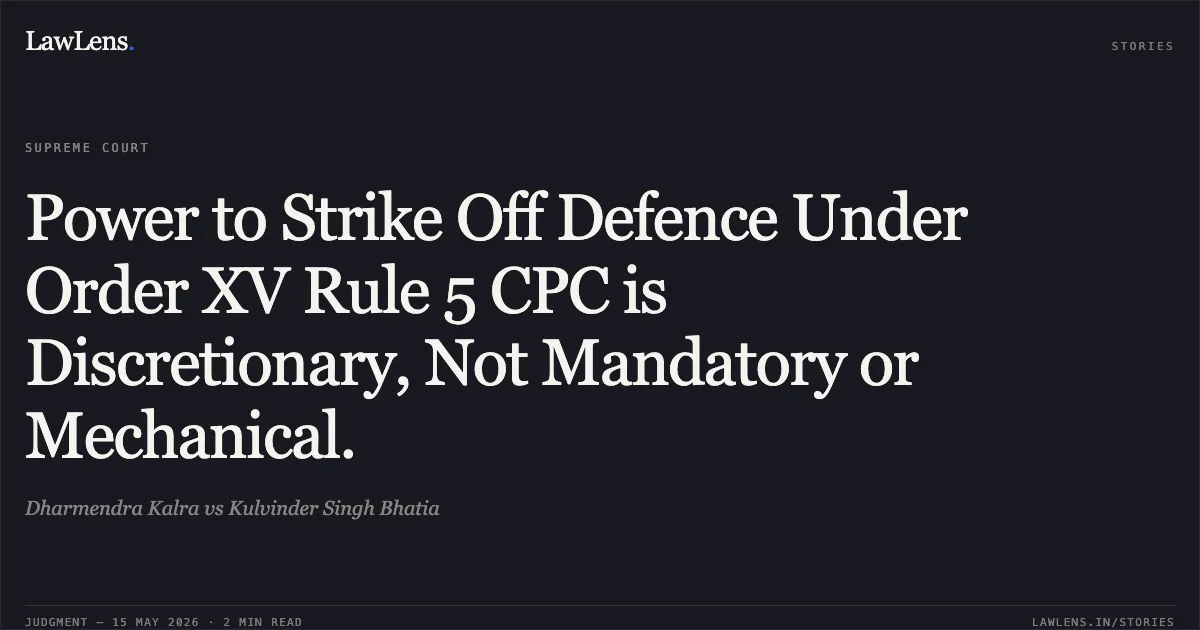
The Supreme Court observed that while Order XV Rule 5 CPC aims to prevent tenants from occupying premises without paying rent, it is not a "mechanical" tool but a discretionary one.
Source reference: para. 15-16The Court analyzed that the Trial Court failed to conclusively determine the "first date of hearing," which is the essential starting point for calculating default.
Source reference: para. 18-20Furthermore, the Court noted that both lower courts failed to balance the tenant's subsequent substantial (though delayed) compliance with the "final" nature of earlier court orders.
Source reference: para. 23-24The Court reasoned that since the Trial Court acted mechanically and the High Court failed to reconcile its own contradictory orders regarding extensions, a fresh adjudication was necessary to verify if the default was "wilful or bonafide".
Source reference: para. 24-25Holding
The Court held that the Trial Court must specifically: (i) determine the "first date of hearing"; (ii) evaluate whether there was substantial compliance with Order XV Rule 5; and (iii) decide if the default was contumacious or if good reason existed for the delay.
The Supreme Court set aside the impugned orders and remanded the matter to the Trial Court for fresh consideration with a direction to pass a reasoned order within six months.
Source reference: para. 28, 29Acts & Sections Cited
3 provisions across 3 statutes referred to in this judgment. Each provision opens on LawLens.
Code of Civil Procedure, 19081
Transfer of Property Act, 18821
Provincial Small Cause Courts Act, 18871
Original Court PDF
Dharmendra KalravsKulvinder Singh Bhatia
Click to open original judgment
Original judgment, available to read, download and summarize on LawLens.in


