Facts
The applicant, a former Senior Division Material Manager with the Indian Railways, was facing trial for alleged corruption offenses.
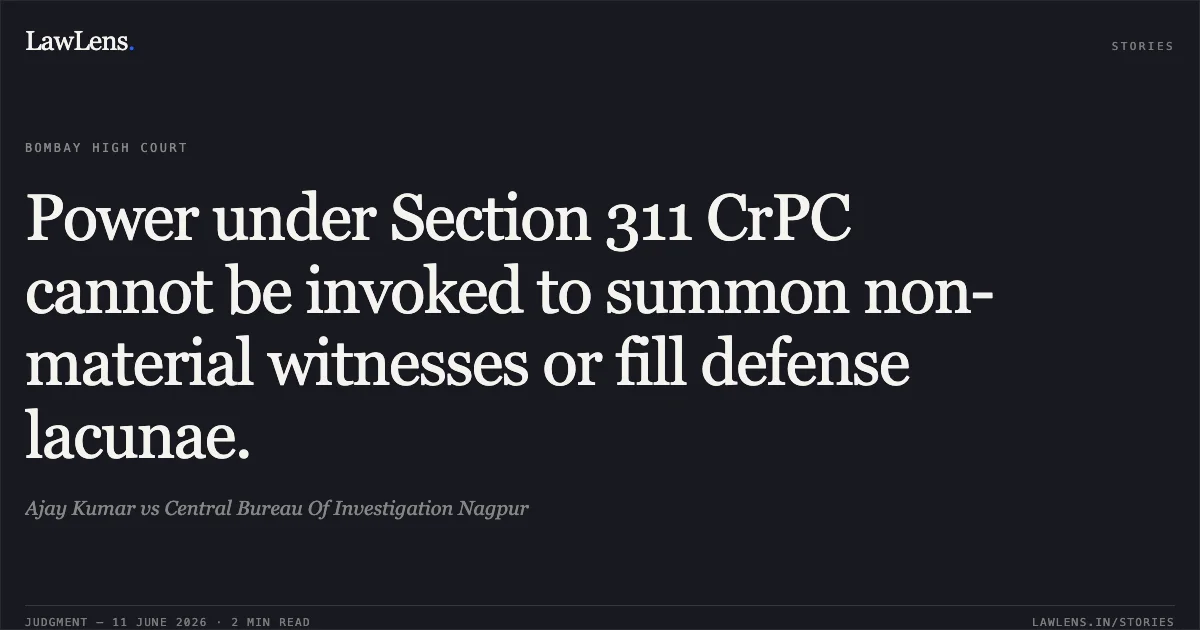
Source reference: no citationAfter the prosecution examined 14 witnesses and the trial moved to the stage of final arguments, the applicant filed an application under Section 311 of the CrPC at Exhibit 272.
Source reference: para. 2, 6The application sought to summon the Superintendent of CBI (ACB), Nagpur, and the Director of the CFSL, New Delhi, as defense witnesses.
Source reference: para. 2The applicant contended that his earlier statement under Section 313 CrPC—where he waived his right to lead defense evidence—was made without proper consultation with his counsel due to the counsel's unavailability.
Source reference: para. 6The Special Judge for CBI, Nagpur, rejected the application on March 7, 2026, leading to this revision.
Source reference: para. 2Issues
1. Whether the examination of the Superintendent of CBI and the Director of CFSL is essential to the just decision of the case under Section 311 CrPC.
Source reference: para. 10, 152. Whether the Trial Court’s rejection of the application for defense witnesses amounted to a denial of a fair trial.
Source reference: para. 3, 14Law Applied
Section 311 of the Criminal Procedure Code (CrPC), which grants the court discretionary power to summon or recall witnesses at any stage if their evidence appears "essential to the just decision of the case".
Source reference: para. 5Principles from Rajaram Prasad Yadav v. State of Bihar and anr. (2013) 14 SCC 461, which mandate that while Section 311 powers are wide, they must be used for finding the truth rather than filling lacunae or delaying trial.
Source reference: para. 8, 9Vijay Kumar v. State of Uttar Pradesh (2011) 8 SCC 136, emphasizing that the evidence sought must be germane to the issues involved.
Source reference: para. 11The right to a fair trial under Article 21 of the Constitution.
Source reference: para. 9, 12Reasoning
The Court observed that the Superintendent of CBI acted only in a supervisory capacity and had no practical role in the investigation, while a Senior Scientific Officer (PW-3) from the CFSL had already been examined and cross-examined regarding the forensic reports.
Source reference: para. 10, 11Consequently, the requested witnesses were not "material" and their evidence was not germane to the core issues.
Source reference: para. 11In applying the Rajaram Prasad Yadav test, the Court found the applicant's excuse for the delay—that he did not meet his advocate—to be factually incorrect as the Roznama showed the counsel was present during the Section 313 statement recording.
Source reference: para. 13The Court reasoned that given the applicant's high professional standing (UPSC-selected official), his claim of being a "layman" who misunderstood the proceedings was untenable.
Source reference: para. 13The timing of the application, filed only at the stage of final arguments, indicated an attempt to "protract the trial" and "fill in lacunae".
Source reference: para. 12, 14Holding
The Court held that the proposed witnesses were not necessary for a just decision and that the discretionary power under Section 311 cannot be invoked to permit an abuse of process.
The Criminal Revision Application was rejected, and the Trial Court's order was upheld.
Source reference: para. 15Acts & Sections Cited
3 provisions across 2 statutes referred to in this judgment. Linked provisions open on LawLens.
Code of Criminal Procedure2
Indian Evidence Act, 18721
Original Court PDF
Ajay KumarvsCentral Bureau Of Investigation Nagpur
Click to open original judgment
Original judgment, available to read, download and summarize on LawLens.in