Facts
The respondents operated a synthetic-detergent manufacturing unit at Vatva, Ahmedabad, from 1 September 1983. The Employees’ State Insurance Act, 1948 (“ESI Act”) was applied to the unit from 1 March 1988, and an ESI Code was allotted with effect from that date.
Source reference: p. 2Subsequently, the Employees’ State Insurance Corporation treated the unit as covered from 1 September 1983 and raised demands aggregating to Rs. 51,72,079, including contributions for the periods from 1 September 1983 to 28 February 1988 and from 1 March 1988 to 28 February 1989.
Source reference: p. 2The respondents challenged the demand before the ESI Court under Section 76 of the ESI Act. The ESI Court partly allowed the application and quashed the demand. The Corporation filed the present appeal under Section 82(2) of the ESI Act.
Source reference: pp. 2–4Issues
Whether the respondents’ premises constituted a “factory” under the unamended Section 2(12) of the ESI Act during the period from 1 September 1983 to 28 February 1988?
Source reference: pp. 4, 8–9Whether the Corporation proved that the manufacturing process was carried on with the aid of power/electricity, as required under the applicable definition of “factory”?
Source reference: pp. 6–7, 9–10Whether the respondents were liable to pay ESI contributions for the period preceding the allotment of the ESI Code and the alleged date of coverage?
Source reference: pp. 2–4, 9–10Whether the ESI Court erred in holding that the respondents’ establishment was not covered under Section 2(12) of the ESI Act?
Source reference: pp. 4, 10Whether the appeal raised any substantial question of law so as to be maintainable under Section 82(2) of the ESI Act?
Source reference: pp. 4, 7, 11Law Applied
The Court applied Section 82(2) of the ESI Act, under which an appeal to the High Court lies only on a substantial question of law.
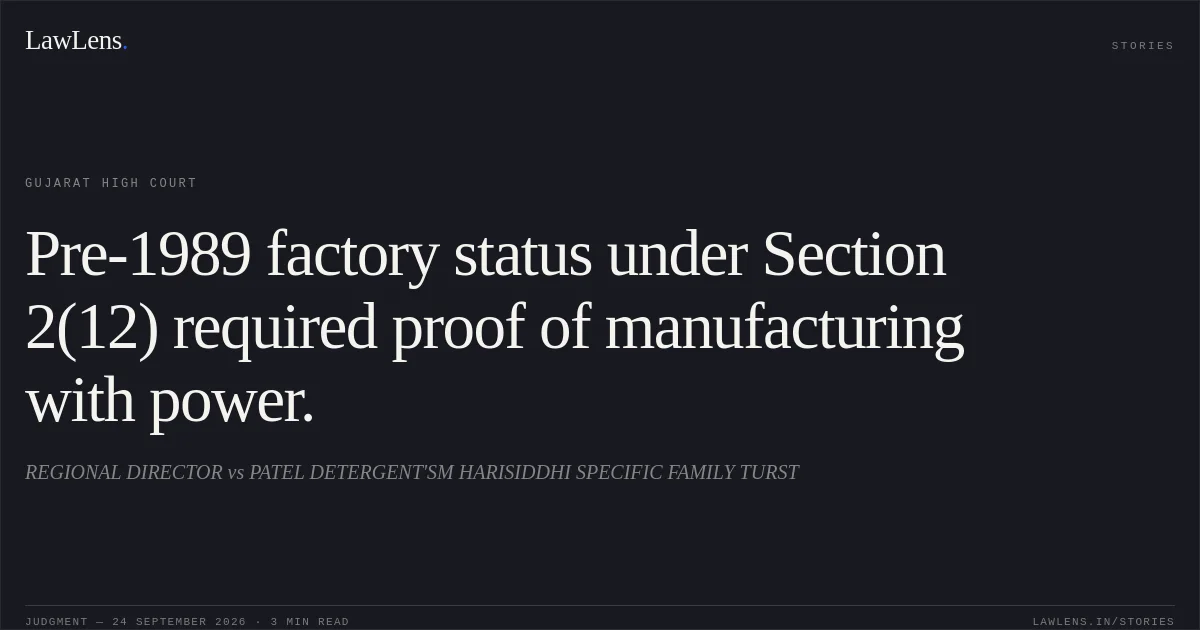
Source reference: p. 11For the relevant period, the Court applied the pre-20 October 1989 version of Section 2(12), defining a “factory” as premises where 20 or more persons were working or had worked on any day during the preceding twelve months and where a manufacturing process was carried on with the aid of power or was ordinarily so carried on.
Source reference: pp. 8–9Thus, both the employment threshold and the use of power in the manufacturing process had to be established.
Source reference: pp. 8–9The burden lay on the Corporation to prove that the establishment satisfied the statutory definition during the period for which contributions were demanded.
Source reference: pp. 9–10Reasoning
The Court accepted that the evidence established the presence of more than 20 employees; indeed, the respondents’ evidence indicated that approximately 500 workers were employed when the factory restarted.
Source reference: p. 9However, the statutory requirement of proving that manufacturing was carried on with the aid of electricity or other power was not established.
Source reference: p. 10The Corporation’s inspector, who inspected the premises in 1987, admitted that no earlier inspection had taken place and that he had not verified whether electricity was used in manufacturing detergent powder.
Source reference: p. 10Another Corporation witness, who visited the premises only on 1 June 1989, admitted that he had no evidence showing that electricity was used to operate machinery or motors.
Source reference: p. 10Consequently, the Corporation failed to prove the essential power-use requirement for the period covered by the demand.
Source reference: p. 10The Court therefore found no error in the ESI Court’s conclusion that the premises did not fall within the applicable definition of “factory” and held that the issues raised were essentially factual and disclosed no substantial question of law.
Source reference: pp. 10–11Holding
The Court held that, although the employee-strength requirement was satisfied, the Corporation failed to prove that the manufacturing process was carried on with the aid of electricity during the relevant period.
The respondents’ establishment therefore could not be treated as a “factory” under the applicable version of Section 2(12) of the ESI Act for the period in question.
Source reference: p. 11Finding no substantial question of law under Section 82(2), the Court dismissed the Corporation’s appeal and upheld the ESI Court’s decision quashing the demand of Rs. 51,72,079.
Source reference: p. 11Acts & Sections Cited
3 provisions across 1 statute referred to in this judgment. Linked provisions open on LawLens.
Employees3
Original Court PDF
REGIONAL DIRECTORvsPATEL DETERGENT'SM HARISIDDHI SPECIFIC FAMILY TURST
Click to open original judgment
Original judgment, available to read, download and summarize on LawLens.in