Facts
The appellant, a manufacturer of optic-fibre transmission systems, received various services and incurred foreign-currency expenditure in connection with its R&D facility in Denmark.
Source reference: pp. 3–6A show-cause notice dated 22 October 2014 proposed service tax of ₹2,24,41,927, including Education Cess and Secondary and Higher Education Cess, with interest and penalties.
Source reference: p. 5The Commissioner dropped the demands relating to intellectual property rights services but confirmed a demand of ₹55,24,252 in respect of services covered by Annexure C, along with interest, and imposed penalties under Sections 77 and 78 of the Finance Act, 1994.
Source reference: pp. 1–3During the proceedings, the appellant produced evidence that ₹6,58,184 in service tax, together with applicable interest, had already been paid on certain admitted liabilities.
Source reference: p. 9Issues
Whether the demand relating to foreign-currency expenditure was invalid because the show-cause notice failed to adequately identify the taxable services and their classification?
Source reference: pp. 10–15, 39–40Whether the expenditure incurred or paid by the appellant in relation to its Denmark R&D facility constituted reimbursable expenses not liable to service tax?
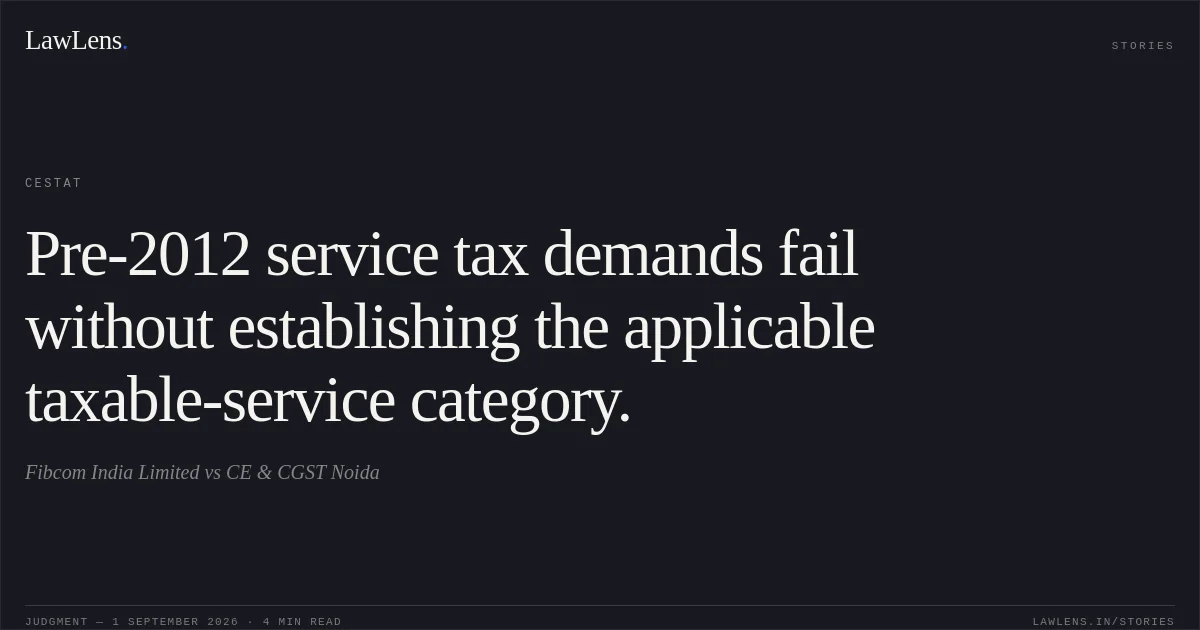
Source reference: pp. 37–39Whether service tax could be demanded for the period prior to 1 July 2012 without establishing the specific taxable-service category under the Finance Act, 1994?
Source reference: p. 39Whether the post-1 July 2012 expenditure was taxable under the negative-list regime, including by treating the Indian and Danish establishments as separate persons?
Source reference: pp. 38–40Whether the appellant was entitled to treat the amounts paid to foreign service providers as cum-tax consideration under Section 67(2) of the Finance Act, 1994?
Source reference: p. 40Whether the extended period of limitation and penalties under Sections 77 and 78 were invocable?
Source reference: pp. 41–43Law Applied
The Tribunal applied Section 66A of the Finance Act, 1994, which governed the taxation of services received from outside India before 1 July 2012 and deemed the recipient in India to be the provider of the taxable service.
Source reference: pp. 13–14Section 66A(2), together with Rule 7 of the Service Tax (Determination of Value) Rules, 2006, treated the Indian and foreign permanent establishments of the same company as separate persons and made the actual consideration for the service the taxable value.
Source reference: pp. 14, 38–39For the post-1 July 2012 period, the Tribunal applied the negative-list regime under Sections 65B(44) and 66, under which consideration for an activity undertaken by one person for another was generally taxable unless otherwise exempt.
Source reference: p. 40The Tribunal relied on Union of India v. Intercontinental Consultants and Technocrats Pvt. Ltd., 2018 (10) G.S.T.L. 401 (S.C.), but held that the principle concerning reimbursement of expenses did not apply where the payments were consideration for services actually received.
Source reference: pp. 37–38Section 67(2), concerning cum-tax valuation, was held applicable to forward-charge demands against the service provider and not to reverse-charge liability imposed on the recipient.
Source reference: p. 40The principles in Rajasthan Spinning & Weaving Mills Ltd., 2009 (238) E.L.T. 3 (S.C.), were applied to hold that penalty provisions requiring fraud, suppression or wilful intent cannot operate absent a legally sustainable finding of deliberate evasion.
Source reference: pp. 41–42The Tribunal also applied the settled principle that an adjudicating authority cannot travel beyond the show-cause notice.
Source reference: pp. 10–12Reasoning
The Tribunal rejected the appellant’s challenge to the show-cause notice insofar as Annexure C was concerned.
Source reference: pp. 14–15, 36–37The appellant’s detailed reply, supported by invoices and transaction-wise explanations, demonstrated that it understood the allegations and the nature of the expenditure; therefore, the notice could not be treated as vague at that stage.
Source reference: pp. 14–15, 36–37The Tribunal also held that the expenditure was not merely reimbursable cost: the appellant had received services from foreign service providers, either directly or through its Denmark branch, and the payments represented consideration for those services.
Source reference: pp. 37–39However, for the period before 1 July 2012, service tax could be imposed only if the Department established that the transaction fell within a specifically defined taxable-service category.
Source reference: p. 39Mere identification of payments or expenditure in the annexure was insufficient, and neither the show-cause notice nor the impugned order established such classification.
Source reference: p. 39For the period after 1 July 2012, the Tribunal found no fundamental error in the Commissioner’s approach because the negative-list regime broadened the taxable field and the expenditure represented consideration for activities undertaken for the appellant.
Source reference: p. 40The plea for cum-tax valuation was rejected because the liability was imposed on the appellant as service recipient under reverse charge, whereas Section 67(2) contemplated a forward-charge situation in which the gross amount charged by the service provider included service tax.
Source reference: p. 40Nevertheless, the Department could not invoke the extended limitation period because the alleged non-payment was revenue-neutral: the service tax paid under reverse charge would have been available to the appellant as credit, and there was no established mala fide intention or deliberate suppression.
Source reference: p. 41Since the appellant had also filed ST-3 returns during the relevant period, the penalty under Section 77 was unsustainable.
Source reference: p. 43In the absence of a sustainable extended-period demand, the penalty under Section 78 also failed.
Source reference: pp. 41–42Holding
The appeal was partly allowed.
The demand relating to the period prior to 1 July 2012 was set aside because the Department had not established the specific taxable-service category applicable to the transactions.
Source reference: pp. 39, 43The demand falling within the normal limitation period was upheld, subject to appropriation of the ₹6,58,184 already deposited by the appellant, along with applicable interest.
Source reference: pp. 9, 43The Tribunal rejected the pleas that the Annexure C demand was vague, that the expenditure was merely reimbursable, and that cum-tax valuation applied to reverse-charge liability.
Source reference: pp. 36–40The penalties imposed under Sections 77 and 78 of the Finance Act, 1994, were set aside.
Source reference: p. 43Acts & Sections Cited
1 provisions across 1 statute referred to in this judgment. Each provision opens on LawLens.
Central Excise Act, 19441
Original Court PDF
Fibcom India LimitedvsCE & CGST Noida
Click to open original judgment
Original judgment, available to read, download and summarize on LawLens.in