Facts
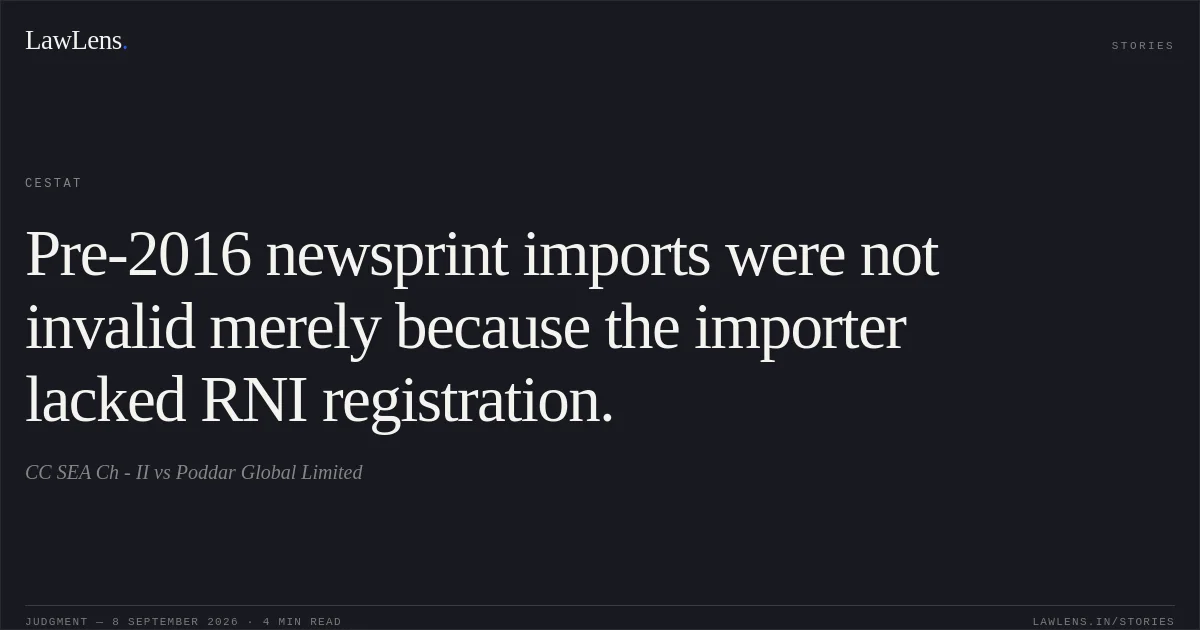
Poddar Global Ltd. imported newsprint under CTH 4801 0010/4801 0090 and stored it in bonded warehouses. The Department alleged that the company, though not itself registered with the Registrar of Newspapers for India (RNI), procured the names and registrations of purported or dummy RNI-registered actual users and enabled duty-free clearances under Notification No. 12/2012-Cus., Sl. No. 264. It further alleged that the company’s Managing Director, Shri Sunil Kumar Poddar, devised the arrangement and recovered import and logistics expenses from newspaper publishers through debit notes
Source reference: para. 2, pp. 2–3During searches in July 2015, newsprint reels were seized from warehouses at Alipur, Assam, Raigad and Gummidipoondi. The adjudicating authority confiscated the goods and imposed aggregate penalties of ₹60,02,000 on Poddar Global Ltd. under Section 112(a) of the Customs Act, 1962, and ₹20 lakh on its Managing Director
Source reference: para. 2, pp. 2–3The respondents contended that the goods were lawfully imported, belonged to RNI-registered publishers, and that discrepancies in reel serial numbers resulted from warehouse stacking and part-clearances. They produced bills of entry, bills of lading, packing lists, invoices, transport records and other documents correlating the seized goods with lawful imports
Source reference: para. 3.2, pp. 4–7The Commissioner (Appeals) set aside the confiscation and penalties, holding that the Department had not proved illegal import, diversion to dummy units, or excess/unaccounted stock.
Source reference: para. 8, pp. 11–14The Tribunal also noted that the Department had not filed the show-cause notice or relied-upon documents with its appeal memorandum.
Source reference: para. 5, pp. 7–8Issues
Whether newsprint imported before 3 June 2016 by a non-RNI-registered importer, and subsequently warehoused or transferred to RNI-registered actual users, violated the applicable Foreign Trade Policy or the conditions of Notification No. 12/2012-Cus.
Source reference: paras. 6–7, 10, pp. 8–10, 14–16Whether discrepancies between the serial numbers of seized newsprint reels and the relevant packing lists established illicit or improper import so as to justify confiscation under Sections 111(d) or 111(o) and penalties under Section 112(a) of the Customs Act, 1962.
Source reference: paras. 8–9.1, pp. 11–15Whether the Department proved that the respondents cleared the newsprint to dummy units or otherwise diverted it for illicit consideration.
Source reference: paras. 4, 9.1, 11–12, pp. 7, 14–17Law Applied
The Tribunal applied the Foreign Trade Policy provisions governing import of newsprint under the Actual User condition and DGFT Notification No. 09/2015–2020 dated 3 June 2016, which changed the relevant requirement from possession of RNI registration “at the time of clearance” to “at the time of import”.
Source reference: para. 6, pp. 8–10It held that Notification No. 12/2012-Cus., Sl. No. 264, exempted specified newsprint from basic customs duty and additional duty without itself prescribing an RNI-registration or Actual User condition.
Source reference: para. 7, pp. 10–11Under Sections 111(d) and 111(o) of the Customs Act, confiscation requires proof of prohibited or improperly imported goods or breach of an applicable condition, while Section 112(a) requires a legally sustainable basis for penalty.
Source reference: para. 9, p. 14The initial burden of proving illicit import lies on the Department under the principle onus probandi actori incumbit, reflected in Section 101 of the Indian Evidence Act, 1872 and Section 104 of the Bharatiya Sakshya Adhiniyam, 2023.
Source reference: para. 9, p. 14The Tribunal relied on Atul Commodities Pvt. Ltd. v. CC, Cochin, 2009 (235) E.L.T. 385 (S.C.), for the proposition that disputed questions concerning interpretation of the Foreign Trade Policy should be referred to the DGFT.
Source reference: para. 10.1, pp. 15–16The Tribunal relied on M/s Tata Steel Ltd. v. Union of India, 2026 INSC 920, for the principle that allegations of fraud, suppression or wilful misrepresentation must be supported by identifiable foundational facts and cannot rest on mere conclusory expressions.
Source reference: para. 11, pp. 16–17Reasoning
The Tribunal held that the Department’s case depended substantially on applying the post-3 June 2016 policy clarification retrospectively to earlier imports.
Source reference: para. 10, pp. 14–16Since the disputed imports preceded that amendment, and the earlier wording referred to RNI registration at the time of clearance, the respondents’ imports could not automatically be treated as policy violations merely because the importer was not itself RNI-registered at the import stage.
Source reference: para. 10, pp. 14–16The Tribunal further found that Sl. No. 264 of Notification No. 12/2012-Cus. contained no independent RNI or Actual User condition, so the exemption could not be denied on that basis.
Source reference: paras. 7, 10, pp. 10–11, 14–16The Department had also neither referred the disputed policy interpretation to the DGFT nor produced the SCN and RUDs necessary to establish the factual foundation of its allegations.
Source reference: paras. 5, 10.1–11, pp. 7–8, 15–17Serial-number discrepancies, without proof of excess stock, unlawful import, diversion, or mismatch in the description and quantity of goods, were insufficient to discharge the Department’s initial burden.
Source reference: para. 8, pp. 11–14Against this, the respondents produced documentary evidence and confirmations from newspaper publishers linking the seized reels to lawful imports.
Source reference: para. 8, pp. 11–14Accordingly, the alleged procedural irregularities did not establish confiscable goods or penal liability.
Source reference: paras. 9.1, 12, pp. 14–17Holding
The Tribunal answered the issues in favour of the respondents.
It held that the pre-3 June 2016 imports could not be treated as violating the Foreign Trade Policy by retrospectively applying the amended requirement that the importer itself be an RNI-registered actual user.
Source reference: para. 12, pp. 17–18Notification No. 12/2012-Cus. independently imposed no such condition, and the Department failed to prove illicit import, diversion to dummy units, or unlawful consideration.
Source reference: para. 12, pp. 17–18The Department’s appeals, Customs Appeal Nos. 40326 and 40327 of 2019, were therefore rejected, and the Commissioner (Appeals)’ order setting aside confiscation and penalties against Poddar Global Ltd. and Shri Sunil Kumar Poddar was upheld.
Source reference: para. 13, p. 18Acts & Sections Cited
5 provisions across 3 statutes referred to in this judgment. Each provision opens on LawLens.
Customs Act,19623
Foreign Trade (Development and Regulation) Act, 19921
Bharatiya Sakshya Adhiniyam, 20231
Original Court PDF
CC SEA Ch - IIvsPoddar Global Limited
Click to open original judgment
Original judgment, available to read, download and summarize on LawLens.in