Facts
The appellant was convicted by the Special Judge Kangra on 24.9.2020 for offences under Section 4 of the POCSO Act and Section 506 of the IPC.
Source reference: para 1The incident occurred in October 2015.
Source reference: para 5The Trial Court sentenced him to 10 years of rigorous imprisonment under the POCSO Act, applying the minimum sentence prescribed by the 2019 Amendment.
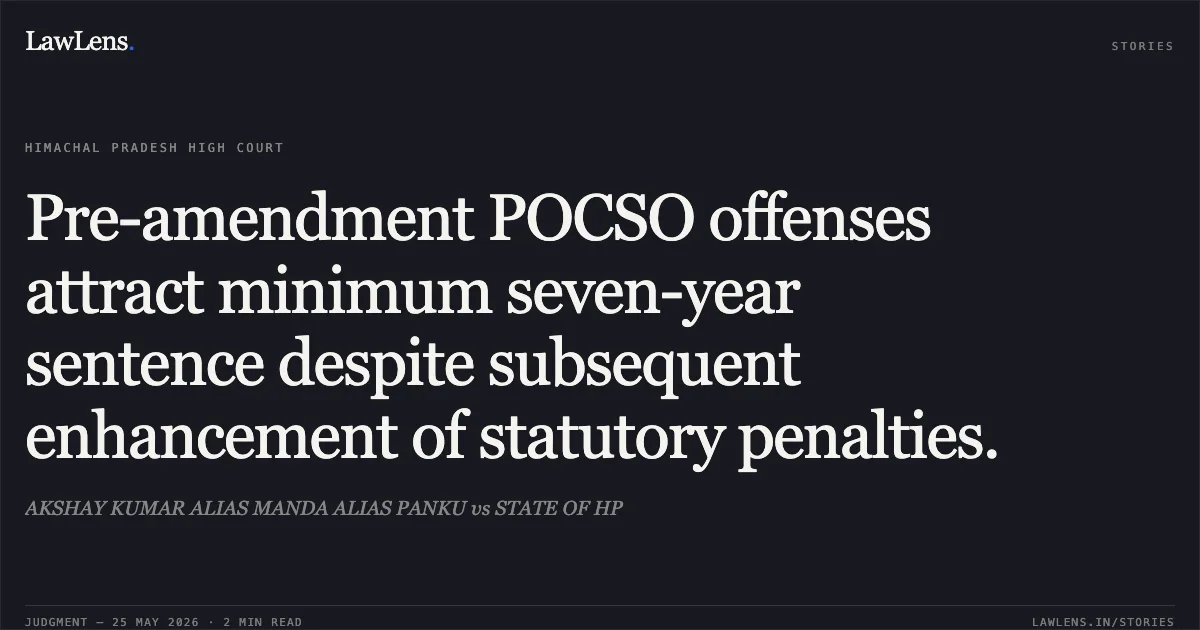
Source reference: para 1, 4On appeal, the appellant did not contest the conviction on merits but limited his challenge to the quantum of sentence, arguing that since the offence took place in 2015, the pre-amendment minimum sentence of 7 years should apply.
Source reference: para 2, 4Issues
1. Whether the 2019 Amendment to the POCSO Act, which increased the minimum sentence under Section 4 from 7 years to 10 years, can be applied retrospectively to an offence committed in 2015.
Source reference: para 4-52. Whether the appellant’s sentence should be reduced to the minimum prescribed period based on the mitigating circumstances of the case.
Source reference: para 5, 11Law Applied
The court primarily applied Section 4 of the POCSO Act as it stood prior to the 2019 Amendment, noting that the minimum sentence then was 7 years rather than the current 10 years.
Source reference: para 4-5It relied on the principle of restorative justice as discussed in Mohd. Firoz v. State of Madhya Pradesh (2022), emphasizing that the goal of sentencing is to allow for the possibility of reformation.
Source reference: para 6Furthermore, it applied the principles of proportionality and deterrence as established in Alister Anthony Pareira v. State of Maharashtra (2012) and Dev Narayan Mandal v. State of U.P. (2004), which dictate that sentencing must consider the age of the accused, the gravity of the crime, and the specific circumstances of the case.
Source reference: para 7-8Reasoning
The Court observed that the offence was committed in 2015, whereas the amendment raising the minimum sentence to 10 years only took effect on 16.8.2019; thus, the 7-year minimum was the relevant legal benchmark.
Source reference: para 5In evaluating the proportionality of the sentence, the Court noted that the appellant was 18 and the victim was 17 at the time of the incident, suggesting an adolescent context where a romantic relationship could not be ruled out, despite the legal immateriality of consent.
Source reference: para 9-10The Court further noted the appellant had already served over 7 years and 6 months of his sentence and maintained a clean record while in custody.
Source reference: para 4-5Balancing the need for retribution with restorative justice, the Court determined that reducing the sentence to the statutory minimum of 7 years was sufficient to meet the ends of justice and allow for the appellant's reformation.
Source reference: para 11-12Holding
The Court upheld the conviction but modified the sentence. It held that the 10-year sentence was excessive as the pre-amendment law (7-year minimum) applied to the 2015 offence.
The sentence under Section 4 POCSO Act was reduced to 7 years of rigorous imprisonment. Since the appellant had already completed more than 7.5 years in custody, the Court directed that the excess period served be set off against the default imprisonment for the ₹20,000 fine and ordered his immediate release if not required in any other case.
Source reference: para 12-13Acts & Sections Cited
5 provisions across 3 statutes referred to in this judgment. Each provision opens on LawLens.
Scheduled Castes and the Scheduled Tribes (Prevention of Atrocities) Act, 19891
Indian Penal Code, 18602
Original Court PDF
AKSHAY KUMAR ALIAS MANDA ALIAS PANKUvsSTATE OF HP
Click to open original judgment
Original judgment, available to read, download and summarize on LawLens.in