01Facts
The petitioner managed M/s Debasree Cinema, a sole-proprietorship cinema business established by his father in 1991.
¶ 2During an EPFO inspection on 2 June 2010, it was alleged that the petitioner had deducted ₹20,128 from employees’ wages towards provident-fund contributions for January–April 2010 but had not remitted the amount within the statutory period prescribed by Paragraph 38 of the Employees’ Provident Fund Scheme, 1952.
¶ 3A case was registered under Sections 406 and 409 of the IPC.
¶ 4The petitioner deposited the entire amount in June 2010, before submission of Chargesheet No. 444 dated 27 July 2010.
¶ 4Nevertheless, the chargesheet was filed and cognizance was taken on 10 August 2010.
¶ 4The petitioner invoked Sections 401 and 482 CrPC seeking quashing of the criminal proceedings.
¶ 1The cinema subsequently closed and surrendered its licence in November 2014, after the petitioner had allegedly cleared all employee and statutory dues.
¶ 2, 1702Issues
i.Whether the pre-chargesheet payment of the entire deducted provident-fund contribution eliminated the essential ingredients of criminal breach of trust and justified quashing of the proceedings under Sections 406 and 409 IPC.
¶ 11(i)ii.Whether the provident-fund default constituted a public wrong of such gravity that subsequent restitution could not justify the exercise of inherent powers under Section 482 CrPC.
¶ 11(ii)03Law Applied
The Court considered Sections 401 and 482 CrPC, which empower the High Court to exercise revisional and inherent jurisdiction to prevent abuse of process and secure the ends of justice.
¶ 1, 18Sections 405 and 406 IPC require entrustment, dishonest misappropriation or conversion, and the requisite culpable mental state for criminal breach of trust; Section 409 IPC applies where the alleged breach is by a person in a position covered by that provision.
Explanation 1 to Section 405 IPC creates a statutory fiction deeming an employer to have been entrusted with employees’ provident-fund deductions and to have dishonestly used the amount when it is not remitted as required by law.
¶ 9Paragraph 38 of the Employees’ Provident Fund Scheme, 1952, read with Section 6 of the EPF Act, prescribes the obligation to remit provident-fund contributions.
¶ 3Relying principally on N. Sridhar v. State of Telangana and Prakash Gupta v. Securities and Exchange Board of India, the Court held that mere temporary non-payment, absent material indicating fraudulent conversion or dishonest personal use, may not sustain criminal proceedings where the statutory liability has been fully remedied.
¶ 6, 13It also considered PUDR v. Union of India, Ajay Jalan v. State of West Bengal, Kartick Chandra Das v. State of West Bengal, Air Transport Corporation v. State of West Bengal, Atelier Fashion Flash Pvt. Ltd. v. Provident Fund Inspector, Adoni Cotton Mills Ltd. v. Regional Provident Fund Commissioner, and contrary authorities concerning the effect of subsequent restitution.
¶ 7–10, 14Provisions in the judgment · 5 · Linked ones open on LawLens
Code of Criminal Procedure, 1973 Section 401Section 482
Indian Penal Code, 1860 Section 405Section 406Section 409
04Reasoning
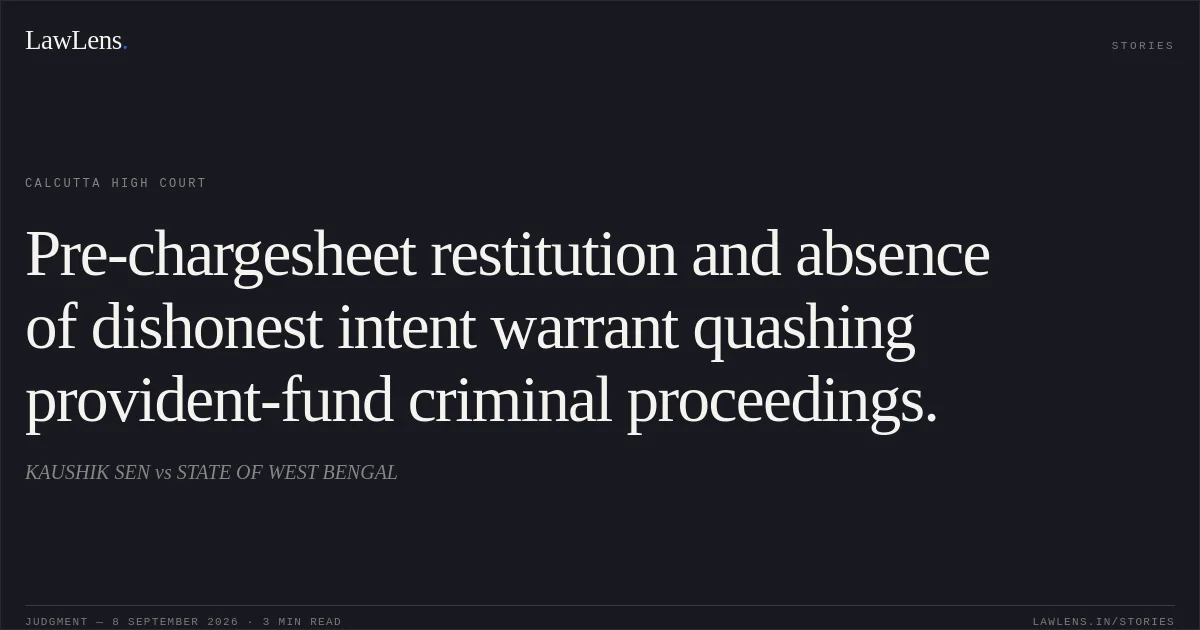
Although Explanation 1 to Section 405 IPC supplied the statutory basis for entrustment and deemed dishonest use upon delayed remittance, the Court held that the petitioner’s complete payment of ₹20,128 in June 2010—before filing of the chargesheet—together with the absence of evidence of personal conversion or continuing misappropriation, substantially undermined the prosecution’s case on mens rea.
¶ 12–15The Court distinguished cases involving persistent, fraudulent, or recalcitrant defaults and treated the present default as a short-lived consequence of the cinema’s financial distress.
¶ 16–17It further held that, since the establishment had subsequently closed and the statutory dues had been restored before trial, continuation of the prosecution would serve no meaningful deterrent or remedial purpose and would amount to an abuse of process.
¶ 18–20The Court therefore preferred to exercise its inherent jurisdiction despite the public-welfare character of provident-fund legislation.
¶ 1905Holding
The Court answered both issues in favour of the petitioner.
It held that the complete pre-chargesheet liquidation of the provident-fund amount, coupled with the absence of material showing active or dishonest misappropriation, deprived the prosecution of a sustainable criminal foundation.
¶ 15The revisional application was allowed, and the entire proceeding in G.R. Case No. 2329 of 2010 arising from Titagarh Police Station Case No. 240 dated 2 June 2010, including Chargesheet No. 444 dated 27 July 2010 and the order taking cognizance dated 10 August 2010, was quashed.
¶ 21–22Earlier interim orders were vacated, with no order as to costs.
¶ 23–24Original Court PDF
KAUSHIK SENvsSTATE OF WEST BENGAL
Click to open original judgment
Original judgment, available to read, download and summarize on LawLens.in