Facts
The appellants—Randhir, his wife Sonia, and their son Sagar—were accused of assaulting Naresh during an agricultural land dispute on 3 September 2023. The prosecution alleged use of lathi-danda and a sharp-edged weapon, caste-based abuse, criminal intimidation, and house-trespass. Naresh’s injury report recorded five head injuries, but only one was initially attributed to a sharp weapon; the remaining injuries were attributed to a blunt weapon. The Investigating Officer filed a charge-sheet under Sections 323, 324, 452, 504 and 506 IPC and the applicable provisions of the Scheduled Castes and Scheduled Tribes (Prevention of Atrocities) Act, 1989.
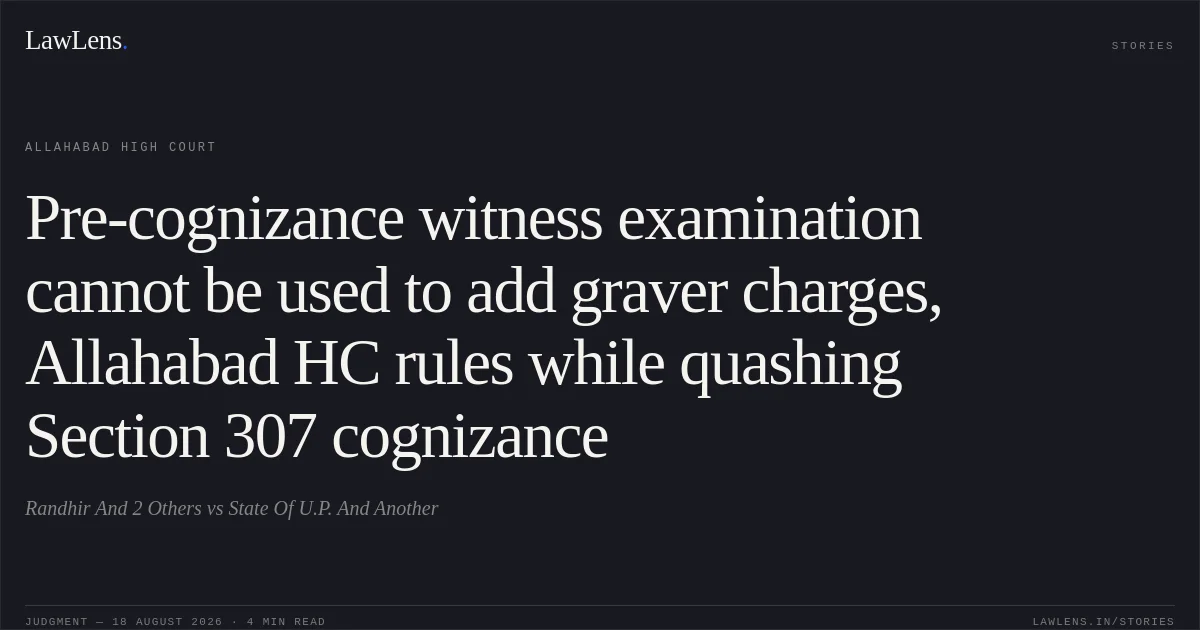
Source reference: para. 4Before taking cognizance, the Special Public Prosecutor filed an application seeking addition of Section 307 IPC. The trial court summoned and examined Dr. Sachin Bansal, the doctor who prepared the injury report. The doctor stated that all five injuries had in fact been caused by a sharp-edged weapon and were potentially fatal. Relying on this fresh statement, the trial court added Section 307 IPC, took cognizance of all the offences, made adverse observations against the doctor, and directed the Chief Medical Officer to initiate departmental proceedings against him.
Source reference: paras. 6–8Issues
1. Whether the trial court, before taking cognizance, could itself examine a prosecution witness and rely on that fresh statement to add Section 307 IPC, instead of confining itself to the material submitted by the Investigating Officer under Section 173(2) Cr.P.C.?
Source reference: para. 9(i); pp. 6–122. Whether the addition of Section 307 IPC and the taking of cognizance of the offences under the IPC and the SC/ST Act were legally sustainable?
Source reference: para. 9(ii); pp. 11–153. Whether the trial court had jurisdiction to direct departmental proceedings against Dr. Sachin Bansal, a prosecution witness who was not a party to the proceedings, without giving him an opportunity of hearing?
Source reference: para. 9(iii); pp. 13–16Law Applied
On receipt of a police report under Section 173(2) Cr.P.C., the court may take cognizance under Section 190(1)(b) on the facts and material collected during investigation, disagree with the Investigating Officer’s conclusion, or direct further investigation under Section 173(8); it cannot, at the pre-cognizance stage, itself examine witnesses to supplement the prosecution material.
Source reference: para. 10The Court relied on India Carat (P) Ltd. v. State of Karnataka, (1989) 2 SCC 132, H.S. Bains v. State, (1980) 4 SCC 631, and S.K. Sinha, Chief Enforcement Officer v. Videocon International Ltd., (2008) 2 SCC 492, concerning judicial application of mind to material already on record.
Source reference: paras. 10–11A defect in procedure does not automatically invalidate proceedings under Section 465 Cr.P.C.; however, interference is warranted where the defect causes failure of justice or materially contaminates the decision.
Source reference: para. 14Although the court may take cognizance of an offence different from or graver than that mentioned in the charge-sheet, that power must be exercised on lawfully collected material and a prima facie assessment; Dharam Pal v. State of Haryana, (2014) 3 SCC 306, was relied upon.
Source reference: para. 13Further, invocation of Sections 3(1)(r), 3(1)(s), 3(2)(v) and 3(2)(va) of the SC/ST Act requires satisfaction of their specific statutory ingredients, including caste-based conduct and, for Sections 3(1)(r) and 3(1)(s), occurrence within “public view”.
Source reference: para. 16A person cannot be subjected to adverse findings or civil consequences without notice and an opportunity of hearing.
Source reference: para. 15Reasoning
The trial court’s examination of Dr. Bansal before cognizance was not authorised by the Cr.P.C. At that stage, the court’s function was to assess the charge-sheet, case diary, injury report, and statements recorded during investigation—not to generate additional evidence. The doctor’s fresh statement was expressly relied upon by the prosecution to seek addition of Section 307 IPC and by the trial court to support that addition.
Source reference: paras. 6, 12, 14Although the court could have added Section 307 IPC if that offence was disclosed by the lawful investigative material, the impugned order did not demonstrate any independent consideration of that material apart from the doctor’s impermissibly recorded statement. Since the order was composite and its basis could not be severed, the procedural illegality vitiated the entire cognizance order.
Source reference: para. 14The trial court also failed to record independent satisfaction regarding the prima facie ingredients of the invoked SC/ST Act provisions, particularly the caste-based nature of the alleged offences and the requirement of “public view” for Sections 3(1)(r) and 3(1)(s).
Source reference: para. 16Separately, the direction for departmental proceedings against Dr. Bansal exceeded the trial court’s jurisdiction. He was a non-party witness, was not given notice or an opportunity to explain the alleged error, and the direction imposed potential civil and disciplinary consequences.
Source reference: para. 15Holding
The High Court treated the proceeding, notwithstanding its description as an appeal, as one invoking its inherent jurisdiction under Section 482 Cr.P.C., now corresponding to Section 528 of the Bharatiya Nagarik Suraksha Sanhita, because the challenge concerned the trial court’s jurisdictional excess.
The appeal was allowed, and the trial court’s order dated 4 June 2025 was set aside in its entirety, including the addition of Section 307 IPC, the order taking cognizance, and the direction for departmental proceedings against Dr. Bansal.
Source reference: para. 20(i)The matter was remitted for fresh consideration of cognizance solely on the charge-sheet, case diary, and other material lawfully collected by the Investigating Officer; the statement recorded from Dr. Bansal before the trial court was expressly excluded.
Source reference: para. 20(ii)Any departmental inquiry initiated pursuant to the impugned order was directed to be dropped.
Source reference: para. 21The trial court was directed to pass a fresh order within four weeks after providing the parties an opportunity of hearing.
Source reference: para. 24Acts & Sections Cited
20 provisions across 4 statutes referred to in this judgment. Each provision opens on LawLens.
Indian Penal Code, 18608
Scheduled Castes and the Scheduled Tribes (Prevention of Atrocities) Act, 19891
Code of Criminal Procedure, 1973
Bharatiya Nagarik Suraksha Sanhita, 20231
Original Court PDF
Randhir And 2 OthersvsState Of U.P. And Another
Click to open original judgment
Original judgment, available to read, download and summarize on LawLens.in