Facts
The Appellant challenged the order dated 21 November 2024 by which the Assistant Controller refused Patent Application No. IN201611009993, filed on 22 March 2016, concerning an improved process for preparing sugammadex using an isolated salt of 3-mercaptopropionic acid, preferably its disodium salt.
Source reference: paras. 1–5; pp. 1–5A pre-grant opposition was filed by Respondent No. 2 under Section 25(1) of the Patents Act, 1970, raising objections including lack of novelty, lack of inventive step and non-patentability under Section 3(d).
Source reference: paras. 6–7; pp. 5–6The Appellant participated in hearings and filed written submissions, but contended that no separate hearing was granted under Section 14 before refusal of the application.
Source reference: paras. 8–13; pp. 6–9The Controller rejected the application principally on the basis of prior art documents D1, D3, D4 and D7, holding that the claimed process lacked novelty and inventive step and was barred under Section 3(d).
Source reference: paras. 7, 52; pp. 5–6, 35The Appellant also alleged that the impugned order failed to consider the distinction between an isolated salt and an in-situ-generated salt, the asserted improvements in purity and reaction time, and the experimental data submitted by it.
Source reference: paras. 14–23; pp. 9–17Issues
1. Whether a hearing granted during pre-grant opposition proceedings under Section 25(1) dispenses with the separate hearing mandated under Section 14 and Rule 129 before refusal of a patent application?
Source reference: paras. 42–51; pp. 28–352. Whether the Controller’s order was vitiated by failure to pass a reasoned and speaking order addressing the Appellant’s submissions on novelty, inventive step and Section 3(d)?
Source reference: paras. 52–57; pp. 35–383. Whether the claimed process lacked novelty or inventive step in view of D1, D3, D4 and D7, or was non-patentable under Section 3(d)?
Source reference: paras. 52–58; pp. 35–38Law Applied
Sections 12–15 of the Patents Act, 1970 establish an examination process under which the Examiner’s objections must be communicated to the applicant and the Controller must provide an opportunity of hearing before refusing the application.
Source reference: paras. 42–43; pp. 28–29Section 25(1) creates a separate pre-grant opposition process initiated by “any person” on specified statutory grounds; it does not merge with or replace the examination process under Chapter IV.
Source reference: paras. 44–47; pp. 29–32Rule 129 of the Patents Rules, 2003 requires the Controller to give the applicant an opportunity of hearing, ordinarily upon 10 days’ notice, before exercising discretionary power likely to affect the applicant adversely.
Source reference: paras. 8, 50–51; pp. 6–7, 33–35In Novartis AG v. Natco Pharma Ltd., the Division Bench held that examination under Chapter IV and opposition under Chapter V are independent proceedings and that a Section 25(1) hearing cannot substitute a Section 14 hearing.
Source reference: paras. 45–47; pp. 30–32Ferid Allani v. Union of India affirmed that Rule 129 casts a statutory duty on the Controller to hear the applicant before adversely exercising discretionary power.
Source reference: para. 51; pp. 33–34The Court also relied on AIC246 AG & Co. KG v. The Patent Office of India and UPL Ltd. v. Union of India for the proposition that the Controller must comply separately with Sections 14 and 15 and pass a reasoned order.
Source reference: paras. 48–49; pp. 32–33On the substantive patentability issues, the Court noted the requirements of clear and unambiguous disclosure for anticipation, avoidance of hindsight in inventive-step analysis, and the relevance of technical effects such as purity, yield and scalability.
Source reference: paras. 54–57; pp. 36–38Reasoning
The Court held that the hearings conducted under Section 25(1), although multiple in number, could not satisfy the distinct statutory requirement under Section 14.
Source reference: paras. 45–51; pp. 30–35The examination process requires the Controller independently to consider the FER and determine whether the application complies with the Patents Act and Rules; the opponent’s participation in pre-grant opposition does not eliminate the applicant’s separate right to be heard before refusal.
Source reference: paras. 45–51; pp. 30–35Since the application was refused on grounds arising substantially from the opposition without a Section 14 hearing, the omission deprived the Appellant of the opportunity to address the objections and, if necessary, propose amendments, thereby going to the root of the decision.
Source reference: para. 51; p. 34The Court further found that the Controller had not adequately addressed whether D1 expressly or implicitly disclosed the use of an isolated salt, whether the alleged technical distinction produced improved purity or reduced reaction time, which document constituted the closest prior art, or why the combination of D1, D3, D4 and D7 would have been obvious without hindsight.
Source reference: paras. 52–57; pp. 35–38The Court specifically noted that the Appellant’s experimental data and assertions regarding reduced impurities, improved purity, reaction reproducibility and scalability had not been meaningfully considered.
Source reference: paras. 53–56; pp. 35–37However, because the matter was being remanded for breach of the mandatory hearing requirement, the Court expressly refrained from determining the merits of novelty, inventive step or Section 3(d).
Source reference: para. 58; p. 38Holding
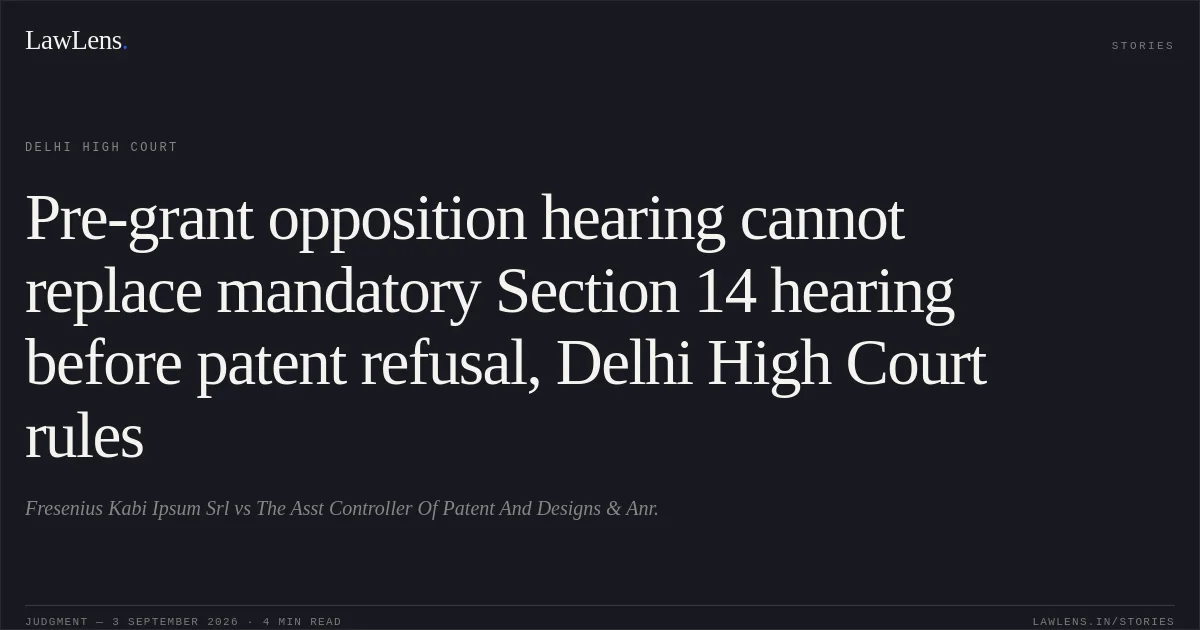
The Court answered the principal procedural issue in favour of the Appellant: a hearing under Section 25(1) does not substitute for the separate hearing required under Section 14 and Rule 129.
The order dated 21 November 2024 was set aside as procedurally unsustainable and the patent application was remanded to the Assistant Controller for fresh consideration.
Source reference: para. 59; p. 38The Controller was directed to decide the application within six months, in accordance with Sections 14, 15 and 25 of the Patents Act and Rule 129 of the Patents Rules, after granting an opportunity of hearing to both the Appellant and Respondent No. 2, without being influenced by the impugned order.
Source reference: para. 59; pp. 38–39The Court expressed no final opinion on the merits of novelty, inventive step or Section 3(d), and disposed of the appeal accordingly.
Source reference: paras. 58–60; pp. 38–39Acts & Sections Cited
7 provisions across 1 statute referred to in this judgment. Each provision opens on LawLens.
Patents Act, 19707
Original Court PDF
Fresenius Kabi Ipsum SrlvsThe Asst Controller Of Patent And Designs & Anr.
Click to open original judgment
Original judgment, available to read, download and summarize on LawLens.in