Facts
The respondent/plaintiff filed a civil suit (RCSA No. 8/2025) for a permanent injunction against the petitioners regarding land in Survey No. 1050/2
Source reference: para. 2The petitioners filed a written statement asserting that their construction was on Survey Nos. 1050/3/1 and 1050/3/2, disclaiming interest in the plaintiff's land
Source reference: para. 2Subsequently, the plaintiff moved an application under Order 6 Rule 17 of the CPC to amend the plaint to include reliefs for declaration and restoration of possession
Source reference: para. 2Although issues had been framed, the trial (recording of evidence) had not yet commenced
Source reference: para. 4The Second Civil Judge, Junior Division, Jaura, allowed the amendment on 13.07.2026, which the petitioners challenged under Article 227 of the Constitution
Source reference: paras. 1–2Issues
1. Whether the trial court committed a jurisdictional error by allowing an amendment to the plaint after the framing of issues but before the recording of evidence
Source reference: paras. 4–52. Whether the proposed amendment regarding the relief of possession and declaration changed the nature of the suit or prejudiced the rights of the defendants
Source reference: paras. 2 & 5Law Applied
Order 6 Rule 17 of the Code of Civil Procedure (CPC), which mandates that all amendments necessary for determining the real question in controversy shall be allowed, provided they do not cause injustice
Source reference: para. 4LIC v. Sanjeev Builders (P) Ltd. (2022) 16 SCC 1, which established that courts should be liberal in allowing amendments before the commencement of trial to avoid multiplicity of proceedings, even if the amendment introduces a new relief, provided it is predicated on existing facts and does not set up a completely "foreign" case
Source reference: para. 4, specifically sub-paras 71.2, 71.10, and 71.11Reasoning
The High Court observed that while issues were framed, the trial had not "commenced" in the technical sense as the recording of evidence had not started
Source reference: para. 4Applying the Sanjeev Builders guidelines, the court reasoned that the amendment was necessary to effectively adjudicate the dispute regarding the alleged encroachment on Survey No. 1050/2 and to prevent future litigation
Source reference: paras. 4–5The court found that the petitioners’ rights were not prejudiced because they retained the opportunity to file an amended written statement to counter the new claims
Source reference: para. 5The court concluded that the trial court’s decision was aimed at pinpointing the actual controversy rather than allowing a "hypertechnical approach" to block the amendment
Source reference: paras. 4–5Holding
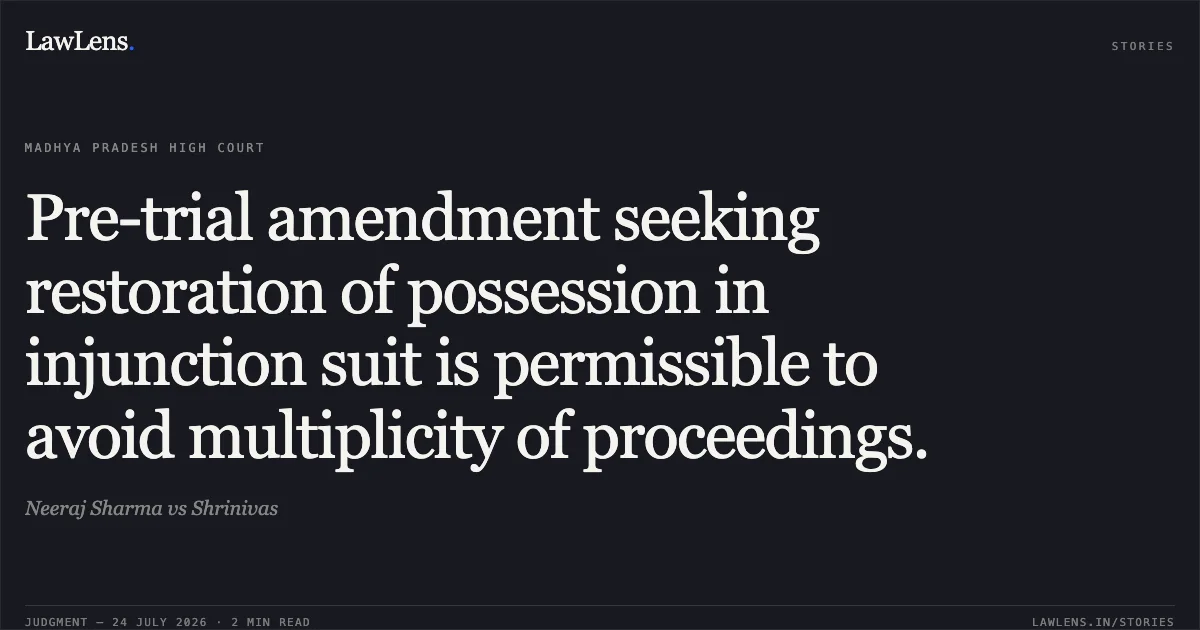
The High Court dismissed the petition, holding that the trial court's order did not suffer from palpable illegality or jurisdictional error
The court affirmed that the amendment was permissible as it avoided multiplicity of litigation and did not fundamentally alter the nature of the suit in a way that irreperably prejudiced the defendants
Source reference: paras. 5–6All pending applications were closed
Source reference: para. 7Acts & Sections Cited
1 provisions across 1 statute referred to in this judgment. Each provision opens on LawLens.
Code of Civil Procedure, 19081
Original Court PDF
Neeraj SharmavsShrinivas
Click to open original judgment
Original judgment, available to read, download and summarize on LawLens.in


