Facts
The petitioner, an Assistant Sub-Inspector serving under the Kamrup District Executive Force, was proceeded against departmentally following registration of ACB Police Station Case No. 84/2023 under Section 7(a) of the Prevention of Corruption Act, 1988.
Source reference: p.2–3, paras. 3–4It was alleged that, while investigating a criminal case, he demanded ₹6,000 from the wife of an accused for producing the case diary in bail proceedings and instructed another person to accept ₹3,000 as part-payment.
Source reference: p.2–3, paras. 3–4A departmental proceeding was initiated, with the statement of allegations, witness list and documents supplied to the petitioner, and an Enquiry Officer and Presenting Officer were appointed.
Source reference: p.3, para. 5The Enquiry Officer found the charges proved on the standard of preponderance of probabilities.
Source reference: p.3–4, para. 6In the second and final show-cause notice dated 12 April 2024, the Disciplinary Authority stated that it agreed with the finding that the charges were proved and that the case was fit for major punishment, while inviting the petitioner’s explanation.
Source reference: p.4, para. 6; p.10, para. 24The petitioner’s explanation was rejected and he was dismissed from service on 31 July 2024. His statutory appeal was rejected on 7 December 2024.
Source reference: p.4, paras. 7–8Issues
1. Whether the second show-cause notice violated the principles of natural justice by recording a final conclusion that the charges were proved and that major punishment was warranted before considering the petitioner’s representation.
Source reference: p.9–12, paras. 23–282. Whether the dismissal order and the appellate order were liable to be quashed on account of the defective decision-making process, notwithstanding the limited scope of judicial review over departmental findings.
Source reference: p.12–14, paras. 29–323. Whether the matter should be remanded for fresh consideration from the stage of consideration of the enquiry report.
Source reference: p.14–15, paras. 32–34Law Applied
The Court applied the principles of natural justice, particularly the requirement that a delinquent employee must receive a meaningful and effective opportunity to represent against an enquiry report before the Disciplinary Authority reaches a final conclusion on guilt or punishment.
Source reference: p.11–12, paras. 25–26The Disciplinary Authority may consider the Enquiry Officer’s findings, but must do so with an open and unbiased mind and independently decide the matter after considering the employee’s representation.
Source reference: p.11–12, paras. 25–26The Court relied on Babulal Das v. State of Assam & Ors., 2004 (2) GLT 259, and Kandarpa Kumar Kalita v. UCO Bank & Ors., which emphasize that prior determination of guilt vitiates the disciplinary process.
Source reference: p.5, para. 12; p.12, para. 28It also recognized that departmental charges are assessed on the standard of preponderance of probabilities, as stated in Deputy Inspector General of Police v. S. Samuthiram, (2013) 1 SCC 598.
Source reference: p.8–9, paras. 18, 21Although judicial review does not ordinarily permit re-appreciation of evidence or substitution of the Court’s conclusions for those of departmental authorities, as explained in Union of India v. H.C. Goel, AIR 1964 SC 364, and State of Karnataka v. N. Gangaraj, (2020) 3 SCC 423, the Court may review procedural fairness and violations of natural justice.
Source reference: p.8–9, para. 20; p.12–13, paras. 29–30The disciplinary authority’s power to impose major punishment was stated to arise under Rule 66 of the Assam Police Manual, Part III.
Source reference: p.7, para. 17Reasoning
The Court examined the language of the second show-cause notice, particularly the statements: “I agree with the opinion of the Enquiry Officer that the Charges framed against you have been proved” and “I therefore, found it a fit case for awarding major punishment”.
Source reference: p.10, para. 24It held that these were not tentative or prima facie observations but disclosed a concluded determination both on guilt and on the appropriate category of punishment before the petitioner’s explanation was considered.
Source reference: p.11, paras. 25–26The purpose of the representation was to enable the petitioner to challenge the findings, identify evidentiary or procedural infirmities, and persuade the Disciplinary Authority to take a different view.
Source reference: p.11–12, paras. 26–28Since the authority had already formed its opinion, the subsequent opportunity was reduced to an empty formality and was therefore ineffective.
Source reference: p.11–12, paras. 26–28The Court clarified that it was not re-assessing the evidence or questioning the standard of proof; the defect lay in the decision-making process itself.
Source reference: p.12–13, paras. 29–31The limited scope of review over departmental findings did not bar intervention where natural justice had been violated.
Source reference: p.12–13, paras. 29–31The Appellate Authority also failed to address this specific procedural defect.
Source reference: p.14, para. 31Holding
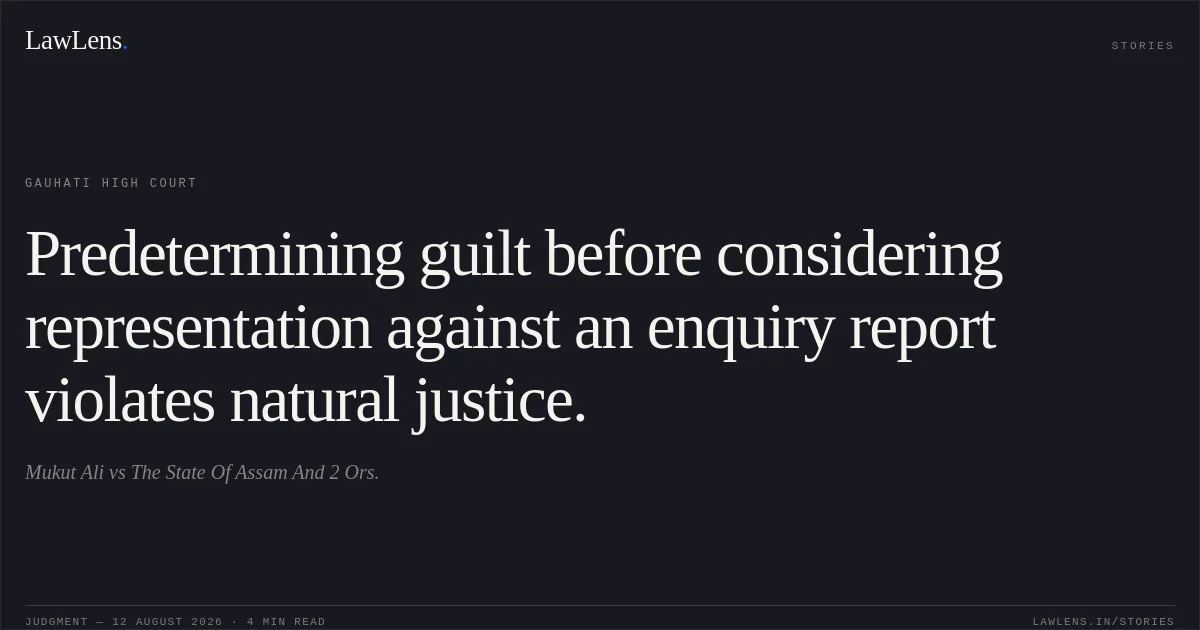
The High Court held that the second show-cause notice demonstrated pre-determination of guilt and punishment, thereby violating the petitioner’s right to an effective opportunity of hearing.
The dismissal order dated 31 July 2024 and the appellate order dated 7 December 2024 were consequently quashed.
Source reference: p.14, para. 32The petitioner was directed to be reinstated, subject to the final outcome of fresh departmental proceedings.
Source reference: p.14–15, paras. 33–34The matter was remanded to the Disciplinary Authority to recommence from the stage of consideration of the enquiry report, provide an effective opportunity for representation, and take an independent decision uninfluenced by the earlier notice, dismissal order or appellate order.
Source reference: p.14–15, paras. 33–34The Court expressed no opinion on the merits of the charges, directed completion of the exercise preferably within three months, and awarded consequential benefits subject to the final disciplinary decision.
Source reference: p.15, paras. 34–35The writ petition was allowed without costs.
Source reference: p.15, paras. 34–35Acts & Sections Cited
2 provisions across 2 statutes referred to in this judgment. Each provision opens on LawLens.
Prevention of Corruption Act, 19881
Indian Penal Code, 18601
Original Court PDF
Mukut AlivsThe State Of Assam And 2 Ors.
Click to open original judgment
Original judgment, available to read, download and summarize on LawLens.in