Facts
The applicants were appointed on a contract basis as an Assistant Administrative Officer (2012) and a Data Entry Operator (2017) at the National Collaborative Centre for Facility-Based Newborn Care (NCC-FBNC) at Kalawati Saran Children’s Hospital.
Source reference: p. 3-4Despite their initial short-term engagements, they continued in service for approximately 13 and 8 years respectively.
Source reference: p. 8In March 2025, the respondents issued termination notices following a decision to close the NCC-FBNC project, citing the withdrawal of funding by UNICEF.
Source reference: p. 4-7The applicants challenged the termination and sought regularization, arguing that the work was perennial and the project’s closure was an arbitrary departmental decision rather than a Ministry directive.
Source reference: p. 5-7Issues
1. Whether the termination of contractual employees due to the closure of a project funded by external agencies (UNICEF) constitutes arbitrary action warranting judicial interference.
Source reference: p. 7-82. Whether long-term contractual service in a project-based role entitles the employees to regularization or preferential treatment in future engagements.
Source reference: p. 8, 14Law Applied
The Tribunal considered the principles of equity and reasonableness in public employment.
Source reference: no citationThe State cannot use "temporary" labels or "financial constraints" as a shield to justify decades of exploitative ad-hocism when the work is of a perennial nature as held in Dharam Singh Ors. v. State of UP and Anr. (2025).
Source reference: p. 8-13The court referenced Secretary, State of Karnataka v. Umadevi, distinguishing between illegal and irregular appointments.
Source reference: p. 10-12Recent precedents like Jaggo v. Union of India caution against the misuse of temporary contracts to evade long-term employer obligations.
Source reference: p. 10-12Reasoning
The Tribunal examined whether the project's closure was genuine or a pretext for termination, noting the applicants relied on Dharam Singh to argue that 13 years of uninterrupted service suggested the work was perennial.
Source reference: p. 8The respondents contended that the applicants were "backdoor entries" via walk-in interviews for non-sanctioned, project-specific posts that had now ceased due to lack of UNICEF funding.
Source reference: p. 13-14The Tribunal noted that while it could not bypass constitutional schemes for permanent absorption, the long service rendered by the applicants created an equitable claim for preference.
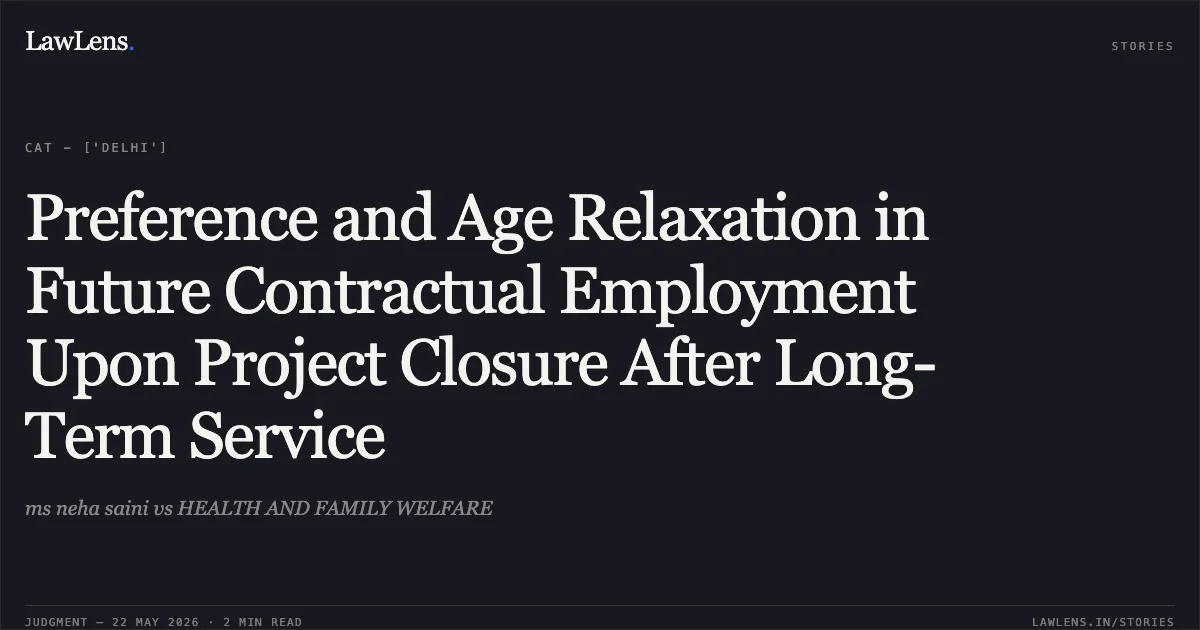
Source reference: p. 14-15During proceedings, a consensus was reached: the project's closure remained effective, but the applicants’ tenure entitled them to protections against recovery of past wages and a right of first refusal for future roles.
Source reference: p. 14-15Holding
The Tribunal declined to quash the termination or order regularization, holding that no interference was warranted in the decision to close the project.
The Tribunal directed that applicants must be given "first preference" for any future contractual employment if the centre is revived.
Source reference: p. 15Applicants shall receive age relaxation equivalent to their years of contractual service for such future roles.
Source reference: p. 15All outstanding salary for the period served must be released within six weeks.
Source reference: p. 15No order was made for costs.
Source reference: p. 16Acts & Sections Cited
1 provisions across 1 statute referred to in this judgment. Each provision opens on LawLens.
Administrative Tribunals Act, 19851
Original Court PDF
ms neha sainivsHEALTH AND FAMILY WELFARE
Click to open original judgment
Original judgment, available to read, download and summarize on LawLens.in