Facts
The petitioner, a Sri Lankan national, entered India on an e-Tourist Visa valid from 14 May to 13 June 2026.
Source reference: p. 1She said that she and J. Arun Kumar, an Indian citizen, had undergone a marriage ceremony on 4 June 2026 and sought a direction requiring the Sub-Registrar to process registration under the Special Marriage Act, 1954, without insisting on a valid visa or police clearance; she also sought consideration of her visa-extension or regularisation application
Source reference: pp. 1–2, 5The State disputed that the ceremony qualified for registration and noted that the petitioner had described it as a Christian marriage, without records showing conversion to Christianity.
Source reference: p. 5At the previous listing, the Court directed a government medical officer to examine the petitioner and the FRRO to keep deportation proposals in abeyance; the medical report confirmed her pregnancy, with an expected delivery date of 2 March 2027.
Source reference: pp. 6–7Issues
1. Whether the ceremony performed by the petitioner and Arun Kumar could be treated as a marriage eligible for registration under Sections 15 and 16 of the Special Marriage Act, 1954, so as to warrant a direction to the Sub-Registrar
Source reference: pp. 3–5, 72. Whether the petitioner should be protected from deportation and permitted to remain in India while the parties regularised their relationship through a valid marriage
Source reference: pp. 5–8Law Applied
Section 15 of the Special Marriage Act, 1954 permits registration of a marriage celebrated in another form only where the statutory conditions are met, including that a marriage ceremony was performed and the parties thereafter lived together as spouses; Section 16 prescribes notice, a 30-day period for objections, and entry of the marriage certificate if the Section 15 conditions are satisfied.
Source reference: pp. 4–5The Court identified the Hindu Marriage Act, 1955, the Indian Christian Marriage Act, 1872, and the Special Marriage Act, 1954 as possible statutory forms through which the parties could solemnise a valid marriage.
Source reference: p. 7Reasoning
The Court held that the ceremony on 4 June 2026 did not, strictly speaking, correspond to a recognised form of marriage ceremony and therefore did not establish the basis for the requested registration under Section 15.
Source reference: p. 7It also noted that the petitioner had overstayed her Tourist Visa, while the confirmed pregnancy and her circumstances made immediate disruption of the relationship inappropriate.
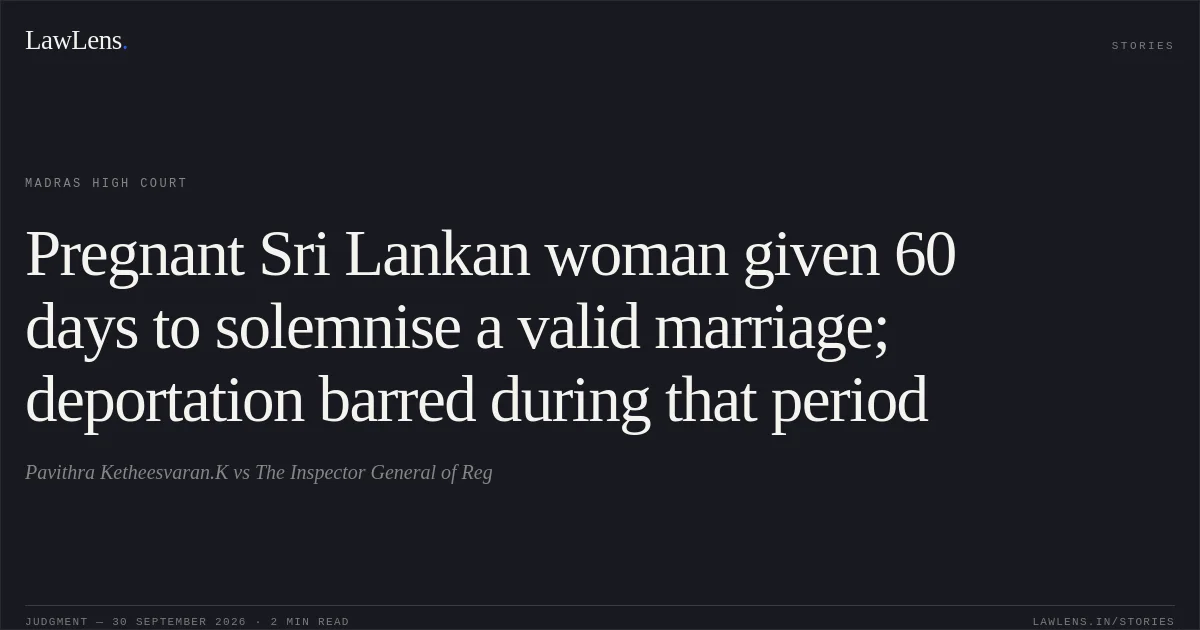
Source reference: pp. 5–7Rather than direct registration or decide the visa application, the Court gave the parties 60 days to solemnise a valid marriage under an applicable statute and directed that the petitioner not be deported during that period.
Source reference: pp. 7–8Holding
The Court disposed of the writ petition without directing the Sub-Registrar to register the existing ceremony or directing the FRRO to grant or consider the petitioner’s visa application.
It allowed the parties 60 days from the order to solemnise a valid statutory marriage; the petitioner was not to be deported during that period and, if the marriage was solemnised and registered within it, she could continue to remain in India subject to applicable law.
Source reference: pp. 7–8The Medical Officer was directed to provide necessary medical assistance as required; there was no order as to costs, and the connected miscellaneous petitions were closed.
Source reference: p. 8Acts & Sections Cited
3 provisions across 1 statute referred to in this judgment. Each provision opens on LawLens.
Special Marriage Act, 19543
Original Court PDF
Pavithra Ketheesvaran.KvsThe Inspector General of Reg
Click to open original judgment
Original judgment, available to read, download and summarize on LawLens.in