Facts
The petitioner was convicted under Sections 302 and 201 read with Section 34 of the Indian Penal Code, 1860, and was undergoing life imprisonment pursuant to the judgment dated 31 January 2011 in S.T. No. 370/2010. His conviction was affirmed in appeal by the High Court and thereafter by the Supreme Court. He had remained in custody since 22 July 2010, had undergone approximately sixteen years and one month of imprisonment, and had earned regular remissions for satisfactory jail conduct
Source reference: para. 2The Jail Superintendent recommended his case for premature release under the prescribed Proforma ‘A’, and the trial Court expressed no objection to remission. However, the competent authorities rejected the claim by order dated 10 April 2026, relying principally on the seriousness of the offence, objections from local persons, and reports of the police authorities, Senior Superintendent of Police and Collector
Source reference: paras. 2–4The petitioner challenged the rejection as arbitrary, cryptic and based on irrelevant considerations
Source reference: para. 3Issues
1. Whether the rejection of the petitioner’s claim for remission/premature release, based primarily on the seriousness of the offence, local objections and a negative recommendation of the State Sentence Review Board, was arbitrary and contrary to the governing statutory scheme?
Source reference: paras. 6–92. Whether the petitioner, having undergone the prescribed period of imprisonment and demonstrated satisfactory conduct, was entitled to consideration and grant of premature release under Section 432 of the Code of Criminal Procedure, 1973 and Rule 358 of the Chhattisgarh Prison Rules, 1968?
Source reference: paras. 6, 8–113. Whether the High Court could judicially review and set aside the remission decision for non-application of mind, reliance on extraneous considerations and failure to assess reformation, likelihood of recidivism and public safety?
Source reference: para. 7Law Applied
The Court applied Section 432 of the Code of Criminal Procedure, 1973, concerning suspension, remission and commutation of sentences, read with Rule 358(7)(viii) of the Chhattisgarh Prison Rules, 1968, which requires consideration of the prisoner’s conduct, prospects of reformation and suitability for reintegration
Source reference: para. 6Remission is discretionary and does not constitute an absolute or vested right, but the discretion must be exercised fairly, reasonably, non-arbitrarily and on relevant considerations
Source reference: paras. 4, 7Relying on Laxman Naskar v. State of West Bengal, (2000) 7 SCC 626, the Court identified the relevant considerations as the impact of the offence on society, likelihood of recurrence, whether the prisoner has lost the propensity to commit offences, and whether continued incarceration would serve a useful purpose
Source reference: para. 7Under Epuru Sudhakar v. Government of Andhra Pradesh, (2006) 8 SCC 161, remission orders are subject to judicial review if arbitrary, mala fide, based on extraneous considerations or affected by non-application of mind
Source reference: para. 7State of Haryana v. Jagdish, (2010) 4 SCC 216, requires remission policies to be applied fairly, consistently and non-discriminatorily in furtherance of their reformative purpose
Source reference: para. 7The Court also invoked Article 14 of the Constitution and the principle against arbitrary State action
Source reference: paras. 8–10Reasoning
The Court found that the petitioner had undergone a substantial period of imprisonment, maintained satisfactory jail conduct, received a favourable recommendation from the Jail Authorities, and obtained a positive opinion/no objection from the trial Court
Source reference: paras. 6, 8–10Against this material, the respondents relied mainly on the negative recommendation of the State Sentence Review Board, the gravity of the offence and local objections, without demonstrating unsatisfactory prison conduct, a likelihood of repetition of the offence, a continuing threat to public safety, or any statutory disqualification
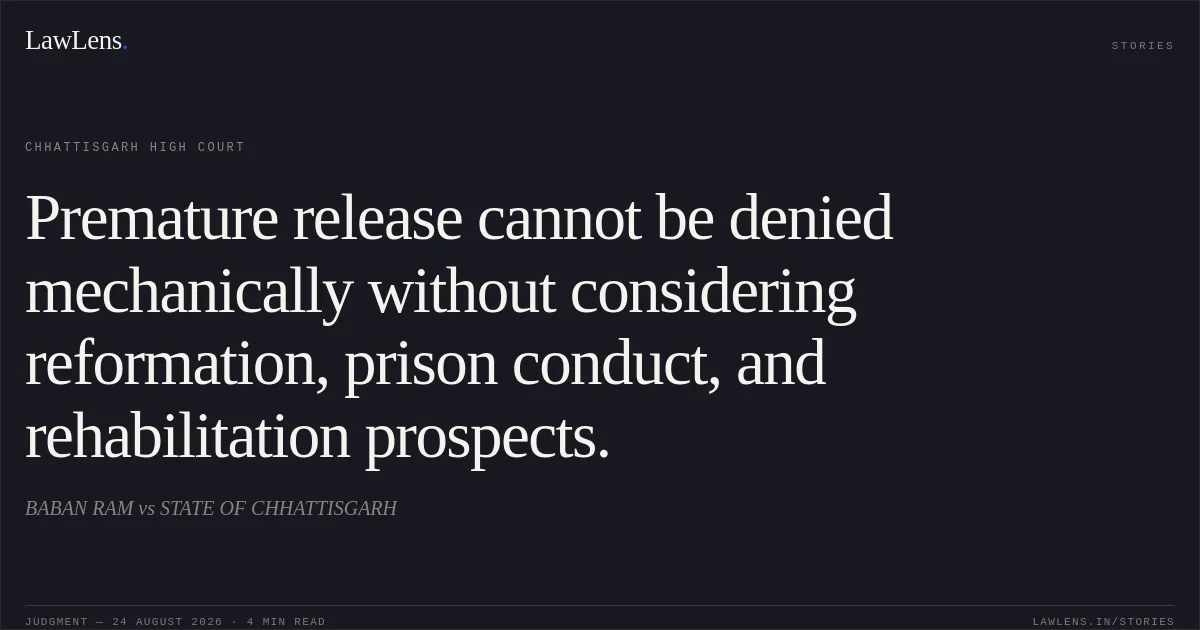
Source reference: paras. 6, 9The Court held that the seriousness of the original offence, by itself, could not replace an assessment of the petitioner’s present conduct, reformation, rehabilitation and likelihood of recidivism.
Source reference: paras. 7–10Since the impugned order did not disclose independent application of mind or intelligible reasons for disregarding the favourable material, it constituted a mechanical and arbitrary exercise of discretion contrary to Section 432, Rule 358 and Article 14
Source reference: paras. 7–10Holding
The High Court allowed the writ petition and quashed the order dated 10 April 2026 rejecting the petitioner’s claim for remission/premature release
It held that the petitioner was entitled to the benefit of premature release under Section 432 of the CrPC, the corresponding provisions of the Bharatiya Nagarik Suraksha Sanhita, 2023, and Rule 358 of the Chhattisgarh Prison Rules, 1968.
Source reference: para. 11The respondents were directed to release him forthwith, if he was not required in any other case, subject to the usual terms and conditions under the Prison Rules
Source reference: para. 11No order as to costs was made
Source reference: para. 12Acts & Sections Cited
4 provisions across 2 statutes referred to in this judgment. Each provision opens on LawLens.
Indian Penal Code, 18603
Code of Criminal Procedure, 19731
Original Court PDF
BABAN RAMvsSTATE OF CHHATTISGARH
Click to open original judgment
Original judgment, available to read, download and summarize on LawLens.in
![Courts will not interfere with transfers absent mala fides or violation of statutory rules.. M Ramya vs EMPLOYEES STATE INSURANCE CORPORATION (ESIC). CAT - ['Chennai']. LawLens](/stories/thumbnails/courts-will-not-interfere-with-transfers-absent-mala-fides-or-violation-of-statutory-rules-a6845e9ca6f548fca284c51c8351957f.webp)
![Courts cannot direct one-time recruitment age relaxation absent authority in the governing rules or advertisement.. UT OF PUDUCHERRY vs M ANDAL. CAT - ['Chennai']. LawLens](/stories/thumbnails/courts-cannot-direct-one-time-recruitment-age-relaxation-absent-authority-in-the-governing-895d78fde47143e2a8ed0207c4b6a44f.webp)
![A review cannot correct an allegedly erroneous decision absent an error apparent on the record.. Ajit Kumar Jha vs RAILWAY BOARD. CAT - ['Delhi']. LawLens](/stories/thumbnails/a-review-cannot-correct-an-allegedly-erroneous-decision-absent-an-error-apparent-on-the-re-8ac952fd4eba470c92f7da20af72a220.webp)