Facts
The petitioner was convicted under Sections 302 (two counts) and 307 of the IPC and sentenced to life imprisonment on 31.08.2013
Source reference: p. 2His appeals were dismissed by the High Court (2018) and the Supreme Court (2021)
Source reference: p. 2As of April 2026, the petitioner had served over 15 years and 11 months of actual imprisonment (over 20 years including remission)
Source reference: p. 2-3Despite a favorable opinion from the Presiding Judge [p. 3] and a satisfactory jail record, the State Sentence Review Board rejected his application for premature release via order dated 22.03.2026.
Source reference: p. 3The rejection was based on the "heinous" nature of the double murder and negative opinions from the Superintendent of Police and District Magistrate regarding potential societal impact
Source reference: p. 3Issues
1. Whether the State’s rejection of the petitioner’s application for premature release was arbitrary and in violation of Rule 358 of the Chhattisgarh Prison Rules
Source reference: p. 3-42. Whether the gravity of the original offence can be the sole ground for denying remission once a convict fulfills the eligibility criteria and demonstrates reformation
Source reference: p. 4, 6Law Applied
The Court applied Section 358(7) of the Chhattisgarh Prison Rules, 1968, which mandates an objective assessment of a life convict’s conduct and suitability for reintegration
Source reference: p. 5-6It relied on Laxman Naskar v. State of West Bengal, establishing that authorities must weigh the likelihood of recurrence and potential for reformation rather than just the crime
Source reference: p. 6Under Epuru Sudhakar v. Government of Andhra Pradesh, the Court affirmed that remission orders are subject to judicial review for arbitrariness
Source reference: p. 6Furthermore, per State of Haryana v. Jagdish, remission policies must be applied consistently and fairly
Source reference: p. 6under E.P. Royappa v. State of Tamil Nadu, any arbitrary state action violates Article 14 of the Constitution
Source reference: p. 8Reasoning
The Court reasoned that while remission is a discretionary power under Section 432 Cr.P.C., it cannot be exercised through "mere conjectures"
Source reference: p. 7The Court found that the State ignored mandatory parameters under Rule 358, specifically failing to give weight to the sentencing Court’s "no objection" and the positive jail conduct reports
Source reference: p. 4, 7The Court determined that the State's reliance on the "heinous nature" of the crime was insufficient as a sole ground for rejection because the philosophy of penology is reformative, not retributive
Source reference: p. 6-7Since the District Magistrate’s negative opinion lacked supporting material to override the statutory scheme of reformation, the decision-making process was deemed opaque, unfair, and a "misconceived interpretation" of the rules
Source reference: p. 6-7Holding
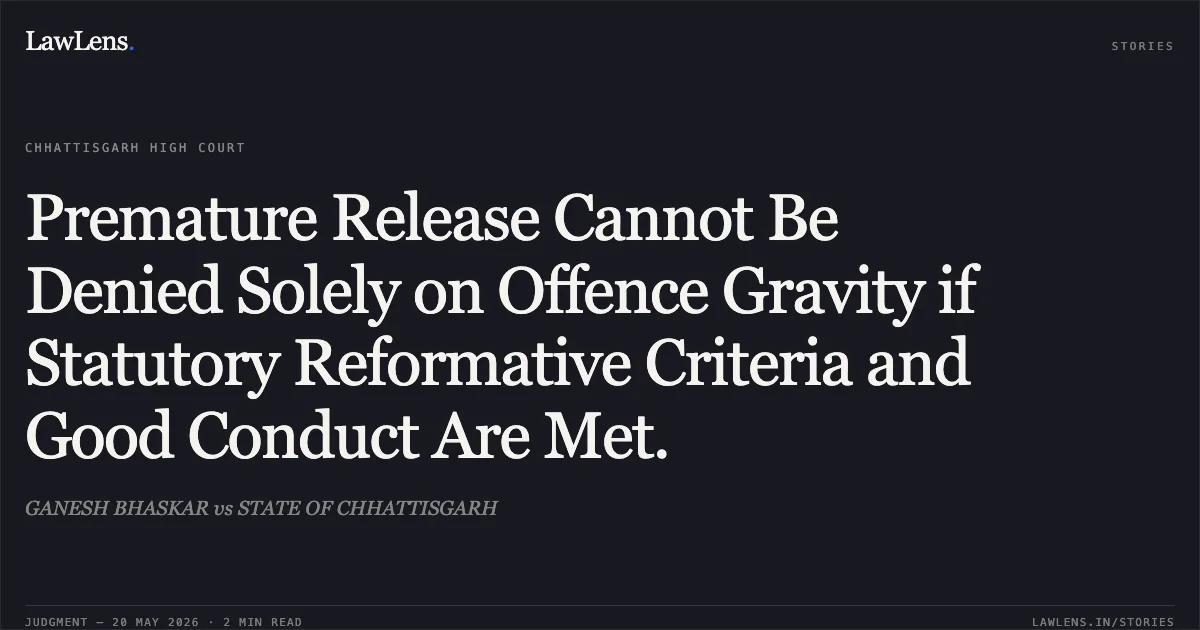
The Court answered the issues in the affirmative, holding that the denial of premature release was arbitrary and violative of Article 14
The High Court quashed the impugned order dated 22.03.2026. The Respondents were directed to grant the benefit of remission to the petitioner and release him forthwith, provided he is not required in any other case, subject to standard terms and conditions under the Chhattisgarh Jail Rules, 1968
Source reference: p. 7, 8Acts & Sections Cited
3 provisions across 2 statutes referred to in this judgment. Each provision opens on LawLens.
Indian Penal Code, 18602
Code of Criminal Procedure, 19731
Original Court PDF
GANESH BHASKARvsSTATE OF CHHATTISGARH
Click to open original judgment
Original judgment, available to read, download and summarize on LawLens.in


