Facts
The applicant, a Senior Section Engineer (SSE/Telecom) in the North Eastern Railway, joined service in 1993
Source reference: p. 2On 08.02.2022, he was issued a memorandum of compulsory retirement, followed by a formal order dated 23.02.2022, under Fundamental Rule (FR) 56(j) and Rule 1802(a) of the IREC
Source reference: p. 8The decision was based on recommendations from a Service Review Committee (convened on 12.11.2021), which evaluated his entire service record and found 11 punishments (major/minor), frequent negligence, unauthorized absence, and the use of unparliamentary language against superiors
Source reference: p. 9-10The applicant challenged the order, alleging caste-based harassment, procedural irregularities regarding his age/service length at the time of review, and claiming that compulsory retirement was used as a shortcut to bypass pending disciplinary inquiries
Source reference: p. 2-3, 6Issues
1. Whether the order of compulsory retirement under FR 56(j) was passed by the competent authority following due process and correct criteria regarding age and service
Source reference: p. 10 / para 152. Whether the retirement order was used as a punitive measure or a "short-cut" to avoid formal disciplinary proceedings in violation of RBE No. 130/2019
Source reference: p. 13 / para 173. Whether the non-service of the relieving order and the pendency of a transfer challenge before the Tribunal invalidated the retirement
Source reference: p. 14 / para 18Law Applied
Fundamental Rule 56(j) and Rule 1802(a) of the Indian Railway Establishment Code (IREC) Vol-II, which grant the Administration absolute power to retire a railway servant in public interest upon attaining 55 years of age (for Group C)
Source reference: p. 8, 12RBE No. 130/2019, which stipulates that while compulsory retirement should not be a shortcut for misconduct proceedings, the total service record—including uncommunicated adverse entries—can be considered to "chop off dead wood"
Source reference: p. 11-12State of Gujarat v. Umedbhai M. Patel (2001), confirming that such orders are not punishments and are based on the subjective satisfaction of the authority regarding the employee’s utility
Source reference: p. 16UOI v. Col. J.N. Sinha (1971), which established that principles of natural justice (like show-cause notices) do not apply to FR 56(j) actions
Source reference: p. 16Reasoning
The Tribunal found that the applicant reached the age of 55 on 20.10.2021, and the Review Committee evaluated his case on 12.11.2021; thus, the criteria for age were met, and the review was timely per the prescribed schedule
Source reference: p. 10, 14The court noted that the committee’s recommendation was based on the "totality of the facts," including a history of 11 penalties and insubordination, which constitutes "dead wood" rather than a shortcut for a single specific misconduct
Source reference: p. 9, 13, 16Regarding the applicant’s claim of non-service of the relieving order, the Tribunal observed that a Joint Inquiry Report confirmed his refusal to accept the notice, and the payment of three months’ salary in lieu of notice satisfied the statutory requirement under FR 56(j)
Source reference: p. 14The existence of pending charge-sheets did not preclude the administration from exercising its right to retire the employee in the public interest, as disciplinary proceedings can continue post-retirement if necessary
Source reference: p. 13-14Holding
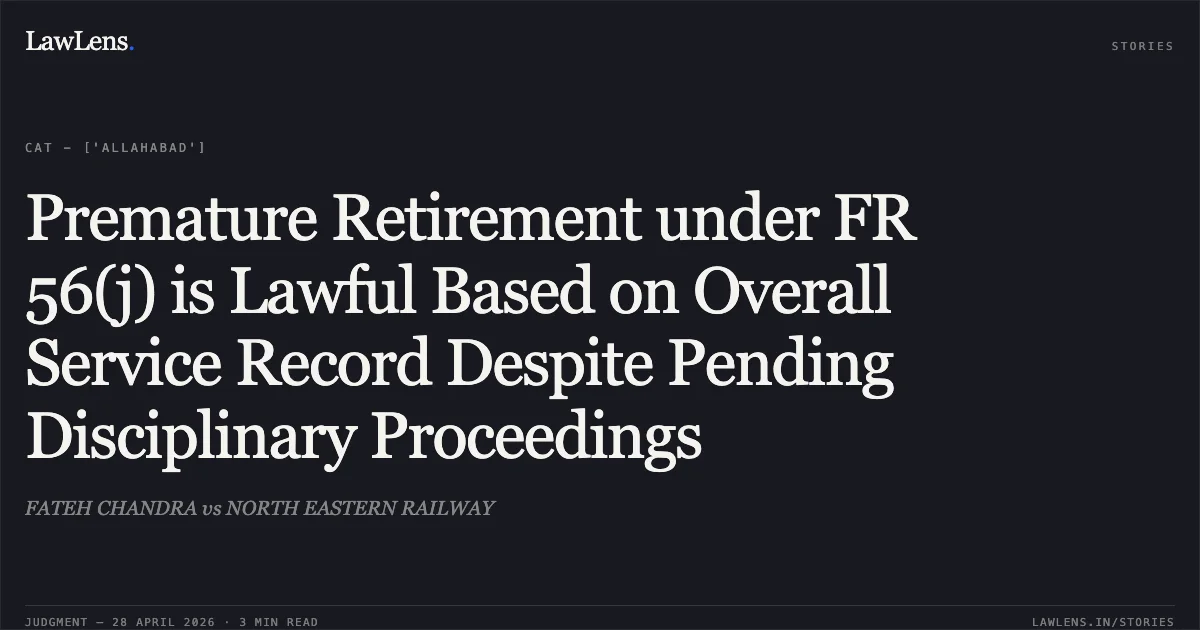
The Tribunal answered the issues in the negative for the applicant, holding that the premature retirement under FR 56(j) did not suffer from procedural infirmity or arbitrary exercise of power
The court held that the Administration's decision was based on a bona fide opinion regarding the applicant's unsatisfactory service record and lack of utility in public interest. Consequently, the Original Application was dismissed, and all interim protections were vacated
Source reference: p. 16, 17Acts & Sections Cited
4 provisions across 2 statutes referred to in this judgment. Each provision opens on LawLens.
Administrative Tribunals Act, 19851
Indian Penal Code, 18603
Original Court PDF
FATEH CHANDRAvsNORTH EASTERN RAILWAY
Click to open original judgment
Original judgment, available to read, download and summarize on LawLens.in