Facts
The petitioner-landlord instituted an ejectment suit against the respondent-tenant.
Source reference: para. 1–7Although summons was served in August 2023, the tenant did not appear, and the suit was set for ex parte hearing.
Source reference: para. 1–7After the landlord’s evidence had been recorded and the suit was listed for ex parte arguments, the tenant appeared on 18 June 2025 and applied under Section 151 of the Code of Civil Procedure, 1908 (CPC), to recall the ex parte order.
Source reference: para. 1–7The tenant filed a written statement on 7 August 2025.
Source reference: para. 1–7On 2 December 2025, the Trial Court allowed the application and accepted the written statement subject to payment of Rs. 1,300.
Source reference: para. 1–7The landlord challenged that order in revision.
Source reference: para. 1–7Issues
Whether the Trial Court could accept a tenant’s written statement filed approximately two years after service of summons in an ejectment suit under the Premises Tenancy Act, 1997.
Source reference: para. 11–12Whether the Trial Court’s order accepting the written statement and recalling the ex parte hearing order warranted interference in revision.
Source reference: para. 7–12Law Applied
The Court considered Section 151 of the CPC, under which the tenant had sought recall of the ex parte order, and the provisions governing written statements in proceedings under the Premises Tenancy Act, 1997.
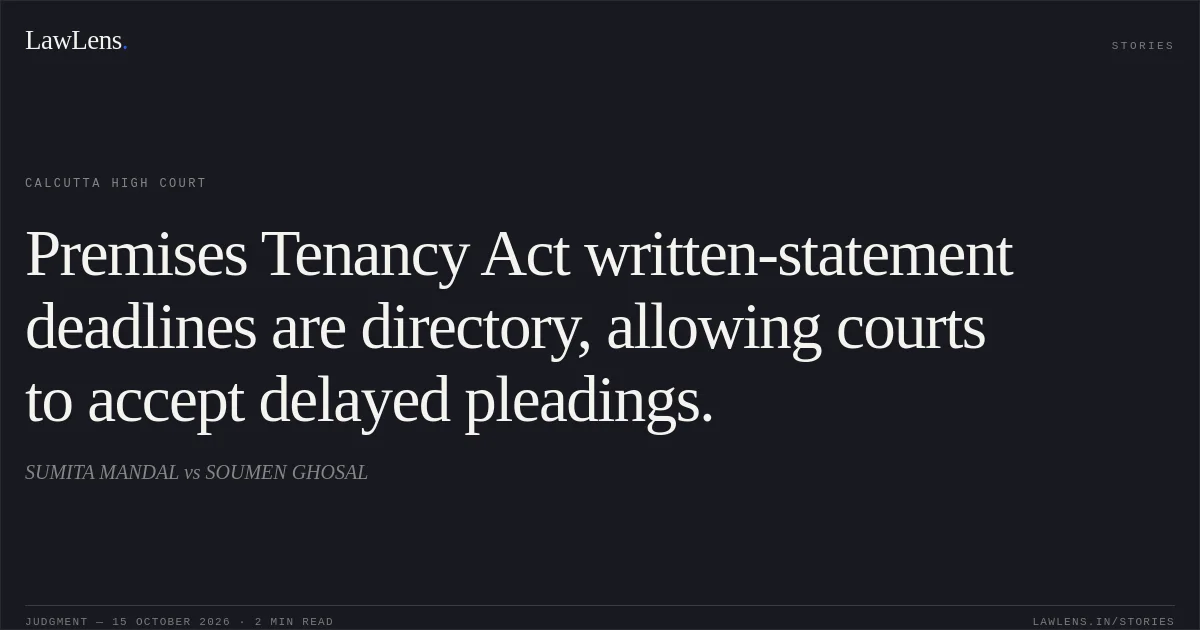
Source reference: para. 4, 12It held that the time limit for filing a written statement in a suit under that Act is directory, rather than mandatory, and that the Trial Court may exercise discretion to accept a late written statement, including subject to costs.
Source reference: para. 12The Court contrasted this with the time limit in suits under the Commercial Courts Act, which it described as mandatory.
Source reference: para. 12Reasoning
The written statement was filed substantially late, after the tenant had failed to appear despite service and after the landlord’s evidence had been recorded.
Source reference: para. 12–14However, the Court treated the filing deadline applicable to this ejectment suit as directory, leaving acceptance of the written statement to the Trial Court’s discretion.
Source reference: para. 12–14Since the Trial Court had accepted it on payment of costs, the High Court found no basis to interfere.
Source reference: para. 12–14It also noted that the landlord’s evidence had been completed and directed that the tenant be permitted to cross-examine the landlord’s witness and present defence evidence.
Source reference: para. 12–14Holding
The Court declined to interfere with the Trial Court’s order accepting the written statement.
It disposed of the revision without an order as to costs and directed that the tenant be allowed to cross-examine PW-1 and adduce defence evidence.
Source reference: para. 12–16The Trial Court was requested to hear argument and dispose of the suit at the earliest, preferably by February 2027, without unnecessary adjournments.
Source reference: para. 12–16Acts & Sections Cited
1 provisions across 1 statute referred to in this judgment. Each provision opens on LawLens.
Code of Civil Procedure, 19081
Original Court PDF
SUMITA MANDALvsSOUMEN GHOSAL
Click to open original judgment
Original judgment, available to read, download and summarize on LawLens.in