Facts
The respondent, a Special Sub-Inspector of Police, appeared before the Judicial Magistrate, Thirukoilur on 25.11.2014 to give evidence in a criminal case.
Source reference: para. 2The Magistrate observed the respondent was in a drunken state, shouting, and incoherent, and directed an immediate medical examination.
Source reference: para. 2A Medical Officer issued a "Certificate of Drunkenness" based on the smell of alcohol, though blood and urine tests were not conducted.
Source reference: para. 2Following a departmental enquiry under Rule 3(b) of the Tamil Nadu Police Subordinate Service Rules, the respondent was ordered into compulsory retirement.
Source reference: para. 3On appeal, this was modified to a postponement of increments for three years.
Source reference: para. 4The Writ Court subsequently set aside the punishment on the ground that blood and urine tests were missing.
Source reference: para. 5The State filed this intra-court appeal.
Source reference: para. 1Issues
1. Whether the absence of blood and urine tests is fatal to a departmental disciplinary proceeding concerning drunkenness.
Source reference: para. 82. Whether the "preponderance of probabilities" standard was met based on the Medical Certificate and the Magistrate’s observation.
Source reference: para. 8-93. Whether police personnel are required to maintain specific decorum and wear uniforms while deposing in Court.
Source reference: para. 12-13Law Applied
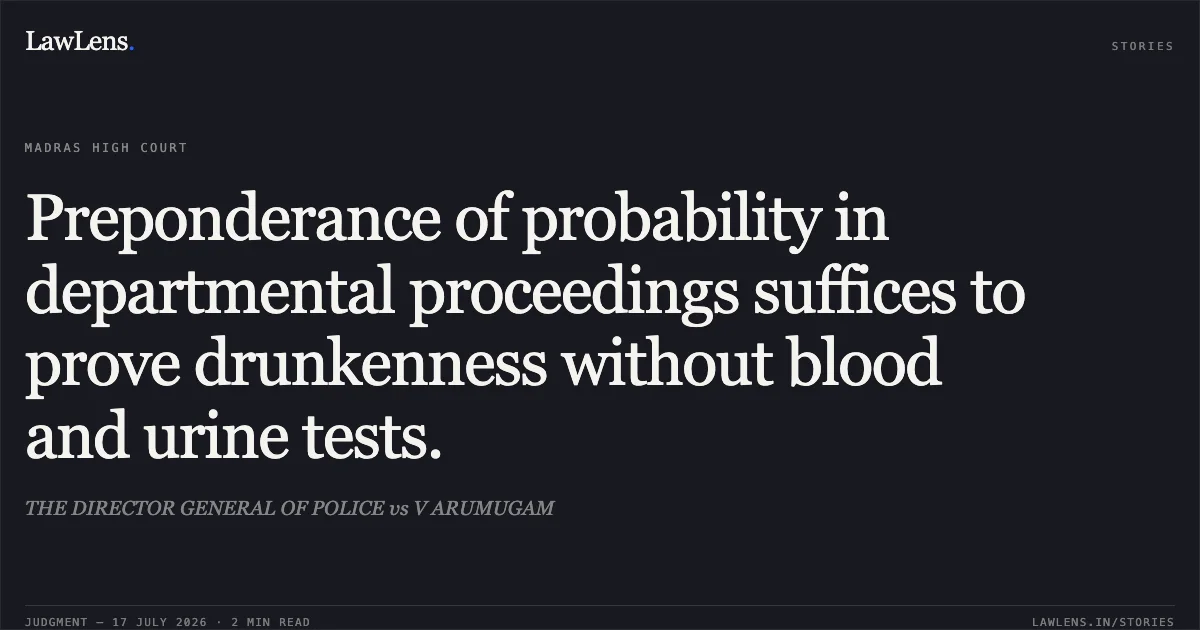
The court primarily applied the principle of "preponderance of probabilities" as the standard of proof in departmental proceedings, distinguishing it from the "strict proof" or "beyond reasonable doubt" standard required in criminal trials.
Source reference: para. 8The court relied on the Tamil Nadu Police Subordinate Service (Discipline and Appeal) Rules, 1955.
Source reference: para. 3The court also emphasized the doctrine of judicial decorum and the duty of public servants to maintain "absolute integrity and devotion to duty" under service conduct rules.
Source reference: para. 10-11Reasoning
The Court reasoned that unlike criminal cases, departmental actions do not require scientific certainty via blood or urine tests if other sufficient evidence exists.
Source reference: para. 8The Medical Officer's certificate (Ex-P.6) and the fact that the misconduct occurred in the presence of a Judicial Magistrate provided a strong basis for the charges.
Source reference: para. 8-9The Court noted that the respondent did not object to the medical examination at the time and that his behavior "totally degraded the image of the police force".
Source reference: para. 10The Court held that misconduct within a Court Hall is intolerable and that the Writ Court erred by applying the strict evidentiary standards of criminal law to a disciplinary matter.
Source reference: para. 11Holding
The Court held that the Drunkenness Certificate and circumstantial evidence were sufficient under the rule of preponderance of probabilities.
The High Court allowed the appeal and set aside the Writ Court's order, thereby restoring the modified punishment of postponement of increments.
Source reference: para. 15The Court issued a mandatory direction to the Director General of Police to issue a Circular within four weeks requiring all police personnel to wear proper uniforms and maintain decorum while attending Court.
Source reference: para. 13-14Acts & Sections Cited
4 provisions across 1 statute referred to in this judgment. Each provision opens on LawLens.
Indian Penal Code, 18604
Original Court PDF
THE DIRECTOR GENERAL OF POLICEvsV ARUMUGAM
Click to open original judgment
Original judgment, available to read, download and summarize on LawLens.in