Facts
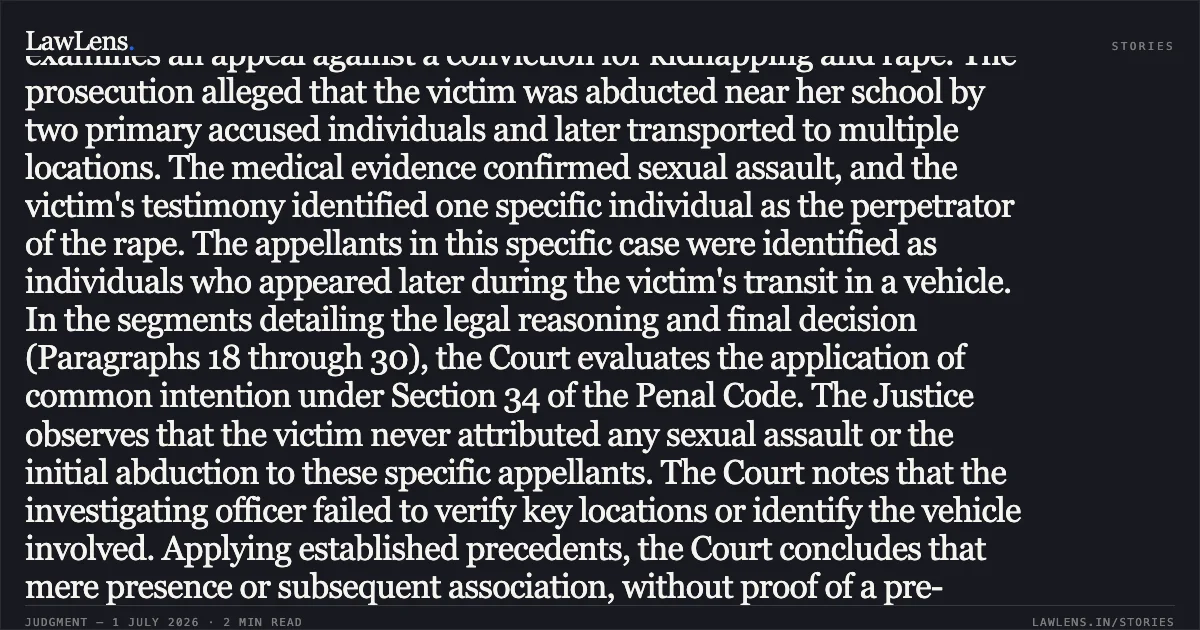
The appellants, Shankar Singh and Raju Singh, were convicted by the Adhoc Additional Sessions Judge-1st, Saharsa, on April 4, 2013, for offenses under Sections 366-A/34 and 376/34 of the Indian Penal Code
Source reference: para. 2The prosecution alleged that on September 12, 2011, a 14-year-old victim was kidnapped by Chandan Kumar and Munna Kumar and taken to a hotel in Banmankhi, where she was raped by Chandan Kumar
Source reference: para. 4The present appellants were allegedly seen the following day in a vehicle with the principal accused, transporting the victim toward Madhepura
Source reference: para. 16, P.W.7The appellants challenged their conviction on the grounds that there was no evidence of their participation in the kidnapping or rape, nor evidence of common intention
Source reference: para. 5-7Issues
1. Whether the appellants can be held vicariously liable under Section 34 IPC for kidnapping and rape in the absence of specific overt acts or shared common intention
Source reference: para. 17-182. Whether the evidence provided by the prosecutrix and investigating officer was sufficient to sustain a conviction under Sections 366-A and 376 of the IPC
Source reference: para. 24-26Law Applied
The court applied Section 366-A (procuration of minor girl) and Section 376 (punishment for rape) of the IPC
Source reference: para. 11It relied on the principle of vicarious liability under Section 34 IPC, which requires the prosecution to prove a "prior meeting of minds" or a "pre-arranged plan"
Source reference: para. 18The court cited Krishnan v. State of Kerala (1996) to establish that while overt acts are not always required, the sharing of common intention must be proved
Source reference: para. 21It further relied on Jasdeep Singh v. State of Punjab (2022) and Constable 907 Surendra Singh v. State of Uttarakhand (2025), which clarify that mere presence or subsequent association does not automatically trigger Section 34
Source reference: para. 22-23Reasoning
The Court observed that the victim (P.W.7) specifically attributed the act of rape solely to co-convict Chandan Kumar and the initial kidnapping to Chandan and Munna Kumar
Source reference: para. 17There were no allegations of sexual assault against the present appellants
Source reference: para. 17Regarding common intention, the Court found no evidence of a pre-arranged plan or that the appellants joined the criminal venture from its inception; their alleged involvement was limited to their presence in a vehicle at a subsequent stage
Source reference: para. 18Furthermore, the investigation was found to be deficient, as the Investigating Officer (P.W.2) failed to examine hotel staff, the vehicle driver, or independent witnesses from the recovery site
Source reference: para. 7, 26The Court concluded that the Trial Court's reliance on Section 34 was based on conjecture rather than concrete evidence
Source reference: para. 6, 26Holding
The ingredients of Section 376 and Section 366-A were not established against the appellants due to the lack of specific allegations and the failure to prove common intention under Section 34
The High Court allowed the appeal, setting aside the judgment of conviction dated April 1, 2013, and the order of sentence dated April 4, 2013. The appellants were acquitted of all charges and discharged from their bail bonds
Source reference: para. 27-28Acts & Sections Cited
6 provisions across 2 statutes referred to in this judgment. Each provision opens on LawLens.
Code of Criminal Procedure, 19734
Indian Penal Code, 18602
Original Court PDF
Shankar Singh and Anr.vsThe State Of Bihar
Click to open original judgment
Original judgment, available to read, download and summarize on LawLens.in