Facts
The applicants, Directors of Milano Papers Pvt. Ltd., entered into a commercial relationship with Respondent No. 2 (Proprietor of Jai Mata Di Traders) for the supply of waste paper.
Source reference: para 2Between 2019 and 2021, the respondent supplied material worth Rs. 4,81,10,503/-, out of which a balance of Rs. 1,13,43,744/- remained unpaid. Cheques issued for the balance were dishonored.
Source reference: para 2The applicants allegedly provided a sale agreement dated June 9, 2022, and minutes of a meeting dated June 20, 2022, falsely assuring the respondent that dues would be cleared upon the sale of their factory.
Source reference: para 2, 9However, the factory had already been declared a Non-Performing Asset (NPA) by Yes Bank on April 28, 2022.
Source reference: para 3, 9Consequently, an FIR was registered under Sections 406, 420, and 120-B of the IPC. The applicants sought quashment of the FIR under Section 528 BNSS / 482 Cr.P.C.
Source reference: para 1Issues
1. Whether the dispute is purely of a civil nature, arising from a commercial transaction, thereby warranting the quashing of criminal proceedings.
Source reference: para 7, 82. Whether the allegations in the FIR and the material collected during investigation prima facie disclose the commission of cognizable offences under Sections 406 and 420 of the IPC.
Source reference: para 8, 11Law Applied
The Court applied the principles governing the inherent powers of the High Court under Section 482 Cr.P.C. as established in State of Haryana v. Bhajan Lal, which provides guidelines for quashing FIRs in the "rarest of rare cases".
Source reference: para 10.4It further relied on Neeharika Infrastructure (P) Ltd. v. State of Maharashtra, emphasizing that courts should not thwart investigations into cognizable offences unless no offence is disclosed.
Source reference: para 10.15Regarding the overlap of civil and criminal liability, the Court cited Amit Kapoor v. Ramesh Chander, holding that a civil claim's maintainability does not preclude criminal prosecution if the facts amount to an offence.
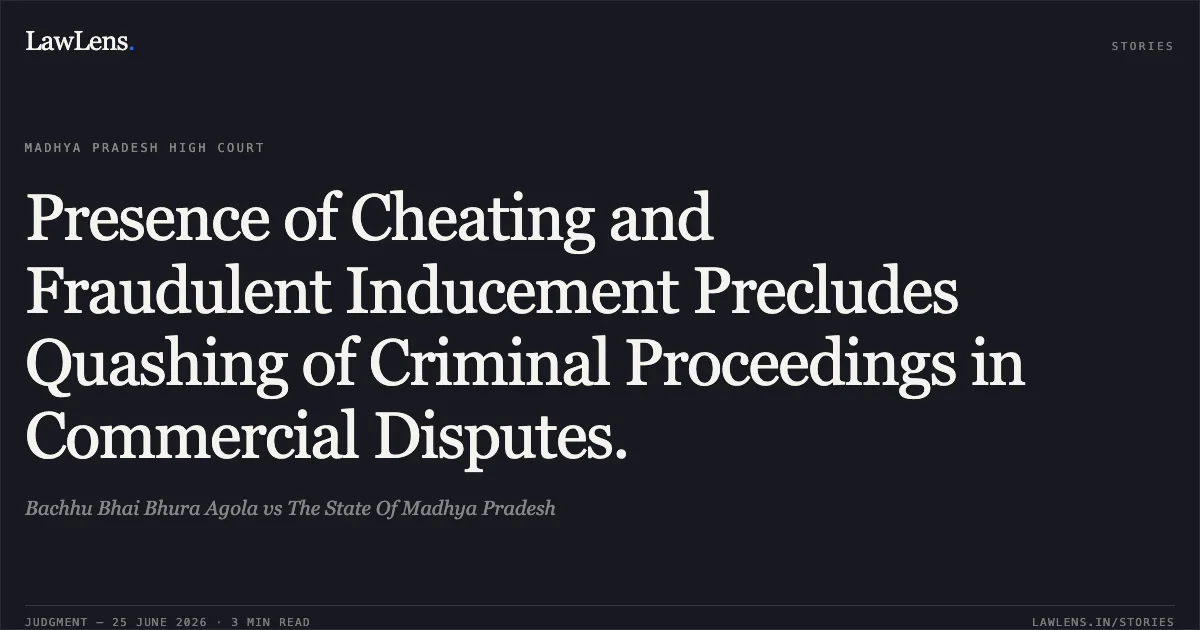
Source reference: para 7Fraudulent inducement and dishonest intention are central to offences under Sections 420 and 406 IPC.
Source reference: para 4, 8Reasoning
The Court observed that while the relationship began as a commercial transaction, the applicants’ subsequent conduct suggested dishonest intention.
Source reference: para 16Specifically, the applicants issued assurances and sale agreements in June 2022 to settle debts through a factory sale, despite knowing the factory had been declared an NPA months earlier in April 2022.
Source reference: para 9, 16The Court reasoned that a commercial dispute does not automatically grant immunity from criminal proceedings if the allegations disclose a criminal offence.
Source reference: para 8It noted that the investigation had already resulted in a charge sheet (RCT No. 3159/2024), and the potential truth of the allegations is a matter for trial, not for appreciation at the quashing stage.
Source reference: para 13, 15The court also took cognizance of the fact that similar criminal cases were registered against the applicants in Gujarat, indicating a possible pattern of deceptive conduct.
Source reference: para 4, 5Holding
The Court answered the issues by holding that there is sufficient material on record to connect the applicants to the alleged offences and that the inherent powers under Section 482 cannot be used to conduct a "mini-trial" or appreciate evidence at this stage.
The Court dismissed the petition, finding it lacked merit. The interim order dated March 3, 2025, was vacated, and the trial court was directed to proceed.
Source reference: para 17, 18Acts & Sections Cited
7 provisions across 3 statutes referred to in this judgment. Each provision opens on LawLens.
Bharatiya Nagarik Suraksha Sanhita, 20231
Code of Criminal Procedure, 19733
Indian Penal Code, 18603
Original Court PDF
Bachhu Bhai Bhura AgolavsThe State Of Madhya Pradesh
Click to open original judgment
Original judgment, available to read, download and summarize on LawLens.in