Facts
The Petitioner, an advocate and social activist, filed a Public Interest Litigation (PIL) challenging the nomination of Respondent No. 3 (Mr. C. Sadanandan Master) to the Rajya Sabha
Source reference: para. 1-2The nomination was made by the President of India via Notification dated 12.07.2025 under Article 80(3) of the Constitution
Source reference: para. 5The Petitioner contended that Respondent No. 3, a State Vice President of the Bharatiya Janata Party, lacks the "special knowledge or practical experience" in literature, science, art, or social service required by the Constitution
Source reference: para. 9It was further alleged that the nomination process is opaque and used to reward political loyalty rather than merit
Source reference: para. 7, 10Issues
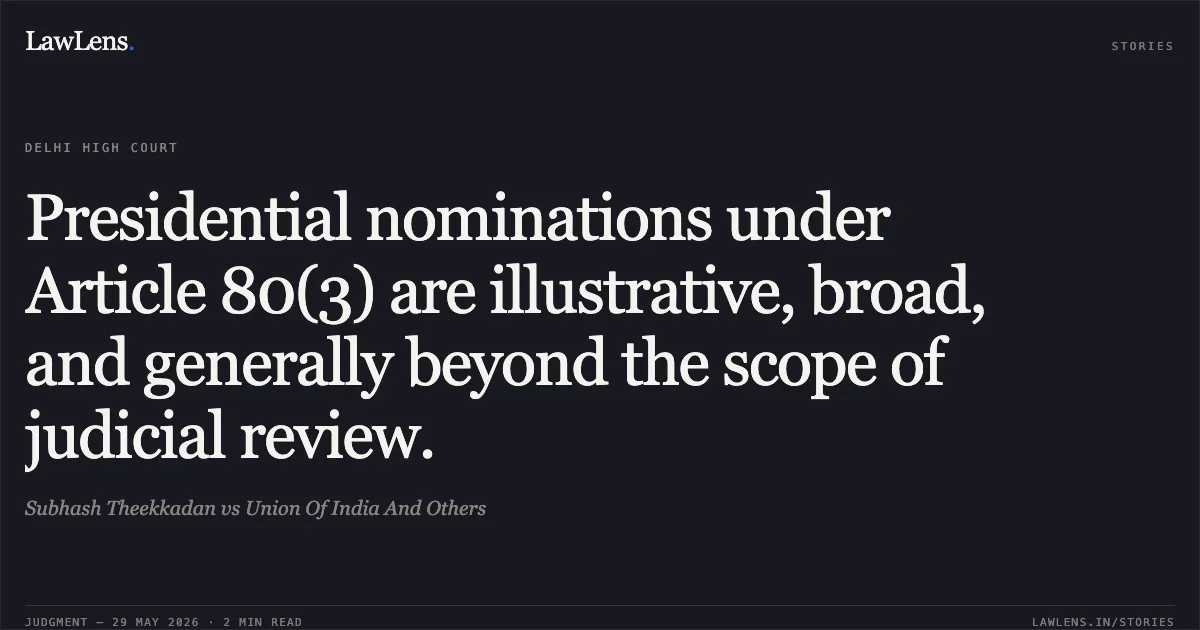
1. Whether the nomination of a member to the Rajya Sabha under Article 80(3) of the Constitution is amenable to judicial review on the grounds of the nominee's suitability or political background
Source reference: para. 19, 252. Whether the categories of "Literature, science, art and social service" enumerated in Article 80(3) are exhaustive or illustrative
Source reference: para. 24Law Applied
Article 80(3) of the Constitution of India, which empowers the President to nominate twelve members to the Council of States based on special knowledge or practical experience
Source reference: para. 22-23The phrase "in respect of such matters as the following" renders the listed categories illustrative rather than exhaustive
Source reference: para. 18, 24Article 74, noting that the President acts on the aid and advice of the Council of Ministers
Source reference: para. 6Reasoning
The Court reasoned that because the categories in Article 80(3) are illustrative, the President possesses broad discretion to nominate individuals with expertise in those or "cognate fields"
Source reference: para. 25The Court emphasized that "special knowledge" and "practical experience" are inherently evaluative terms; thus, the judiciary cannot sit in appeal over the executive's assessment unless there is no "reasonable nexus" to the constitutional categories
Source reference: para. 26Regarding the nominee’s political background, the Court held that active participation in politics or contesting elections does not disqualify a person, as political service can be subsumed under the ambit of "social service" or "social science"
Source reference: para. 30The Court found the Petitioner's claims to be "conjectural" and "unsubstantiated," ruling that the Constitution does not prescribe a specific procedural mechanism for selection that the Court can supplement
Source reference: para. 28, 31Holding
The Court dismissed the Writ Petition, holding that the nomination did not violate Article 80(3)
The Petitioner failed to produce material proving Respondent No. 3 lacked the requisite distinction to enrich parliamentary debate
Source reference: para. 33The Court affirmed that judicial intervention is not warranted when constitutional discretion is exercised within the broad parameters of the illustrative fields mentioned in Article 80(3)
Source reference: para. 25, 34No costs were ordered
Source reference: para. 34Original Court PDF
Subhash TheekkadanvsUnion Of India And Others
Click to open original judgment
Original judgment, available to read, download and summarize on LawLens.in