Facts
The petitioner, husband of Opposite Party No. 2, sought quashing of Gandhi Maidan P.S. Case No. 18 of 2026, registered on 9 January 2026 under Sections 126(2), 115(2), 85, 352 and 351(2) of the Bharatiya Nyaya Sanhita, 2023 (“BNS”), read with Section 3(5) BNS, and all consequential proceedings.
Source reference: para. 2The informant alleged that she had been subjected to matrimonial harassment since her marriage in 2010 and that, on 7 January 2026, the petitioner brought her and their two daughters to Hotel Maurya, Patna, where he allegedly pressured her to sign divorce and child-custody papers and assaulted her when she refused.
Source reference: paras. 3–4.1The parties had previously entered into a mediated settlement before the Delhi High Court Mediation and Conciliation Centre on 23 September 2025, following which pending proceedings were withdrawn.
Source reference: para. 5The informant admitted that their relations remained cordial from 23 September 2025 until 31 December 2025.
Source reference: para. 8.6The State and the informant opposed quashing, relying, inter alia, on medical material, the informant’s statement under Section 183 of the Bharatiya Nagarik Suraksha Sanhita, 2023 (“BNSS”), and the principle that investigation should ordinarily not be interdicted at an early stage.
Source reference: para. 6Issues
Whether the allegations in the FIR, taken at their face value and accepted in their entirety, disclosed the commission of offences under Sections 85, 126(2), 115(2), 351(2) and 352 BNS against the petitioner.
Source reference: paras. 8, 8.7–8.12Whether the High Court could examine attending circumstances and materials beyond the FIR while exercising its inherent jurisdiction to determine whether the prosecution was manifestly frivolous, legally untenable or covered by the principles in State of Haryana v. Bhajan Lal.
Source reference: paras. 8.1–8.5Whether the continuation of proceedings for the non-cognizable offences was invalid in the absence of an order of a Magistrate under Section 174(2) BNSS.
Source reference: para. 8.14Whether the FIR was liable to be quashed on the ground of mala fide or ulterior motive arising from the matrimonial dispute.
Source reference: para. 8.18Law Applied
The Court applied the principles governing quashing of criminal proceedings under the first, third, fourth and seventh categories of State of Haryana v. Bhajan Lal, 1992 Supp (1) SCC 335, particularly where the allegations, even if accepted, do not constitute an offence or where the proceedings are legally barred.
Source reference: para. 8Relying on Mahmood Ali v. State of Uttar Pradesh, 2023 SCC OnLine SC 950, the Court held that, in cases alleging frivolous or vexatious prosecution, the High Court may examine the FIR together with attending circumstances and materials on record, while not conducting a mini-trial.
Source reference: paras. 8.1, 8.5It also relied on Dara Lakshmi Narayana v. State of Telangana, (2025) 3 SCC 735, and Achin Gupta v. State of Haryana, (2025) 3 SCC 756, concerning misuse of criminal proceedings in matrimonial disputes and the need to read between the lines where an oblique motive is apparent.
Source reference: paras. 8.2–8.4Under Sections 85 and 86 BNS, cruelty requires conduct likely to drive a woman to suicide or cause grave injury or danger to life, limb or health, or harassment to coerce an unlawful demand for property or valuable security.
Source reference: para. 8.7Section 174(2) BNSS requires a Magistrate’s order for police investigation of non-cognizable offences; Sections 115(2), 351(2) and 352 BNS were classified as non-cognizable and bailable, whereas Sections 85 and 126(2) were treated as cognizable.
Source reference: para. 8.14The Court also considered Neeharika Infrastructure Pvt. Ltd. v. State of Maharashtra, AIR 2021 SC 1918, holding that its restriction on interference with investigation does not eliminate the High Court’s power to quash where no offence is disclosed under the Bhajan Lal parameters.
Source reference: paras. 8.15–8.16Reasoning
The Court confined its examination to the alleged occurrence at Hotel Maurya on 7 January 2026, since the earlier matrimonial allegations related to disputes that had been settled and withdrawn, and the informant herself pleaded that relations had remained cordial until the end of December 2025.
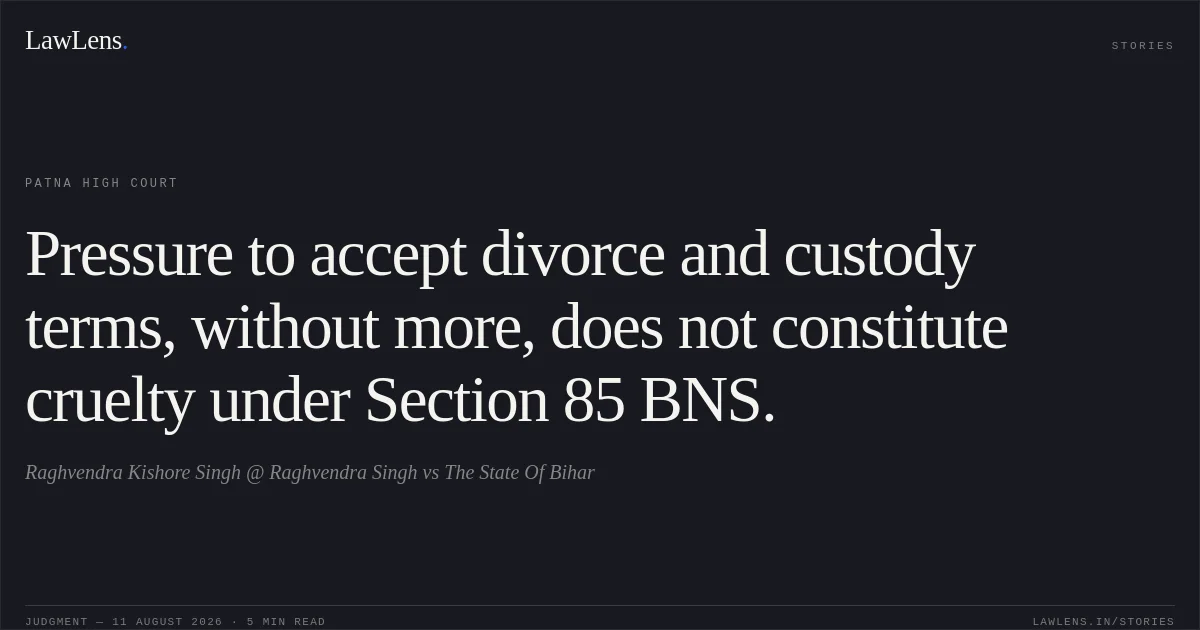
Source reference: para. 8.6The allegation that the petitioner pressured the informant to sign divorce and custody papers amounted, in the Court’s view, to an acrimonious matrimonial negotiation and did not constitute cruelty under Section 85 read with Section 86 BNS: it was neither a demand for property or valuable security nor, by itself, conduct likely to drive her to suicide or cause grave injury or danger to her health.
Source reference: para. 8.7The allegation under Section 126(2) BNS failed because the informant’s earliest version stated that she shut herself in the room out of fear and later left with her father and the police; it did not allege that the petitioner confined her.
Source reference: para. 8.8The later assertion in the counter-affidavit that she had been made captive and escaped was inconsistent with the FIR and could not supply the missing ingredient.
Source reference: para. 8.8The allegation under Section 351(2) was also insufficient because the alleged threat concerned the informant’s parents, neither of whom complained to the police, although the father was present and subsequently came to the hotel with the police.
Source reference: para. 8.9Although the medical discharge ticket recorded a contusion, the Court found that the informant’s counter-affidavit attributed the injury to a separate assault allegedly committed in Delhi on 4 January 2026, whereas the FIR attributed the assault to the Hotel Maurya incident on 7 January 2026.
Source reference: paras. 8.10–8.12Since these were distinct incidents and no medical material connected the injury with the Patna occurrence, Section 115(2) could not sustain the prosecution.
Source reference: paras. 8.10–8.12Once Sections 85 and 126(2) were found unsustainable, only non-cognizable offences remained. As no Magistrate’s order under Section 174(2) BNSS had been obtained, the investigation itself was legally unsupported.
Source reference: para. 8.14The Court did not base its decision on a definitive finding of mala fide, observing that the quashing was independently justified under the first, third and fourth Bhajan Lal categories.
Source reference: paras. 8.17–8.18Holding
The High Court held that the FIR and the materials on record did not disclose the essential ingredients of the offences alleged against the petitioner and that the remaining non-cognizable offences were investigated without the requisite Magistrate’s order under Section 174(2) BNSS.
Accordingly, Gandhi Maidan P.S. Case No. 18 of 2026 and all proceedings arising from it were quashed insofar as they concerned Raghvendra Kishore Singh @ Raghvendra Singh.
Source reference: paras. 9–10The Court clarified that the order would not affect the parties’ matrimonial, guardianship or domestic-violence proceedings, which were to be decided independently on their own merits.
Source reference: para. 11Acts & Sections Cited
14 provisions across 5 statutes referred to in this judgment. Each provision opens on LawLens.
Bharatiya Nyaya Sanhita, 20237
Bharatiya Nagarik Suraksha Sanhita, 20233
Code of Criminal Procedure, 19731
Indian Penal Code, 18602
Hindu Marriage Act, 19551
Original Court PDF
Raghvendra Kishore Singh @ Raghvendra SinghvsThe State Of Bihar
Click to open original judgment
Original judgment, available to read, download and summarize on LawLens.in