Facts
The appellant filed a complaint under Section 138 of the Negotiable Instruments Act, 1881 (N.I. Act) against the second respondent, a mediator and friend of the appellant’s husband.
Source reference: para. 2, 3Following a matrimonial and property dispute settlement, the husband agreed to pay the appellant ₹50 crores.
Source reference: para. 3To safeguard this interest, the second respondent issued a cheque for ₹50 crores on January 12, 2022.
Source reference: para. 3The cheque was dishonoured on April 6, 2022, with the remark "payment stopped by drawer".
Source reference: para. 3Despite a statutory notice, no payment was made, leading the Metropolitan Magistrate to issue process on June 17, 2022.
Source reference: para. 2, 3The Sessions Court, however, set aside this order, holding that no legally enforceable debt existed at the time of issuance because the settlement agreement was unsigned by the respondent.
Source reference: para. 2, 5The High Court of Bombay upheld the Sessions Court's decision, leading to this appeal.
Source reference: para. 2Issues
1. Whether the statutory presumption under Section 139 of the N.I. Act can be dislodged at the pre-trial stage of issuance of process on the ground that the debt was not legally enforceable.
Source reference: para. 8, 102. Whether the Sessions Court was justified in scuttling the criminal proceedings under Section 138 of the N.I. Act by evaluating the merits of the underlying debt before the commencement of the trial.
Source reference: para. 10Law Applied
The court applied Section 138 and Section 139 of the Negotiable Instruments Act, 1881.
Source reference: para. 9Section 139 stipulates a mandatory "reverse onus" presumption that the holder of a cheque received it for the discharge of a debt or liability.
Source reference: para. 9This principle was reinforced by Rangappa v. Sri Mohan, which clarifies that the presumption includes the existence of a legally enforceable debt.
Source reference: para. 9Furthermore, in Rajesh Jain v. Ajay Singh, the court held that once the signature and issuance of the cheque are admitted, the evidential burden shifts to the accused to prove the contrary during the trial.
Source reference: para. 9Reasoning
The Supreme Court observed that at the stage of issuing process, the Magistrate is only required to verify the prima facie ingredients of Section 138: issuance of the cheque, dishonour, statutory notice, and filing within the limitation period.
Source reference: para. 8The Court reasoned that since the second respondent did not dispute the signature or the issuance of the cheque, the statutory presumption under Section 139 was immediately triggered.
Source reference: para. 10The Sessions Court erred by conducting a mini-trial and giving undue weight to the fact that the settlement agreement was unsigned, thereby "washing away" the statutory presumption before the trial even commenced.
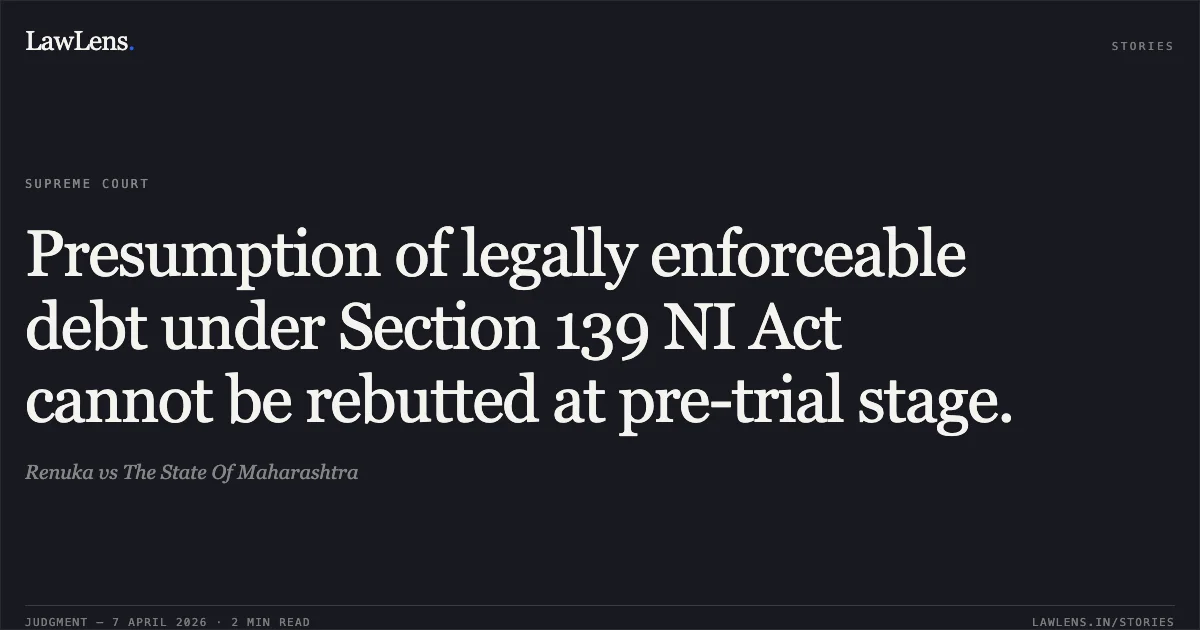
Source reference: para. 10The Court emphasized that the rebuttal of such a presumption is a matter of evidence to be determined during the trial, not a summary determination to be made at the pre-trial stage.
Source reference: para. 8, 10Holding
The Supreme Court allowed the appeal, setting aside the orders of the High Court and the Sessions Court.
The Court held that the dismissal of the complaint at the pre-trial stage was unjustified as the basic ingredients of Section 138 were satisfied.
Source reference: para. 10The complaint (CC1831/SC/2022) was restored for adjudication on its merits, with a clarification that the trial court should decide the matter independently of any observations made in this judgment.
Source reference: para. 11Acts & Sections Cited
3 provisions across 1 statute referred to in this judgment. Each provision opens on LawLens.
Negotiable Instruments Act, 18813
Original Court PDF
RenukavsThe State Of Maharashtra
Click to open original judgment
Original judgment, available to read, download and summarize on LawLens.in