01Facts
The appellant, Mickey Toys, challenged an assessment-reopening notice issued under Section 148A(1) of the Income Tax Act, 1961, by filing W.P.(C) No. 24153 of 2026.
¶ 1The appellant contended that its income was below ₹50 lakhs and that reopening after three years and three months from the end of the relevant assessment year was barred by Section 149(1)(a) of the Act. It relied on the presumptive taxation scheme under Section 44AD, although it admitted that it had not filed income-tax returns.
¶ 1–2The Department stated that information available through the Insight Portal, flagged under its Risk Management Strategy, prima facie indicated escaped income exceeding ₹50 lakhs. It further contended that the notice was only a preliminary notice and that the appellant could establish its income position by filing objections.
¶ 4The learned Single Judge declined to interfere, following which the appellant preferred the present writ appeal.
¶ 802Issues
i.1. Whether the appellant could invoke the ₹50-lakh limitation under Section 149(1)(a) when it had not filed income-tax returns and had not yet established that the escaped income was below ₹50 lakhs.
¶ 2, 4, 7ii.2. Whether the notice issued under Section 148A(1) was liable to be quashed on the ground that reopening was initiated beyond three years and three months from the end of the relevant assessment year.
¶ 1–3iii.3. Whether the appellant was entitled to rely on the presumptive taxation scheme under Section 44AD despite having failed to file returns.
¶ 2, 5iv.4. Whether the decision in Vipendra Ravindra Mandal v. ITO, Ward 22(3)(6), ITA No. 1819/Mum/2025, supported interference at the notice stage.
¶ 603Law Applied
The Court applied Section 148A(1) of the Income Tax Act, 1961, which provides the statutory mechanism for considering information suggesting escaped income before issuance of a reassessment notice.
¶ 1It considered Section 149(1)(a), under which reopening beyond the ordinary limitation period is subject to the statutory condition concerning escaped income of ₹50 lakhs or more.
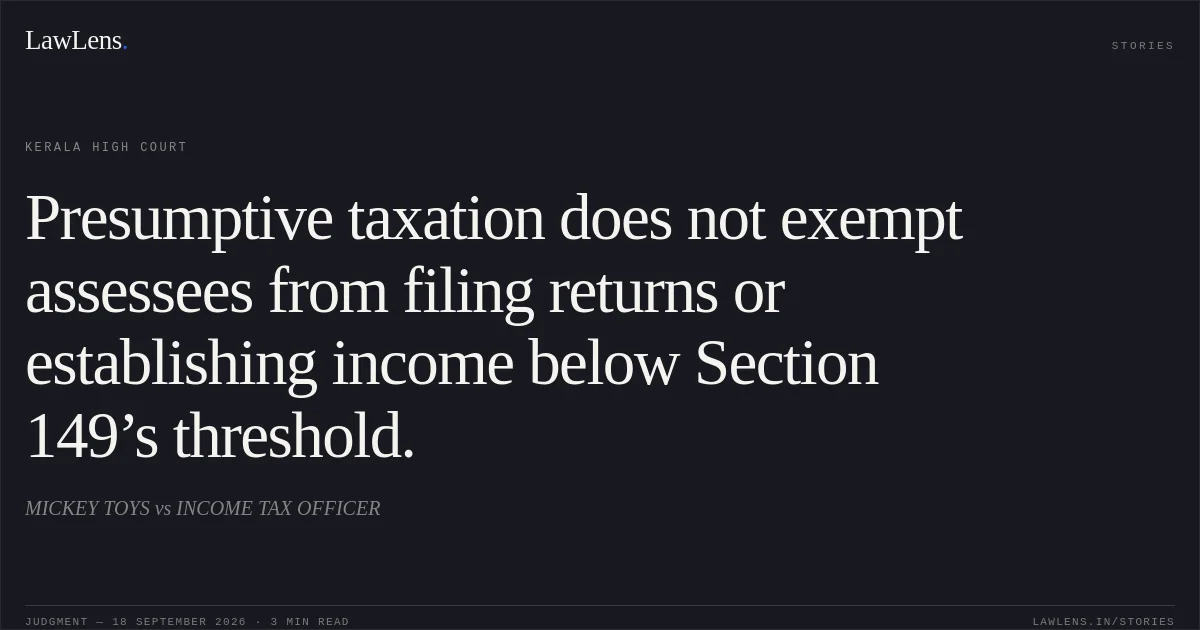
¶ 2–4Section 44AD was treated as a presumptive taxation provision that may reduce the obligation to maintain detailed books of account but does not exempt an eligible assessee from filing returns.
¶ 5The Court also applied the principle that disputed factual questions—such as the quantum of income allegedly escaping assessment—cannot ordinarily be conclusively determined in proceedings under Article 226 of the Constitution at the preliminary-notice stage.
¶ 7The decision in Vipendra Ravindra Mandal was distinguished because the assessee there had participated in the Section 148A proceedings and had been afforded an opportunity to contest the quantum of escaped income, unlike the appellant in the present case.
¶ 6Provisions in the judgment · 3
Income Tax Act, 1961 Section 148ASection 149Section 44AD
04Reasoning
The Court held that the appellant could not conclusively assert that its income was below ₹50 lakhs when it had neither filed returns nor submitted objections to the Section 148A(1) notice.
¶ 5–7The Department’s information from the Insight Portal prima facie indicated escaped income exceeding ₹50 lakhs, thereby raising a factual issue requiring consideration by the assessing authority rather than determination under Article 226.
¶ 4The Court further rejected the appellant’s reliance on Section 44AD because presumptive taxation does not dispense with the statutory obligation to file returns.
¶ 5Since the appellant had not yet participated in the Section 148A proceedings, the ratio of Vipendra Ravindra Mandal was held inapplicable.
¶ 6Accordingly, the learned Single Judge was found to have committed no error in refusing to quash the notice.
¶ 805Holding
The writ appeal was disposed of without interference with the impugned judgment.
¶ 9The appellant was granted liberty to file objections to the Section 148A(1) notice within one month from receipt of a copy of the judgment.
¶ 9If objections were filed within that period, the competent authority was directed to consider them after providing an opportunity of hearing.
¶ 9If the authority found that the escaped income was below ₹50 lakhs, it was required to address the applicability or otherwise of Section 149(1)(a) in the subsequent order.
¶ 9Original Court PDF
MICKEY TOYSvsINCOME TAX OFFICER
Click to open original judgment
Original judgment, available to read, download and summarize on LawLens.in