Facts
The petitioner challenged the detention order No. DMS/PSA/28/2025 dated 02.06.2025, passed by the District Magistrate, Srinagar, under Section 8 of the Jammu and Kashmir Public Safety Act, 1978.
Source reference: p. 1-2The detention was based on allegations that the petitioner crossed into Pakistan Occupied Kashmir (POK) for militant training in 1989 (while a juvenile), was arrested in 1991, and released in 1992.
Source reference: p. 4, para. 8The respondents contended the petitioner remained an active conduit for banned outfits like ‘TRF’ and ‘LeT’ and had been bound down on five occasions to prevent anti-national activities.
Source reference: p. 2-3, para. 3-4However, no fresh FIRs or specific criminal acts were recorded between 1992 and 2025.
Source reference: p. 4, para. 9Issues
1. Whether a detention order can be sustained based on "stale" and remote incidents occurring over three decades prior to the order
Source reference: p. 5, para. 122. Whether the non-supply of relied-upon material in a vernacular language understood by the detenue violates constitutional safeguards
Source reference: p. 7, para. 163. Whether the failure to specify recent prejudicial activities renders the grounds of detention "vague" and "indefinite"
Source reference: p. 6, para. 14Law Applied
Section 8 of the J&K Public Safety Act, 1978, concerning preventive detention for the security of the State
Source reference: p. 2Article 22(5), which guarantees the right to make an effective representation against detention
Source reference: p. 7Principle from Rekha v. State of Tamil Nadu (2011), establishing that preventive detention must not be based on mere suspicion or ipse dixit
Source reference: p. 5Judicial doctrine of "live and proximate link," which requires a temporal connection between the past conduct and the necessity of current detention
Source reference: p. 5-6Reasoning
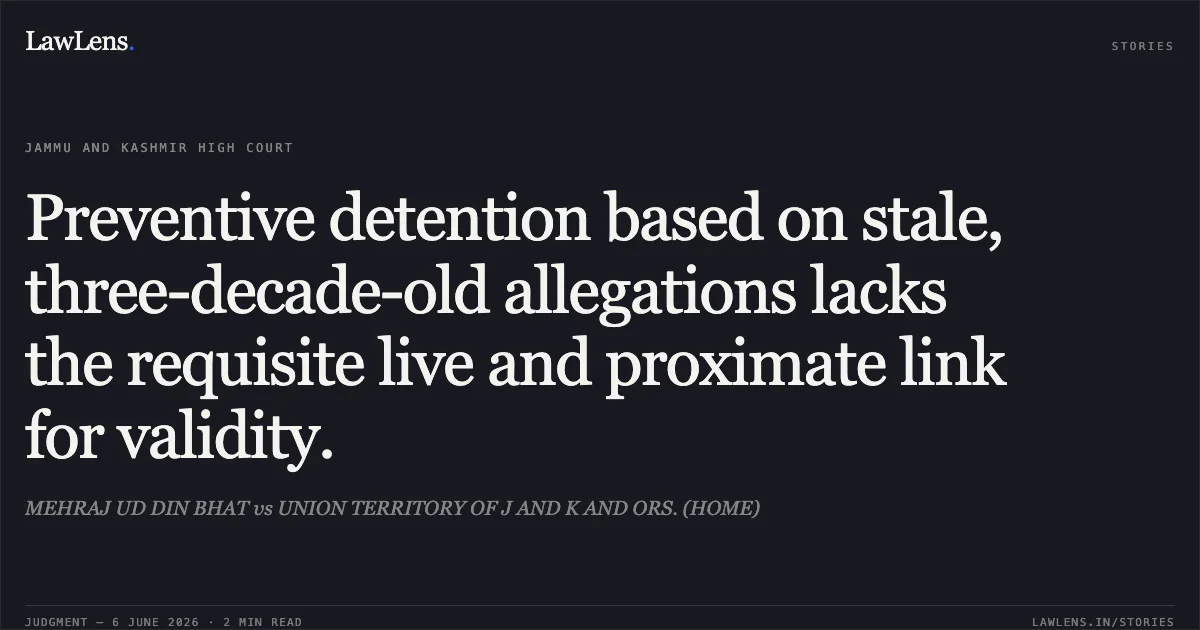
The Court reasoned that preventive detention is a precautionary measure, not a punitive one, and requires a "live and proximate link" between the alleged activities and the detention order.
Source reference: p. 5, para. 10It found that the foundational allegations dated back to 1989–1992, creating a 33-year gap during which no specific criminal act or FIR was attributed to the petitioner.
Source reference: p. 5-6, para. 12The Court observed that the grounds were "vague" and "bald assertions" lacking particulars like dates, places, or names, which prevented the petitioner from making a meaningful representation.
Source reference: p. 6, para. 14Additionally, the respondents failed to prove that the detention record was translated into a language the petitioner understood, which is a mandatory procedural safeguard under Article 22(5).
Source reference: p. 7-8, para. 16-17The Court also noted the detaining authority failed to consider the petitioner’s juvenile status during the initial 1989 incidents.
Source reference: p. 7, para. 17Holding
The Court held that the detention order was legally unsustainable due to the lack of a proximate link between the stale incidents and the current detention, the vagueness of the grounds, and the procedural violation of not providing translated documents.
The Court quashed Detention Order No. DMS/PSA/28/2025 and directed the immediate release of the petitioner from custody, provided he is not required in any other case.
Source reference: p. 8, para. 19-20Acts & Sections Cited
1 provisions across 1 statute referred to in this judgment. Linked provisions open on LawLens.
Jammu And Kashmir Public Safety Act, 19781
Original Court PDF
MEHRAJ UD DIN BHATvsUNION TERRITORY OF J AND K AND ORS. (HOME)
Click to open original judgment
Original judgment, available to read, download and summarize on LawLens.in