Facts
The petitioner was preventively detained by an order dated 08.02.2026 passed by the Police Commissioner, Surat City, labeling him a “dangerous person” under Section 2(c) of the Gujarat Prevention of Anti-social Activities Act, 1985 (PASA).
Source reference: para 1The detention was based on two criminal cases registered against the petitioner between June and December 2025 under Sections 115(2), 304(2), and 54 of the Bharatiya Nyaya Sanhita (BNS).
Source reference: para 7Despite the petitioner being granted bail in these cases by the competent court, the detaining authority concluded that his activities were prejudicial to "public order".
Source reference: para 7.1The petitioner challenged the legality of this detention.
Source reference: para 2Issues
Whether the material on record was sufficient to establish that the petitioner’s activities adversely affected the maintenance of “public order” as opposed to mere “law and order”.
Source reference: para 6Whether the detention order under the Act of 1985 is sustainable when ordinary criminal law (such as cancellation of bail) could have addressed the State's apprehensions.
Source reference: para 9, 10Law Applied
The court applied Section 2(c) of the Gujarat Prevention of Anti-social Activities Act, 1985, which defines a "dangerous person" as one who habitually commits or attempts to commit specific offences under the IPC (now BNS).
Source reference: para 8It relied on the constitutional protection under Article 21, asserting that preventive detention is an extraordinary measure to be used sparingly.
Source reference: para 9Furthermore, the court applied the principles from Dhaya M. v. State of Kerala (AIR 2025 SC 2868) and Ameena Begum v. State of Telengana, which establish that if a person is enlarged on bail, the State should seek cancellation of bail under ordinary law rather than resorting to the "hard law" of preventive detention unless public order is specifically threatened.
Source reference: para 9Reasoning
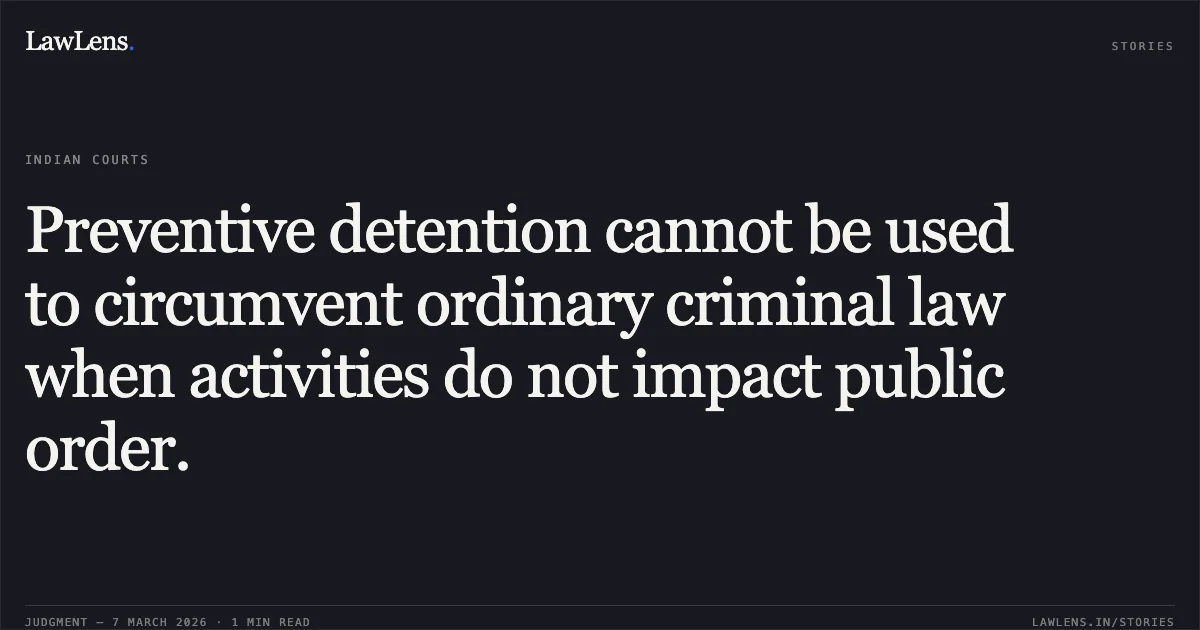
The court reasoned that the two registered criminal cases against the petitioner did not provide a sufficient nexus to conclude that "public order" or "public tranquility" was disturbed.
Source reference: para 4, 10It noted that the detaining authority failed to show how the petitioner’s actions affected the community at large rather than being individual instances of crime.
Source reference: para 10The court highlighted that because the petitioner had already been granted bail by a competent court, the detaining authority exercised insufficient caution.
Source reference: para 9Invoking Supreme Court precedents, the court observed that preventive detention should not be used mechanically to "clip the wings" of an accused when ordinary criminal procedure—such as appealing against a bail order—is available but ignored by the State.
Source reference: para 9Consequently, the subjective satisfaction of the authority was deemed legally flawed.
Source reference: para 10Holding
The High Court allowed the petition and quashed the detention order dated 08.02.2026.
The court held that the material was insufficient to prove that the petitioner’s activities were prejudicial to the maintenance of public order.
Source reference: para 10The court directed that the detenue be set at liberty forthwith, provided he is not required in any other case.
Source reference: para 11Rule was made absolute.
Source reference: para 11Acts & Sections Cited
7 provisions across 3 statutes referred to in this judgment. Each provision opens on LawLens.
Gujarat Prevention of Anti-social Activities Act, 19851
Bharatiya Nyaya Sanhita, 20233
Indian Penal Code, 18603
Original Court PDF
Jaysukhkumar @ Jaysukh @ Jasho S/o Kishanlal @ Kishanbhai Solanki v. State of Gujarat & Ors., R/Special Criminal Application No. 2240 of 2026.
Click to open original judgment
Original judgment, available to read, download and summarize on LawLens.in