Facts
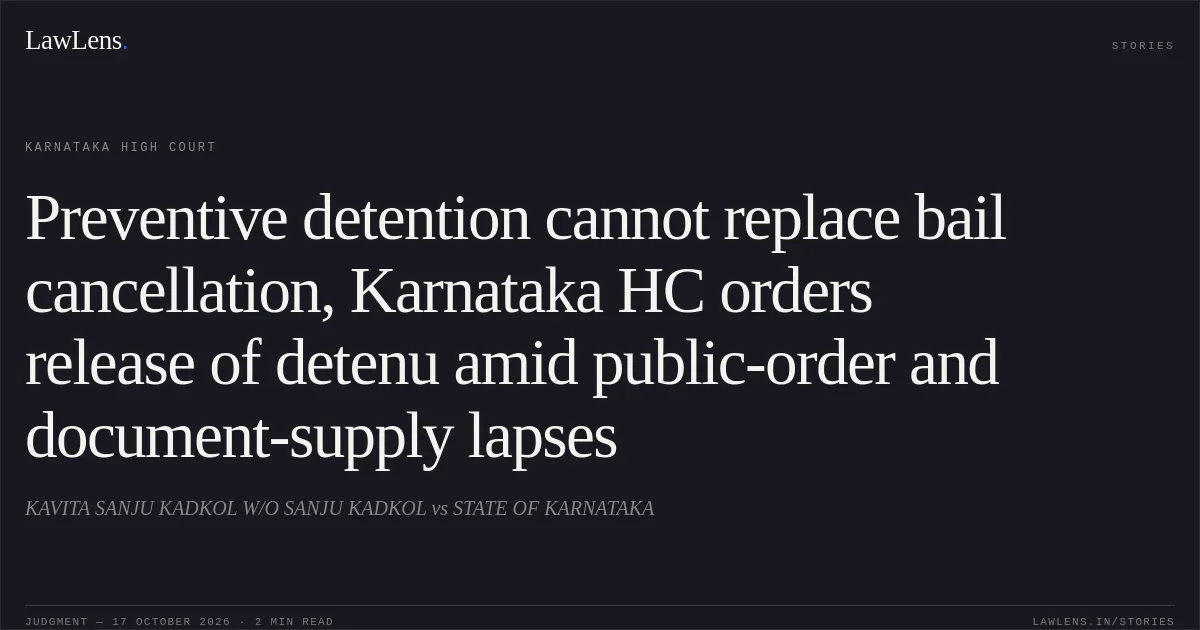
The petitioner, wife of the detenu Sanju Kadkol, challenged his preventive detention under Section 3 of the Karnataka Prevention of Dangerous Activities Act, 1985.
Source reference: pp. 3–5The detention order relied on four criminal cases: one ending in acquittal and three pending trial, in which the detenu had been released on bail.
Source reference: pp. 3–5It also referred to preventive proceedings, a rowdy sheet, alleged gang activity and asserted effects on public order.
Source reference: pp. 3–5The State had not sought cancellation of bail in the pending cases. The petitioner further contended that material relied upon for detention had not been furnished to the detenu.
Source reference: pp. 7–8The Advisory Board had rejected his request for release
Source reference: pp. 67–78Issues
1. Whether preventive detention could be used as an alternative to seeking cancellation of bail in the pending criminal cases
Source reference: p. 6; pp. 7–192. Whether the material relied upon established a threat to public order, rather than a law-and-order problem
Source reference: p. 6; pp. 19–683. Whether non-supply of material relied upon by the detaining authority violated Article 22(5) of the Constitution
Source reference: p. 6; pp. 69–78Law Applied
Article 22(5) of the Constitution requires the grounds of detention and relied-upon documents to be communicated in time to enable an effective representation; failure to supply material relied upon may vitiate detention (Jaseela Shaji v. Union of India, (2024) 9 SCC 53)
Source reference: pp. 69–78Under Sections 3 and 2(a) of the Karnataka Prevention of Dangerous Activities Act, 1985, preventive detention requires conduct prejudicial to the maintenance of public order, not merely a breach of law and order; the impact must extend to the community or public at large (Ram Manohar Lohia v. State of Bihar, AIR 1966 SC 740; Banka Sneha Sheela v. State of Telangana, (2021) 9 SCC 415)
Source reference: pp. 19–33Preventive detention should not ordinarily substitute for seeking cancellation of bail where ordinary criminal law provides a remedy (Ameena Begum v. State of Telangana, (2023) 9 SCC 587; Nenavath Bujji v. State of Telangana, (2024) 17 SCC 294).
Source reference: pp. 8–19The power is exceptional and must be strictly exercised.
Source reference: no citationReasoning
The Court found that the detenu was on bail in the three pending cases, yet the State had not applied to cancel bail; nor was there a non-bailable warrant or identified breach of bail conditions. The detention therefore could not be used as a substitute for remedies under ordinary criminal law.
Source reference: pp. 7–19, 67–68Although the detention grounds described serious alleged conduct, including organised robbery and conspiracy, the order’s general assertions of fear and insecurity did not adequately demonstrate how the detenu’s acts affected public order or the even tempo of community life. Preventive proceedings and rowdy-sheet history did not, without sufficient supporting material, establish that threshold.
Source reference: pp. 19–68Further, the material relied upon in forming the detaining authority’s satisfaction had not been supplied to the detenu, impairing his constitutional opportunity to make an effective representation.
Source reference: pp. 69–78Holding
The Court answered the issues in favour of the detenu and allowed the petition.
It quashed the detention order dated 6 July 2026 and the subsequent orders dated 16 July and 18 August 2026, and issued a writ of habeas corpus directing the detenu’s release forthwith, unless he was required in another case.
Source reference: pp. 68–69, 89–90Acts & Sections Cited
24 provisions across 6 statutes referred to in this judgment. Each provision opens on LawLens.
Code of Criminal Procedure, 19735
Arms Act, 19591
Indian Penal Code, 1860
Bharatiya Nyaya Sanhita, 20232
Bharatiya Nagarik Suraksha Sanhita, 20231
Telangana Prevention of Dangerous Activities of Boot-leggers, Dacoits, Drug-Offenders, Goondas, Immoral Traffic Offenders Land-Grabbers, Spurious Seed Offenders, Insecticide Offenders, Fertiliser Offenders, Food Adulteration Offenders, Fake Document Offenders, Scheduled Commodities Offenders, Forest Offenders, Gaming Offenders, Sexual Offenders, Explosive Substances Offenders, Arms Offenders, Cyber Crime Offenders and White Collar or Financial Offenders Act, 1986.2
Original Court PDF
KAVITA SANJU KADKOL W/O SANJU KADKOLvsSTATE OF KARNATAKA
Click to open original judgment
Original judgment, available to read, download and summarize on LawLens.in