Facts
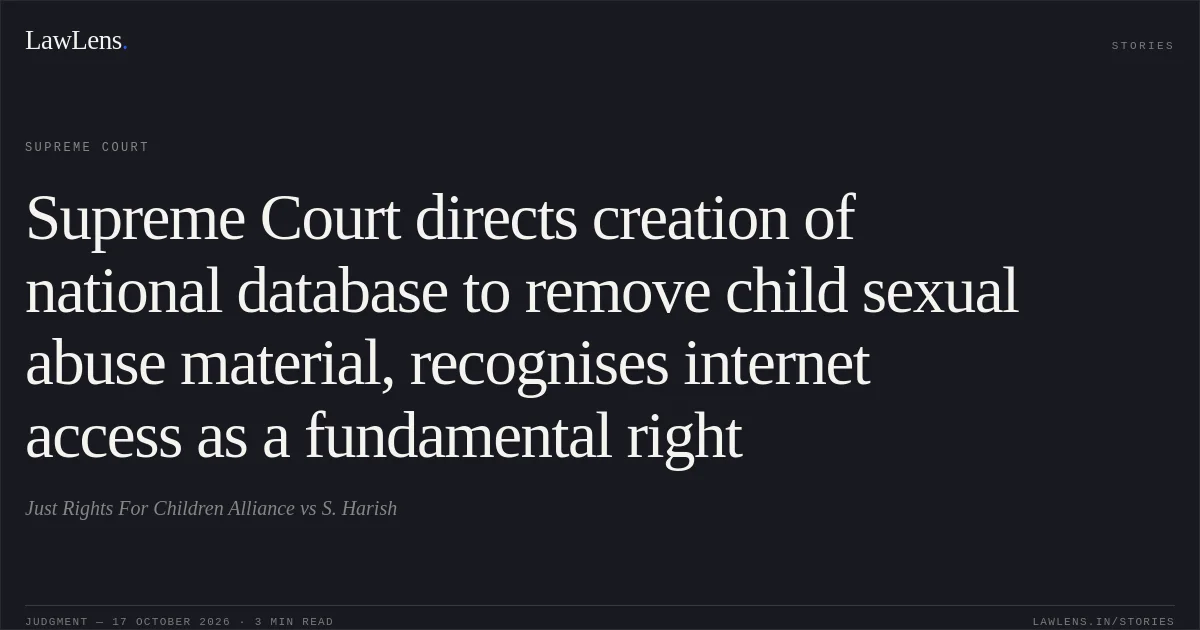
In the continuing proceedings arising from Just Rights for Children Alliance & Anr. v. S. Harish & Ors., 2024 INSC 716, the applicants placed before the Supreme Court reports alleging that child sexual exploitation and abuse material (“CSEAM”) was being promoted on social media through advertisements, redirect links and paywalled content.
Source reference: paras. 2–17, pp. 3–7The Court noted continuing concerns about intermediaries’ detection, removal and reporting of CSEAM, despite its earlier directions concerning compliance with the POCSO Act and the IT Act.
Source reference: paras. 2–17, pp. 3–7After hearing the applicants and the Union of India, the Court considered measures for coordinated detection and removal, reporting, grievance redressal, intermediary accountability, children’s online access and digital-safety education.
Source reference: paras. 18–20, pp. 7–9Issues
1. Whether existing intermediary mechanisms were adequate to detect and remove CSEAM across platforms, and whether hash matching, URL listing and a national database should be established.
Source reference: paras. 19–50, pp. 8–20; paras. 51–97, pp. 21–372. Whether CSEAM reporting, intermediary grievance redressal and reporting to law-enforcement authorities required standardised procedures, dedicated personnel and prescribed timelines.
Source reference: paras. 98–127, pp. 37–49; paras. 169–219, pp. 63–823. Whether material that indirectly facilitates the creation or circulation of CSEAM—including advertisements for tools or links to external content—falls within intermediaries’ regulatory obligations.
Source reference: paras. 131–168, pp. 50–624. Whether persistent intermediary non-compliance warranted consequences beyond loss of safe-harbour protection, including monetary penalties and disgorgement of paywall revenue.
Source reference: paras. 223–279, pp. 83–1005. Whether child-safety measures should include restrictions on children’s internet access, and what complementary measures were needed to protect children online.
Source reference: paras. 280–315, pp. 100–121Law Applied
The Court relied on Sections 15, 19, 20 and 21 of the Protection of Children from Sexual Offences Act, 2012 (“POCSO Act”), and Rule 11 of the POCSO Rules, 2020, concerning possession-related liability and the obligation to report suspected or known offences to the designated authorities.
Source reference: paras. 99–103, pp. 37–42It applied Sections 67B and 79 of the Information Technology Act, 2000, together with Rules 3 and 4 of the Information Technology (Intermediary Guidelines and Digital Media Ethics Code) Rules, 2021, as amended, concerning online child exploitation, intermediary due diligence, content removal and safe harbour.
Source reference: paras. 35–46, pp. 14–19; paras. 143–160, pp. 53–58Following Just Rights (2024 INSC 716), the Court distinguished the visual-depiction requirement relevant to certain POCSO offences from the broader regulatory duties under the IT Act and Rules, which can extend to material that facilitates or promotes child exploitation.
Source reference: paras. 136–162, pp. 51–59It also relied on Articles 21 and 19(1)(a) of the Constitution and Anuradha Bhasin v. Union of India and Pragya Prasun v. Union of India, recognising internet access as constitutionally protected while requiring proportionate child-safety measures.
Source reference: paras. 287–302, pp. 102–108Reasoning
The Court considered platform-by-platform detection and individual reporting insufficient because CSEAM removed from one service could continue circulating elsewhere, and indirect links could evade ordinary detection.
Source reference: paras. 19–33, pp. 8–12It therefore directed the Union to create a national hash-and-URL database, with human verification, audit trails, safeguards against erroneous listings, notice to affected users and a grievance mechanism.
Source reference: paras. 63–97, pp. 25–37; para. 316(2)–(4), pp. 123–126The Court found that existing reporting timelines and grievance systems did not adequately address CSEAM, and prescribed reporting channels, timelines, trained officers, complaint tracking and compliance reporting.
Source reference: paras. 104–127, pp. 42–49; paras. 187–220, pp. 68–82; para. 316(5)–(9), pp. 126–133It further held that intermediaries could not assess material only by its surface appearance: context, captions, links and the function of promoted tools must be considered where content may facilitate exploitation.
Source reference: paras. 154–168, pp. 57–62On children’s access, the Court rejected blanket internet restrictions as disproportionate and unsupported by demonstrated efficacy, while recognising the need for proportionate safeguards, parental involvement and child-oriented measures.
Source reference: paras. 284–303, pp. 101–108Holding
The Court issued directions requiring the Union of India, through the Ministry of Electronics and Information Technology and the Ministry of Law and Justice, to oversee implementation and formulate guidelines, standard operating procedures and, where necessary, amendments to the IT Act and IT Rules.
The directions include creation of a national hash-and-URL database; procedures for removal, notice and review; timely reporting of CSEAM to the designated authorities; accessible complaint mechanisms and dedicated trained grievance officers; and consideration of proportionate monetary penalties and paywall-revenue disgorgement.
Source reference: para. 316(1)–(10), pp. 122–135The Court also set out measures for digital-safety education and victim support, while declining to endorse blanket restrictions on children’s internet access.
Source reference: paras. 292–303, pp. 105–108; para. 315, pp. 116–121The Union was directed to file an affidavit reporting progress by the next hearing; the matter was listed for 10 December 2026.
Source reference: paras. 317–320, p. 135Acts & Sections Cited
8 provisions across 2 statutes referred to in this judgment. Each provision opens on LawLens.
Information Technology Act, 20002
Protection of Children from Sexual Offences Act, 20126
Original Court PDF
Just Rights For Children AlliancevsS. Harish
Click to open original judgment
Original judgment, available to read, download and summarize on LawLens.in